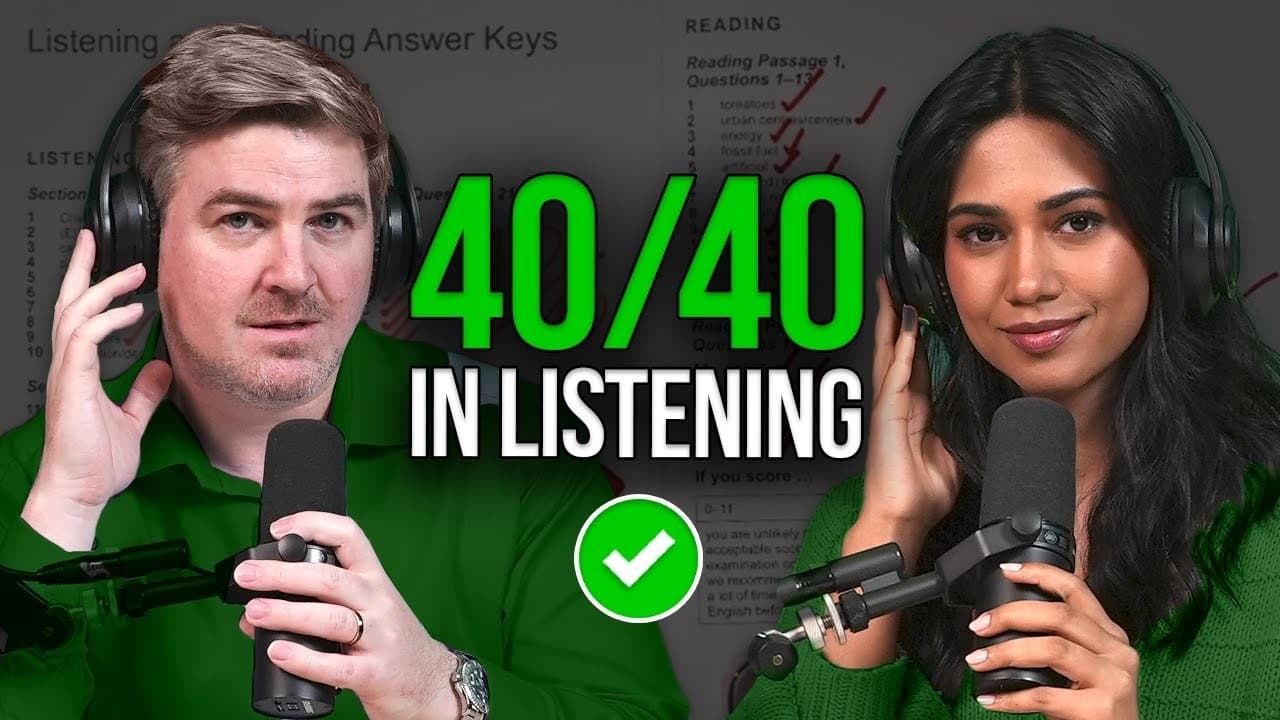
How to Achieve Band 9 in IELTS Listening
TL;DR
Prioritize Parts 3 and 4, build concentration gradually to 30 minutes, and practice hearing information only once. Prepare separately for each question type, train with natural English that is harder than the test audio, and choose a testing setup with clear sound so the actual IELTS listening test feels more manageable.
Transcript
What if I told you that 95% of IELTS students are preparing completely wrong for the IELTS listening test? They practice for hours. They memorize vocabulary. They do mock test after mock test and they still fail. But band nine students that we work with, they don't have better English than you. They don't have secret hacks or shortcuts. They unders... Read More
Key Insights
- The IELTS listening test has 40 questions divided across four parts, and its difficulty increases deliberately. Parts 1 and 2 are comparatively easier, while Parts 3 and 4 contain the academic discussions and lectures that more strongly challenge candidates.
- An efficient practice allocation is about 20% of preparation time for Parts 1 and 2 and 80% for Parts 3 and 4. This maintains performance on easier material while concentrating improvement efforts on the sections where students commonly struggle.
- Part 1 is an artificial form-filling situation that rewards precise recognition of phone numbers, dates, addresses, and spelled information. Official Cambridge tests can provide targeted practice that makes capturing these details more automatic than general podcast listening would.
- Part 2 features one person discussing a social topic without offering clarification or repetition. Solo podcasts and YouTube channels about enjoyable subjects can build the ability to follow a continuous speaker while turning commutes or lunch breaks into relevant listening practice.
- Part 3 requires listeners to distinguish several speakers in an academic discussion while tracking interruptions, agreements, disagreements, and developing ideas. Debate podcasts with three or four speakers provide focused training for voice differentiation and the flow of group discussion.
- Part 4 is a university-style academic lecture whose logic is often signposted by transitions such as firstly, however, and in conclusion. Actively analyzing TED Talks helps listeners recognize these structural signals instead of merely consuming the talk passively.
- Listening stamina can be developed through the marathon method, beginning with five minutes of uninterrupted focus and increasing to 10, 15, 20, and finally 30 minutes over five weeks. Timed sessions should exclude phone checking and other distractions.
- Harder natural English can make the test's deliberately clear speech feel easier. Podcasts, films without subtitles, and live radio debates expose learners to fast speech, mumbling, interruptions, and natural conversation, creating more demanding conditions than typical IELTS-focused material.
Install to Summarize YouTube Videos and Get Transcripts
Explore YouTube Video Summarizer or Get YouTube Transcript Extractor
Questions & Answers
Q: How should I divide IELTS listening practice time?
Spend about 20% of listening preparation on Parts 1 and 2 and about 80% on Parts 3 and 4. The first two parts are deliberately easier, so practice there should mainly maintain accuracy. The final two contain multi-speaker academic discussions and complex lectures, making them the sections where more concentrated preparation can address the greatest difficulty.
Q: How should I prepare for IELTS Listening Part 1?
Prepare for Part 1 by practicing form-filling situations with official Cambridge tests. Focus specifically on recognizing phone numbers, dates, addresses, license plate numbers, and words that are spelled aloud. These tasks represent an artificial listening situation that general English content may not reproduce, so repeated targeted work should make accurate information capture increasingly automatic.
Q: What is the best practice for IELTS Listening Part 2?
Use solo podcasts and YouTube channels in which one person speaks continuously about a social topic. Choose subjects you genuinely enjoy so practice can fit naturally into a commute or lunch break. The important challenge is following the speaker without requesting clarification, because the IELTS recording provides only one opportunity to hear the information and does not repeat it.
Q: How can I improve at IELTS Listening Part 3?
Listen to debate podcasts featuring three or four speakers discussing academic topics. Train yourself to identify individual voices, notice interruptions, and follow when participants agree, disagree, or build upon another person's point. The goal is not merely to collect isolated facts, but to remain oriented throughout a changing multi-speaker discussion without losing track of who said what.
Q: How can TED Talks help with IELTS Listening Part 4?
TED Talks can prepare you for the single-speaker, university-style lecture used in Part 4. Listen actively for the structure of each presentation and notice transition language such as firstly, however, and in conclusion. These signals reveal how an academic speaker organizes and moves between ideas, helping you follow the lecture's logic rather than depending only on individual words.
Q: How do I build concentration for the full listening test?
Use the marathon method to increase focused listening gradually. Begin with five minutes in week one, then progress to 10 minutes, 15 minutes, 20 minutes, and a complete 30-minute session in week five. Use a timer, stay fully attentive, avoid checking your phone, and resist mental wandering so sustained concentration becomes familiar before test day.
Q: Why should I avoid replaying listening practice immediately?
The test recording is heard only once, so immediate replay creates practice conditions that do not match the examination. Listen to a podcast or YouTube recording once, answer the questions, and only then check your work. Although this can feel uncomfortable initially, it develops the discipline to capture information on first hearing and reduces dependence on repetition.
Q: How can audio quality affect IELTS listening performance?
Clear audio can support concentration and reduce the effort required to hear the recording. Computer-based tests provide headphones, which can block distractions such as coughing and deliver sound directly to the listener. If that option is unavailable, contact test centers about their equipment. Report genuinely poor audio immediately at the center instead of waiting until after receiving a low score.
Summary & Key Takeaways
-
IELTS listening contains 40 questions across four parts with a deliberate difficulty curve. Parts 1 and 2 are easier, while Parts 3 and 4 demand stronger attention and comprehension. High-scoring preparation therefore assigns about 20% of practice to the first two parts and 80% to the final two.
-
Each section requires targeted practice. Form-filling exercises develop accuracy with numbers, addresses, and spelling. Solo podcasts prepare learners for uninterrupted monologues, debate programs develop voice recognition and discussion tracking, and TED Talks help students recognize transitions and the logical structure of university-style academic presentations.
-
Effective preparation also develops concentration, first-time comprehension, and comfort with difficult natural speech. Students can extend focused listening from five minutes to 30 minutes over five weeks, avoid immediate replays, practice question-specific strategies, train with fast unscripted English, and investigate the test center's audio setup before taking the examination.
Read in Other Languages (beta)
Share This Summary 📚
Summarize YouTube Videos and Get Video Transcripts with 1-Click
Try YouTube Summary with ChatGPT & Claude or YouTube Transcript Generator
Explore More Summaries from IELTS Advantage 📚




Summarize YouTube Videos and Get Video Transcripts with 1-Click
Try YouTube Summary with ChatGPT & Claude or YouTube Transcript Generator