How to Improve Advanced C2 English Listening and Speaking
TL;DR
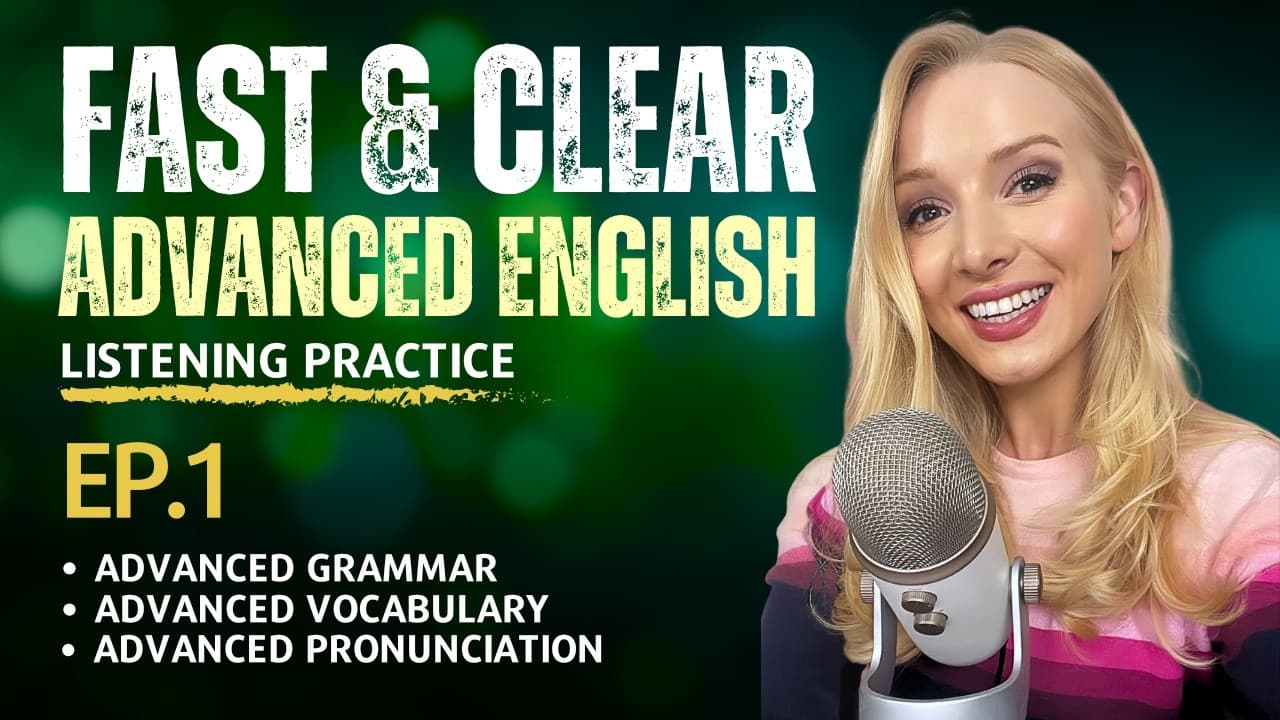
Reaching C2 English means mastering informal British vocabulary, tricky grammar like participle clauses and inverted word order, and subtle cues like sarcasm and alliteration. This lesson tests listening using three real clips (Bake Off, Travel Man, and a dyslexia documentary), breaking down expressions such as 'a warming cup of char', 'to whack', 'sign a waiver', and 'to write someone off'.
Transcript
Hello, lovely students, and Today's lesson is advanced fast I'm going to train you to improve your We are going to focus on C2. This Today, I'm going to test your incredibly advanced clips Now, as I test you, I'm also going I'll test your listening but I will advanced grammar and advanced pronunciation tips. We will focus on informal language becau... Read More
Key Insights
- C2-level English focuses heavily on informal language, because in real life native speakers use informal English far more than formal English, making everyday idioms and slang essential to understand.
- Participle clauses make sentences more concise, as in 'Kate will add the buttercream topping, infusing her love of tea into the cake', where the clause expresses purpose or reason without a full subordinate clause.
- Inverting typical word order is a stylistic C2 device, as when Jamie says 'the dyslexia word' instead of 'the word dyslexia', a euphemism used to soften a subject once treated as taboo.
- Sarcasm is a key feature of British humour, shown when Joe jokes that Adam should sign a waiver before riding a low-risk carousel, exaggerating danger to comedic effect through rising intonation and tone.
- Alliteration, the repetition of the same initial consonant sound, appears in 'Prance around Prague', a literary device comedians use for satisfying, playful, memorable phrasing that requires strong English grasp to catch.
- The informal British expression 'a warming cup of char' uses 'char' as a synonym for tea to avoid repetition, describing a hot drink like tea, hot chocolate, or soup that feels especially soothing.
- 'Signing a waiver' means officially agreeing in writing that you will not hold someone responsible for injury, damage, or loss that might occur, often required before doing a potentially hazardous activity.
- Inferring meaning, or reading between the lines, is an essential skill from C1 level upward, letting listeners reach conclusions from subtle cues even when a speaker does not state something directly or explicitly.
Install to Summarize YouTube Videos and Get Transcripts
Explore YouTube Video Summarizer or Get YouTube Transcript Extractor
Questions & Answers
Q: How can I improve my advanced C2 English listening and speaking?
Train your listening with challenging real clips and study the informal language, advanced grammar, and pronunciation inside them. This lesson tests you using three clips from Bake Off, Travel Man, and a dyslexia documentary, then breaks down tricky vocabulary, participle clauses, inverted word order, sarcasm, and alliteration. A free downloadable PDF includes the scripts and more in-depth analysis so you can review the C2-level language covered.
Q: What does the informal British verb 'to whack' mean?
If you 'whack something somewhere', you put it there without much care or attention. It is an informal British usage, for example answering 'Where should I put these clothes?' with a casual instruction to just whack them somewhere. In the Bake Off clip, understanding this informal verb helps you follow how the contestant describes handling an ingredient in a relaxed, offhand way rather than carefully.
Q: What is a participle clause and why is it useful?
A participle clause is a shortened clause used to show things like purpose or reason and to make sentences more concise. In 'Kate will add the buttercream topping, infusing her love of tea into the cake', the main clause is about adding the topping and the participle clause 'infusing her love of tea' can expand to 'in order to infuse' or 'because she wants to infuse', both expressing why she does it.
Q: What does it mean to 'sign a waiver'?
If you 'sign a waiver', you officially agree in writing that you will not hold someone responsible for injury, damage, or loss that might occur, often before doing a potentially hazardous activity. In the Travel Man clip, Joe jokes that Adam should sign one before riding the carousel because it does not meet modern safety standards, using exaggeration for sarcastic, comedic effect even though a carousel is not really dangerous.
Q: Why does the lesson focus on informal English rather than formal English?
The lesson focuses on informal language because, in real life, native speakers use informal English far more than formal English. To reach C2 level and truly understand everyday British speech, comedy, and casual conversation, you need to grasp informal expressions like 'char' for tea, 'to whack', and 'to skimp on'. Understanding this informal register is essential for catching wordplay, sarcasm, and the natural way people actually talk.
Q: What is alliteration and where does it appear in the lesson?
Alliteration is a literary device involving the repetition of the same initial consonant sound across nearby words, often used because it is satisfying to say. In the Travel Man clip, presenter Joe Lycett uses 'Prance around Prague', repeating the 'pr' sound. Recognising alliteration and wordplay like this requires an excellent grasp of English and helps you catch the playful, poetic language that comedians and presenters build into their speech.
Q: What does 'prance' mean and why is it a clever word choice?
'Prance' has a double meaning. With people, it means to walk energetically with exaggerated movements, and it can also describe a horse moving in a lively, spirited way. Joe's choice gives a playful image of him and Adam happily dancing around Prague, and it neatly leads into the next scene where they ride a carousel, a children's ride with horses. This layered wordplay is typical of high-level English.
Q: How does Jamie describe his experience with dyslexia in the documentary clip?
Jamie says that in the 80s the 'dyslexia word' was used very rarely and always came with a negative feeling of being seen as stupid or not bright. He uses inverted word order like 'the dyslexia word' and 'was used very rarely' as euphemism and emphasis, the word 'extracted' to suggest a painful, forced experience, and the 'dunce's hat' metaphorically to express shame. He admits he essentially 'wrote himself off', an unfair judgment.
Summary & Key Takeaways
-
This C2-level lesson trains advanced English listening and speaking by testing viewers on three challenging real audio clips, focusing on informal British language, advanced grammar, and pronunciation. A free downloadable PDF with scripts and deeper analysis is offered, plus a waiting list for a new C2 course launching early 2026.
-
The first clip, from Celebrity Bake Off, features baking vocabulary like 'cardamom' with its schwa ending, and informal terms including 'to whack' (to put something somewhere carelessly), 'char' for tea, and 'to skimp on' meaning to not use enough of something. A participle clause about infusing flavour is also analysed.
-
The Travel Man Prague clip highlights sarcasm, the double meaning of 'prance', alliteration in 'Prance around Prague', 'sign a waiver', 'saddle up', and a playful Apocalypse Now nod. The final Jamie's Dyslexia Revolution clip covers 'like' as a filler, inverted word order, 'extracted', 'dunce's hat', 'psyche', and 'writing yourself off'.
Read in Other Languages (beta)
Share This Summary 📚
Summarize YouTube Videos and Get Video Transcripts with 1-Click
Try YouTube Summary with ChatGPT & Claude or YouTube Transcript Generator
Explore More Summaries from English with Lucy 📚



Summarize YouTube Videos and Get Video Transcripts with 1-Click
Try YouTube Summary with ChatGPT & Claude or YouTube Transcript Generator