How Do AI Agents Transform Data Integration?
TL;DR
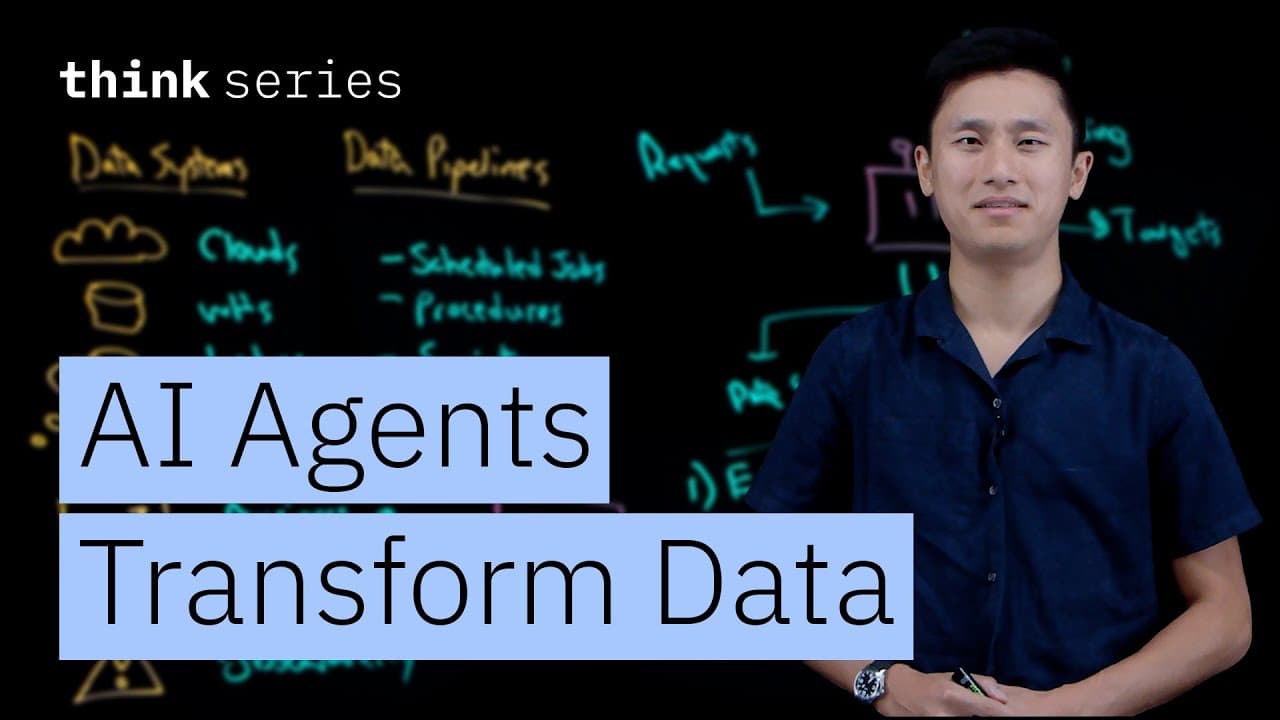
AI agents can create, execute, monitor, and adapt data pipelines from natural language requests, reducing repetitive engineering work. By understanding sources, metadata, entity relationships, business rules, and delivery mechanisms, they can support self-service access, detect data quality problems early, and provide cleaner, fresher data for analytics and machine learning.
Transcript
Data teams spend more time wrangling data and maintaining pipelines than delivering insights. Agentic AI can change that. Data engineering today is very complicated and siloed. The data lives across different clouds, operational warehouses, data lakes, as well as APIs. And each of these systems comes with its own set of constraints. Additionally, w... Read More
Key Insights
- Modern data engineering is fragmented across clouds, operational warehouses, data lakes, APIs, and on-premises systems. Each environment has different constraints, forcing engineering teams to coordinate many technologies before data can flow reliably to its intended destination.
- Pipeline maintenance is a major drain on engineering capacity because scheduled jobs, stored procedures, scripts, transformations, and business logic must continue working together. A single source schema change or column rename can trigger hours of debugging and retesting.
- A data integration agent is designed to understand multiple source types and locations, including relational data, unstructured documents, APIs, cloud systems, and on-premises environments. This broad awareness allows it to plan integration work across otherwise siloed systems.
- Metadata and entity relationships are essential for agentic integration because they connect technical data structures with business terms and meanings. Understanding these relationships helps an agent interpret requests and build pipelines that reflect how the organization actually uses its data.
- An integration agent can create pipelines with multiple joins, transformations, logic, and business rules. It can also select among ETL, ELT, change data capture, streaming, and unstructured integration based on the mechanism best suited to delivering the requested data.
- Agentic systems work by combining large language models, reinforcement learning, and tool calling. Language models translate natural language intent into structured actions, successful pipeline runs reward better plans, and tool calling enables agents to use APIs and operational applications.
- Declarative pipeline authoring lets engineers or analysts describe a desired outcome instead of manually coding every pipeline step. The agent can translate that outcome into a complete pipeline, reducing the hand-coded ETL work that consumes data engineering time.
- Data quality agents can detect column changes, type mismatches, and anomalies before jobs fail. They can also propose fixes, perform automatic backfills, and reroute around failed sources, helping preserve trustworthy data for analytics, machine learning, and other downstream AI workloads.
Install to Summarize YouTube Videos and Get Transcripts
Explore YouTube Video Summarizer or Get YouTube Transcript Extractor
Questions & Answers
Q: How do AI agents automate data integration pipelines?
AI agents automate data integration by interpreting a user's natural language request, examining available data sources, understanding metadata and entity relationships, and translating the requested outcome into structured actions. They can construct joins, transformations, logic, and business rules, choose an appropriate delivery mechanism, call required APIs and applications, and execute a working pipeline without relying entirely on hand-coded ETL.
Q: Why is modern data engineering difficult to maintain?
Modern data engineering is difficult to maintain because data is distributed across clouds, operational warehouses, data lakes, APIs, and on-premises systems, each with its own constraints. Pipelines also depend on scheduled jobs, stored procedures, complicated scripts, transformations, and business logic working together. A source schema change or renamed column can disrupt that chain and require hours of debugging and retesting.
Q: What data sources can a data integration agent understand?
A data integration agent can understand multiple structures and locations rather than being limited to one system. The supported examples include relational data, unstructured data such as documents, and information obtained through APIs. These sources can exist in cloud or on-premises environments, allowing the agent to work across the varied and siloed systems commonly handled by data engineering teams.
Q: How do large language models support integration agents?
Large language models help integration agents parse natural language requests and determine the user's intent. The agent then translates that intent into structured actions needed to build and operate a pipeline. The language model is part of a wider agentic system that also uses reinforcement learning to improve plans and tool calling to interact with data sources, APIs, applications, and transformation systems.
Q: What is declarative pipeline authoring with AI agents?
Declarative pipeline authoring allows an engineer or analyst to describe the outcome they want instead of manually specifying and coding every integration step. The agent uses that desired outcome to create the complete data pipeline, including the necessary joins, transformations, logic, and business rules. This approach reduces repetitive hand-coded ETL work and lets teams focus more attention on complex integration and strategic tasks.
Q: How can AI agents improve data quality and observability?
AI agents can continuously inspect pipelines for data quality and operational problems. They can detect column changes, type mismatches, and anomalies early, then propose fixes before jobs fail. They can also perform automatic backfills and reroute processing around failed data sources. These capabilities help keep downstream data trustworthy, timely, and suitable for analytics, machine learning models, and other AI systems.
Q: How can business users benefit from data integration agents?
Business users can gain faster access to reliable data without waiting through long handoffs with engineering teams. Through self-service workflows, analysts can request or create new data sets while the agent handles the underlying integration work. The described benefits include improved accuracy and faster time to insights, while engineers spend less time responding to repetitive requests and maintaining routine pipeline logic.
Q: What value do AI agents provide to data engineering teams?
AI agents reduce the repetitive fixes and maintenance work that consume data engineers' time, allowing teams to focus on complex integration and strategic capabilities. They also help business users obtain reliable data more quickly and create cleaner, fresher pipelines for analytics and machine learning. By planning, monitoring, and adapting pipelines, agents help data arrive with the quality and timeliness required by downstream workloads.
Summary & Key Takeaways
-
Modern data engineering is complex because information is distributed across clouds, operational warehouses, data lakes, APIs, and on-premises systems. Pipelines combine scheduled jobs, stored procedures, scripts, transformations, and business logic. Even a source schema change or renamed column can therefore cause extensive debugging, retesting, and ongoing maintenance work.
-
A data integration agent can understand relational records, unstructured documents, APIs, metadata, entity relationships, and business meanings. It can build pipelines containing joins, transformations, logic, and business rules, then choose an appropriate delivery mechanism such as ETL, ELT, change data capture, streaming, or unstructured integration for the requested outcome.
-
Agentic systems use large language models to interpret natural language intent, reinforcement learning to improve plans through successful pipeline runs, and tool calling to operate APIs and applications. Practical uses include declarative pipeline authoring, business-user self-service, anomaly detection, automatic backfills, early schema-change detection, and rerouting around failed sources.
Read in Other Languages (beta)
Share This Summary 📚
Summarize YouTube Videos and Get Video Transcripts with 1-Click
Try YouTube Summary with ChatGPT & Claude or YouTube Transcript Generator
Explore More Summaries from IBM Technology 📚


Summarize YouTube Videos and Get Video Transcripts with 1-Click
Try YouTube Summary with ChatGPT & Claude or YouTube Transcript Generator