What is minimax and self play in classic games
TL;DR
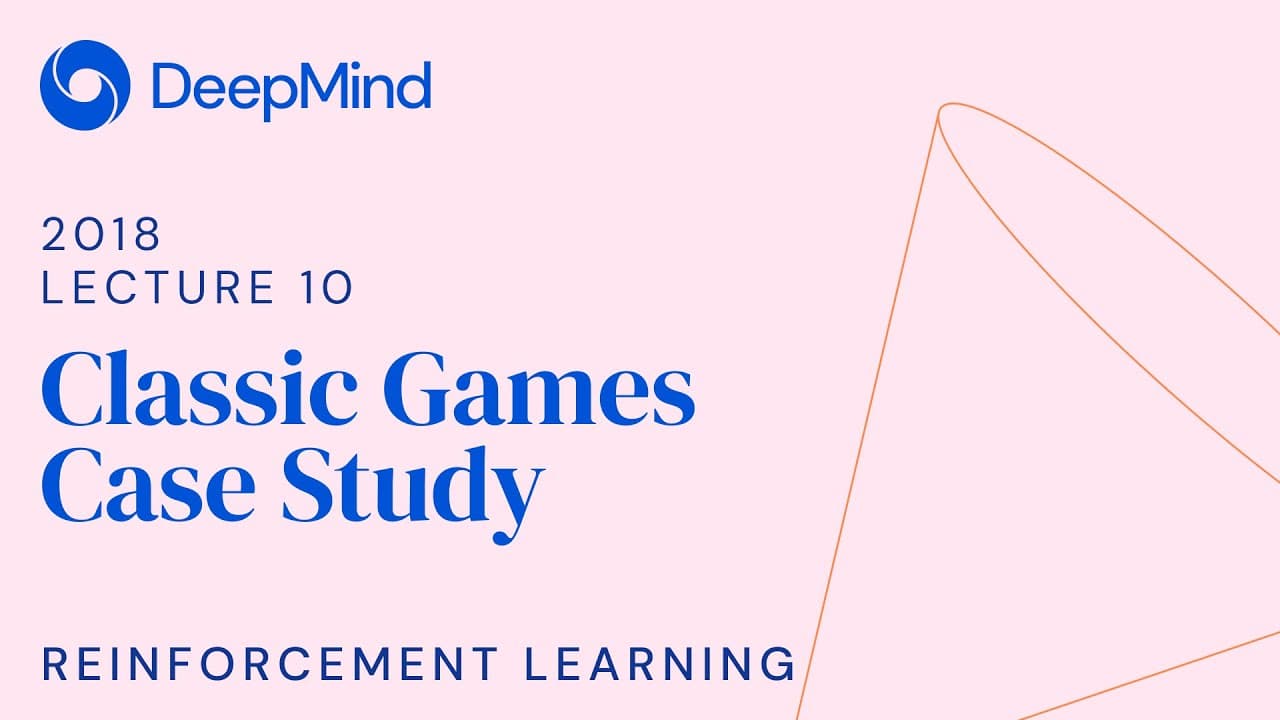
Minimax is presented as the central optimality principle for two player games, with Nash equilibrium providing the best response against fixed opponents. The lecture shows how reinforcement learning with self play reaches superhuman or perfect play in many classic games, and explains why games serve as a simple yet rich testbed for AI before applying ideas to the real world.
Transcript
okay good morning everyone so uh well done for making it to the end of this course so I've got a different face today I'm David Silva and I'm going to tell you a little bit about games in particular classic games like the kind of board games which you might play or watch other people playing and it turns out there's an awful lot of the rest of the ... Read More
Key Insights
- Minimax is the foundational idea for optimal play in two-player settings, guiding how a player chooses moves against an adversary with the aim of maximizing their own outcome.
- Nash equilibrium defines a stable policy where each player’s strategy is the best response to others, so no one benefits from unilaterally changing their strategy.
- Self play enables agents to learn by competing against versions of themselves, steadily discovering stronger strategies without external supervision or labeled examples.
- Reinforcement learning in games demonstrates that learning from interaction can reach superhuman level in multiple board games and poker, not just traditional domains.
- The field uses games as the Drosophila of artificial intelligence, simple rules yielding deep strategic complexity suitable for study and experimentation.
- Perfect play in checkers has been achieved, illustrating the boundary between human and machine performance in well-defined domains.
- The lecture emphasizes understanding what it means to achieve optimal behavior when multiple learners interact, rather than a single agent interacting with a static environment.
- Games provide meaningful IQ tests for AI progress, enabling controlled experimentation before deployment to real-world tasks and domains.
Install to Summarize YouTube Videos and Get Transcripts
Explore YouTube Video Summarizer or Get YouTube Transcript Extractor
Questions & Answers
Q: Why is minimax important for two-player games and how does it relate to optimality?
Minimax is important because it formalizes how a player can choose moves to maximize their minimum guaranteed payoff when facing an optimal opponent. It defines a strategy that hedges against the worst-case responses, leading to robust play in adversarial settings. This concept underpins many classical game playing algorithms and provides a baseline for evaluating more complex learning methods.
Q: What is Nash equilibrium and why does it matter in multi-agent settings?
Nash equilibrium captures a situation where each player’s strategy is the best response to the others, meaning no one benefits from changing their policy unilaterally. It matters because it provides a stable outcome concept in games with multiple adaptive agents, guiding how agents reason about others and how learning might converge.
Q: How does self play contribute to learning in reinforcement learning for games?
Self play allows an agent to improve by playing against progressively stronger versions of itself, continually updating strategies based on observed outcomes. This approach removes the need for labeled data or external opponents, enabling autonomous discovery of winning strategies and the emergence of sophisticated tactics through iterative improvement.
Q: What does it mean that games are the Drosophila of AI, and why is that useful?
Calling games the Drosophila of AI means they are simple, well‑defined systems that reveal core principles of intelligence without extraneous complexity. This makes it easier to study, reproduce, and understand fundamental ideas like learning, planning, and strategic reasoning, before scaling to real-world, noisy environments.
Q: What is the state of the art in classic games with reinforcement learning, according to the lecture?
The lecture notes that reinforcement learning has achieved perfect play in checkers and superhuman performance in games like chess, backgammon, and go, with several titles reaching or exceeding human capabilities. It emphasizes that principled RL methods can reach high performance across varied game domains.
Q: Why are games considered useful testbeds for AI capabilities beyond gaming itself?
Games distill complex decision making into a controllable environment with clear rules and objectives, enabling researchers to analyze learning, generalization, and strategic reasoning. Insights gained from games can be transferred to real-world problems by validating principles in a simplified yet representative context.
Q: How is the concept of optimality in games different from single-agent MDPs?
In games, optimality depends on the behavior of other agents; there is no single objective function independent of others. This contrasts with single-agent MDPs where the environment is fixed. The game framework requires considering opponents’ potential strategies and sometimes leads to equilibria rather than a single optimal policy.
Q: What role does the history of minimax play in understanding modern AI for games?
The history of minimax informs how researchers approached optimal decision making in adversarial settings, shaping the development of search algorithms and learning frameworks. It provides a lens to study how to balance exploitation and exploration while accounting for opponents, and connects past ideas to current self-play and reinforcement learning practices.
Summary & Key Takeaways
-
This summary explains how minimax underpins optimal play in two-player games and how Nash equilibrium describes best responses when opponents fixed. It also outlines how self play in reinforcement learning enables agents to reach superhuman performance in games like chess and go, establishing games as essential AI testbeds.
-
The case study highlights that classical games have simple rules but deep strategic depth, enabling researchers to study core AI concepts such as learning, adaptation, and strategic reasoning in a controlled environment.
-
The talk argues that progress in games translates to broader AI capabilities by iteratively moving from game-specific insights to general reinforcement learning principles and real-world impact, treating games as microcosms of complexity.
Read in Other Languages (beta)
Share This Summary 📚
Summarize YouTube Videos and Get Video Transcripts with 1-Click
Try YouTube Summary with ChatGPT & Claude or YouTube Transcript Generator
Explore More Summaries from Google DeepMind 📚

Summarize YouTube Videos and Get Video Transcripts with 1-Click
Try YouTube Summary with ChatGPT & Claude or YouTube Transcript Generator