How Does the Immune System Defend Against Invaders?
TL;DR
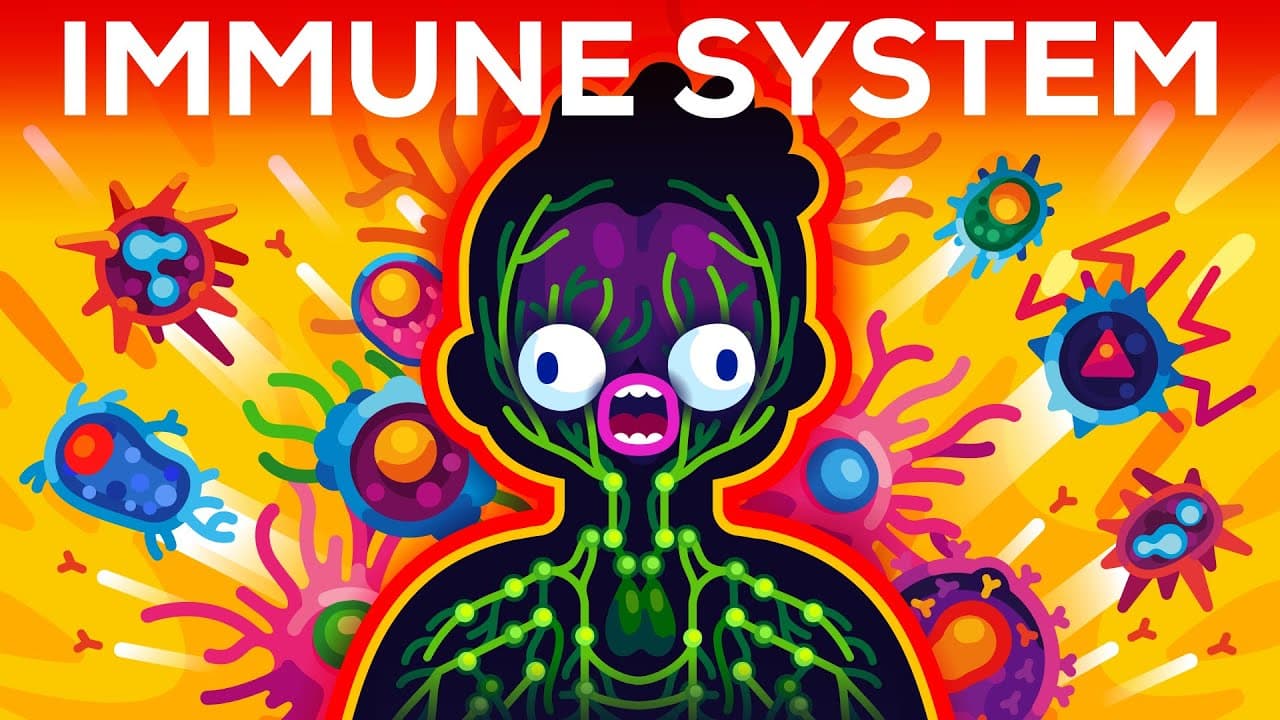
The immune system defends against invaders using complex cellular mechanisms, starting with macrophages and neutrophils that attack pathogens at the site of injury. Helper T cells and B cells are then activated to enhance the response, including the production of antibodies for long-term immunity. This multi-layered defense ensures your body can fight off infections effectively and remember past threats.
Transcript
the human immune system is the most complex biological system we know after the human brain and yet most of us never learn how it works or what it is your immune system consists of hundreds of tiny and two large organs it has its own transport Network spread throughout your body every day it makes hundreds of billions of fresh cells organized like ... Read More
Key Insights
- 🧑🏭 The human immune system acts as a sophisticated defense mechanism, orchestrated by various cells like macrophages, neutrophils, and helper T cells.
- 🦻 Inflammation occurs as a response to invasion, signaling the activation of complement proteins that aid in pathogen elimination.
- 🎯 The immune response involves precision targeting of invaders by activating specific helper T cells and B cells to orchestrate defense efforts.
- 😃 Long-term immunity is facilitated by memory cells and B cells that continue to safeguard against recurring threats.
Install to Summarize YouTube Videos and Get Transcripts
Explore YouTube Video Summarizer or Get YouTube Transcript Extractor
Questions & Answers
Q: What initiates the immune response when the body faces an invasion?
The immune response starts with injured or dying cells releasing chemical signals that awaken the immune system, leading to the recruitment of macrophages and neutrophils to combat invaders.
Q: How do macrophages and neutrophils eliminate bacteria during the immune response?
Macrophages engulf and digest bacteria, while neutrophils release deadly chemicals or create DNA-filled traps to destroy pathogens, even sacrificing themselves in the process.
Q: What role do helper T cells play in the immune response?
Helper T cells, the immune system's intelligence officers, identify specific bacteria parts and activate appropriate defense mechanisms by cloning themselves and coordinating with other immune cells.
Q: How do memory cells and B cells contribute to long-term immunity?
Memory cells, derived from helper T cells, remain in tissues guarding against future invasions, while B cells produce antibodies tailored to specific pathogens, providing immunity for extended periods.
Summary & Key Takeaways
-
The human immune system comprises intricate cellular soldiers and warriors defending against invasive bacteria and ensuring cellular well-being.
-
Initial defense mechanisms involve macrophages and neutrophils engaging in battles with invading pathogens, causing temporary inflammation.
-
The immune response escalates with helper T cells activating various defense lines, including B cells producing antibodies for long-term immunity.
Read in Other Languages (beta)
Share This Summary 📚
Summarize YouTube Videos and Get Video Transcripts with 1-Click
Try YouTube Summary with ChatGPT & Claude or YouTube Transcript Generator
Explore More Summaries from Kurzgesagt – In a Nutshell 📚





Summarize YouTube Videos and Get Video Transcripts with 1-Click
Try YouTube Summary with ChatGPT & Claude or YouTube Transcript Generator