How Do Generative AI and Large Language Models Work?
TL;DR
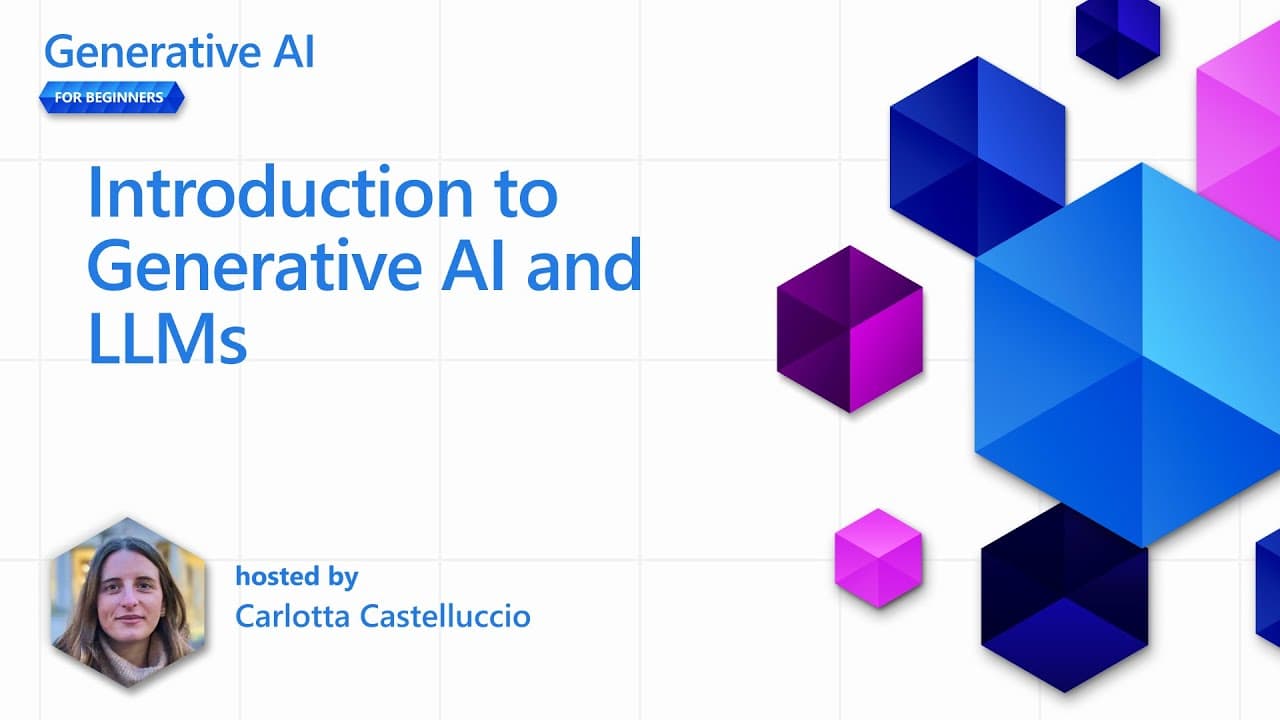
Large language models generate text by converting a prompt into tokens, predicting one output token, and repeatedly adding each selected token to the next input. Modern generative AI models commonly use the Transformer architecture and attention mechanisms, while controlled randomness helps them produce varied, creative completions for tasks such as answering questions, completing text, and creating educational assignments.
Transcript
hi everyone and welcome to the first lesson of the generative AI for beginners course uh this course is based on an open source curriculum with the same name available on gab that you can find at a link on the screen I'm carot cucho I'm A Cloud Advocate at Microsoft focusing on artificial intelligence Technologies and in this video video I'm going ... Read More
Key Insights
- Generative AI is a subset of deep learning built on decades of progress in chatbots, statistical text analysis, machine learning, neural networks, and natural language processing. Its recent visibility follows a much longer history beginning with early artificial intelligence prototypes in the 1950s and 1960s.
- Early chatbots were limited by their dependence on expert-maintained knowledge bases and keyword matching. Because responses were selected from predefined information rather than learned flexibly from data, this approach encountered scalability problems and could not provide the adaptability associated with modern generative models.
- Transformer architecture is the foundation of many modern large language models. Transformers can handle longer input sequences and use an attention mechanism to focus on relevant information regardless of where it appears in the input, improving the model’s ability to use textual context.
- Tokenization is the process of dividing input text into chunks and mapping those chunks to integer indices. Large language models operate more efficiently on these numerical representations than on raw text, making tokenization central to text processing, context-window limits, and usage-based pricing calculations.
- Text generation works by predicting one output token from the tokens already provided. The selected token is added to the input for the next iteration, creating an expanding sequence that can develop into coherent, contextually relevant responses containing one sentence or several sentences.
- Token selection is based on a probability distribution derived from patterns in the model’s training data. The model does not always select the highest-probability option because controlled randomness can be introduced, allowing identical prompts to produce different outputs that may feel more creative and engaging.
- A prompt is the textual input supplied to a large language model, while a completion is the generated output. The term completion reflects the model’s repeated mechanism of selecting the next token to extend and complete the text currently available in its input.
- Educational applications include generating assignments, answering historical questions, and completing unfinished passages as writing assistance. The fictional startup scenario shows how these capabilities might support personalized learning and global accessibility while still requiring attention to social consequences and technological limitations.
Install to Summarize YouTube Videos and Get Transcripts
Explore YouTube Video Summarizer or Get YouTube Transcript Extractor
Questions & Answers
Q: What is generative AI and how did it develop?
Generative AI is presented as a subset of deep learning that emerged after decades of artificial intelligence research. Early systems in the 1950s and 1960s included chatbots using expert-maintained knowledge bases and keyword matching. Statistical text analysis in the 1990s introduced algorithms that learned patterns from data, while later hardware advances, neural networks, and Transformers enabled more capable language generation.
Q: How does a large language model generate text?
A large language model receives text as a prompt, divides it into tokens, and predicts a single token that could follow the existing sequence. The selected token is incorporated into the input for the next iteration. Repeating this expanding-window process produces a completion that can remain coherent and contextually relevant across one or multiple sentences.
Q: What is tokenization in a large language model?
Tokenization is the process of breaking input text into smaller chunks called tokens. Each token can contain a sequence of characters and may vary in length. The tokenizer maps these chunks to integer indices, creating numerical representations that the model can process more efficiently than raw text. Tokenization also relates to context limits and pricing calculations.
Q: Why can the same prompt produce different answers?
A model calculates a probability distribution for the token that should follow the current text sequence, using patterns acquired from its training data. It does not necessarily choose the option with the highest probability every time. Introducing some randomness into selection allows the same prompt to generate different completions and helps the resulting language feel creative and engaging.
Q: What is the Transformer architecture in generative AI?
The Transformer is a model architecture that emerged after decades of artificial intelligence research and underlies many generative AI models called large language models. It can process longer text sequences and uses an attention mechanism to focus on the most relevant information, regardless of that information’s order or position within the input text.
Q: What is the difference between a prompt and a completion?
A prompt is the natural-language text supplied to a large language model as input. It may be an instruction, a conversational question, or the beginning of an unfinished passage. A completion is the model’s generated output. Its name reflects the underlying process of repeatedly predicting and adding the next token to complete the current sequence.
Q: How can large language models support education?
Large language models can support educational work by generating assignments, producing open-ended questions, answering learners’ questions, and completing unfinished passages as writing assistance. The course’s fictional startup also explores using generative AI to improve global learning accessibility, provide equitable access to education, and personalize learning experiences according to the needs of individual learners.
Q: What limitations should educational generative AI projects consider?
Educational generative AI projects should consider both the technology’s limitations and its social impact. The fictional startup aims to improve accessibility, equitable access, and personalized learning, but the course emphasizes that these ambitions come with inevitable challenges. Evaluating those challenges is part of using large language models responsibly within an educational setting.
Summary & Key Takeaways
-
Generative AI developed through decades of research, beginning with knowledge-base chatbots that matched keywords to expert-maintained responses. Statistical text analysis later enabled machine learning systems to discover patterns without explicit programming. Hardware advances and neural networks then improved language processing, context recognition, virtual assistants, and the development of Transformer-based large language models.
-
Large language models process text through tokenization because numerical representations are more efficient than raw text sequences. A tokenizer divides input into text chunks and maps them to integer indices. The model predicts one token, incorporates it into the next input, and repeats the process within a model-specific maximum context window.
-
A large language model receives a prompt and produces a completion. Prompts can contain explicit instructions, conversational questions, or unfinished passages. In education, these patterns can support assignment creation, historical explanations, and writing assistance. Effective adoption must also consider technological limitations, social impact, equitable access, and learners’ individual needs.
Read in Other Languages (beta)
Share This Summary 📚
Summarize YouTube Videos and Get Video Transcripts with 1-Click
Try YouTube Summary with ChatGPT & Claude or YouTube Transcript Generator
Explore More Summaries from Microsoft Developer 📚
![What are Conditional Statements in Bash? [15 of 20] | Bash for Beginners thumbnail](/_next/image?url=https%3A%2F%2Fi.ytimg.com%2Fvi%2Fgg9LzZ4d9cI%2Fhqdefault.jpg&w=750&q=75)
![Setting up our Bash Environment [3 of 20] | Bash for Beginners thumbnail](/_next/image?url=https%3A%2F%2Fi.ytimg.com%2Fvi%2FdfYTrhQuSdA%2Fhqdefault.jpg&w=750&q=75)


Summarize YouTube Videos and Get Video Transcripts with 1-Click
Try YouTube Summary with ChatGPT & Claude or YouTube Transcript Generator