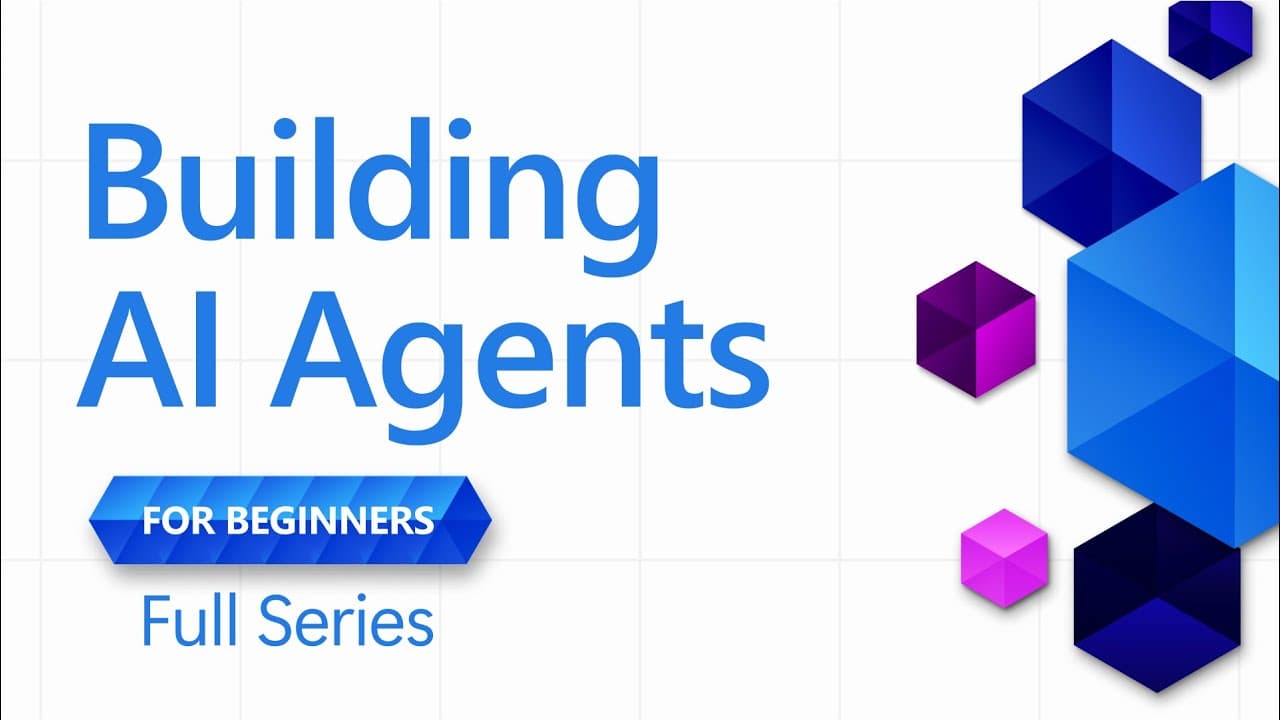
How Do You Build AI Agents? Full Beginners Course (Lessons 1–10)
TL;DR
Building an AI agent starts with combining a large language model for reasoning, memory for context and improvement, and tools such as APIs or functions for taking action. Across 10 lessons, the course moves from these fundamentals to agentic frameworks, tool use, agentic RAG, metacognition, evaluation, and production concerns such as errors and costs. Read on for a practical breakdown of each core concept.
Transcript
what are AI agents what are the best use cases for them and what do we need to start building them we're going to answer these questions in this first lesson of the AI agents for beginners course in this course we're going to take you from concept to code covering the fundamentals of building AI agents and in this short video follows along with the... Read More
Key Insights
- AI agents are systems designed to perform tasks based on user instructions by leveraging tools like large language models.
- Memory in AI agents can be short-term or long-term, aiding in task completion and improving performance over time.
- Agentic frameworks help manage tasks and context, enabling the use of multiple agents for complex tasks.
- The tool use design pattern allows AI agents to interact with external tools to complete user requests effectively.
- Agentic RAG (Retrieval Augmented Generation) enhances LLMs by planning tasks and retrieving data from external sources.
- Metacognition in AI agents involves reflecting on actions to improve future task performance and decision-making.
- Evaluation of AI agents involves assessing system components, user intent identification, and tool response effectiveness.
- Deploying AI agents to production requires error handling, cost management, and continuous evaluation for improvements.
Install to Summarize YouTube Videos and Get Transcripts
Explore YouTube Video Summarizer or Get YouTube Transcript Extractor
Questions & Answers
Q: What are AI agents, and how do they work?
AI agents are systems that perform tasks from user instructions by combining a large language model, memory, and tools. The model recognizes the task and creates a plan, memory supplies relevant context or data, and tools such as APIs and functions carry out actions.
Q: What components are needed to start building an AI agent?
The three core components presented are a large language model, memory, and tools. The model provides reasoning, memory can retain conversational or historical information, and tools give the agent access to actions and external data.
Q: What is the difference between short-term and long-term memory in an AI agent?
Short-term memory holds the context of the current conversation between the user and the agent. Long-term memory is a collection of data that can help the agent improve how it completes tasks over time.
Q: How do agentic frameworks help when building AI agents?
Agentic frameworks manage tasks and context for an AI agent. They can also support multiple agents working on complex tasks, improving task management, contextual understanding, and collaboration.
Q: How does the course demonstrate an AI agent in code?
The lesson uses Semantic Kernel, a Microsoft agentic framework, with GitHub Models and GPT-4o mini. A destinations plugin supplies a function that selects a random city, allowing the agent to respond to a natural-language request for a day trip.
Q: How do tools and memory work together in the travel-agent example?
The tool selects destinations from an assigned list, while conversational memory tracks the user's earlier response. After the agent suggests Sydney and the user rejects it, the agent uses that context to offer Rio de Janeiro instead of repeating the first destination.
Q: What is agentic RAG, and how does it enhance an AI agent?
Agentic RAG, or Retrieval Augmented Generation, enables an agent to plan tasks and retrieve relevant data from external sources. It also checks whether the retrieved information is sufficient to answer the user's query, supporting more complex, multi-step interactions.
Q: What should be evaluated before deploying an AI agent to production?
Evaluation should cover the whole system, including model responses, user-intent identification, tool use, tool responses, and user feedback. Production planning should also address error handling and cost management, with evaluation points throughout the workflow to support continuous improvement.
Q: Which AI agent framework should I use for production or research?
Use Semantic Kernel when building production-focused AI agents, or AutoGen when exploring the latest agentic research. Semantic Kernel supports C, Java, and Python and offers connectors to various model services, while AutoGen helps researchers and developers test agentic ideas in code.
Q: How can I access free large language models for an AI agent project?
GitHub Models provides free access to large language models for the course’s code samples. The lesson uses it with Semantic Kernel and assigns GPT-4o mini as the model for the example agent.
Q: Does Azure AI Agent Service support multiple AI agents?
Azure AI Agent Service is currently designed for single agents through code or the UI. After one agent is working, it can be combined with others using a framework with multi-agent support, such as Semantic Kernel or AutoGen.
Summary & Key Takeaways
-
AI agents leverage tools like large language models and memory to perform tasks based on user instructions. They use frameworks to manage tasks and context, improving task execution and allowing for complex interactions.
-
The tool use design pattern enables AI agents to interact with external tools, enhancing task completion. Agentic RAG further improves this by planning tasks and retrieving necessary data from external sources.
-
Metacognition allows AI agents to reflect on actions and improve over time. Effective deployment involves evaluating system components, handling errors, and managing costs, ensuring continuous improvement and user satisfaction.
Read in Other Languages (beta)
Share This Summary 📚
Summarize YouTube Videos and Get Video Transcripts with 1-Click
Try YouTube Summary with ChatGPT & Claude or YouTube Transcript Generator
Explore More Summaries from Microsoft Developer 📚
![Setting up our Bash Environment [3 of 20] | Bash for Beginners thumbnail](/_next/image?url=https%3A%2F%2Fi.ytimg.com%2Fvi%2FdfYTrhQuSdA%2Fhqdefault.jpg&w=750&q=75)
![How to Find Files in the terminal with Bash [7 of 20] | Bash for Beginners thumbnail](/_next/image?url=https%3A%2F%2Fi.ytimg.com%2Fvi%2FDzo38btP-Bc%2Fhqdefault.jpg&w=750&q=75)
Summarize YouTube Videos and Get Video Transcripts with 1-Click
Try YouTube Summary with ChatGPT & Claude or YouTube Transcript Generator