How to Discuss Hard AI Questions Productively
TL;DR
Start productive AI conversations by identifying and validating the moral concern behind each objection before offering facts or reframing the issue. Discuss AI as a tool for augmenting people, compare its resource demands with those of other industries, acknowledge current flaws as part of a rapidly changing prototype phase, and aim to encourage curiosity instead of winning converts.
Transcript
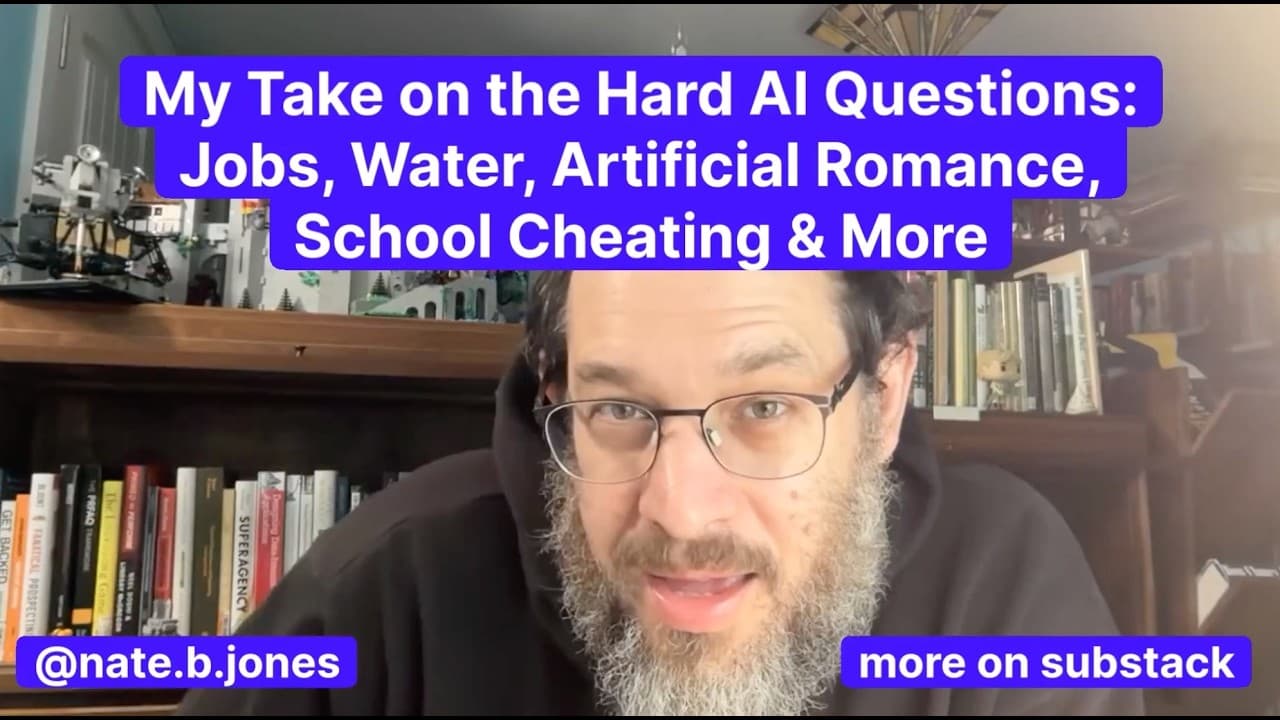
It's Thanksgiving in the US and this is a video all about how to talk about AI around the Thanksgiving table. I'm going to assume that like many Americans, you have people with a wide range of opinions on AI sitting down to have turkey together. Some of them may be very pro AI. Many of them may be suspicious of AI or not happy that AI is coming int... Read More
Key Insights
- AI objections often express deep moral intuitions rather than narrow disagreements about technology. Identifying whether someone is protecting fairness, authenticity, care, or another value makes it possible to validate the concern before discussing policies, evidence, or possible uses.
- School cheating concerns are fundamentally connected to fairness and meaningful effort. One proposed analogy treats AI like steroids in sports, restricting it during competition while considering carefully defined uses for training, practice, or learning outside evaluated work.
- Criticism of AI-generated art can reflect a desire for purity and authenticity. Comparing AI with a camera preserves a distinction between quickly generated material and human work valued for the intention, struggle, and creative process behind it.
- Job-loss anxiety can express care for people who may be left behind while wealth becomes more concentrated. A constructive response acknowledges that fear and argues for broad access to AI so more people can potentially use it to support their careers.
- Augmentation presents AI as a tool that strengthens human capability rather than replacing a person one for one. The doctor example frames AI as an Iron Man suit that can provide useful diagnostic suggestions while leaving medical responsibility with a human professional.
- AI resource use should be judged at the scale of an industry rather than compared only with individual household consumption. The speaker argues that AI deserves scrutiny, possibly heightened scrutiny because of its investment, but should not be treated as uniquely exempt or uniquely guilty.
- AI tutoring could make personal educational attention more abundant. Tutoring is described as scarce and disproportionately available to wealthy children, while successful AI systems could potentially give every student access to individualized support, despite the technology remaining imperfect and messy.
- Current AI limitations are characteristics of a rapidly changing prototype phase, not necessarily permanent boundaries. The speaker compares judging AI by older systems with judging the internet by a dial-up modem and notes that claims from even six months earlier may no longer apply.
Install to Summarize YouTube Videos and Get Transcripts
Explore YouTube Video Summarizer or Get YouTube Transcript Extractor
Questions & Answers
Q: How can you discuss AI with skeptical family members?
Begin by listening for the value underneath the objection instead of immediately defending the technology. A concern about cheating may protect fairness, criticism of generated art may defend authenticity, and fear of job losses may reflect care for vulnerable workers. Validate that concern sincerely, then introduce facts, analogies, or alternative frames. The goal is to create curiosity and honest discussion, not to force agreement or convert anyone into an AI enthusiast.
Q: Why should moral values be addressed before AI facts?
Arguments about AI policies often function as defenses of deeper moral intuitions. If a person believes generated schoolwork undermines effort or that synthetic art lacks authenticity, a factual rebuttal alone may fail to address what actually matters to them. Naming and respecting the protected value establishes common ground. Facts can then contribute to a shared discussion about boundaries, tradeoffs, and acceptable uses instead of becoming ammunition in a debate neither side expects to lose.
Q: How should schools distinguish AI assistance from cheating?
A useful starting point is the analogy between AI and steroids in sports. AI could be prohibited during evaluated competition, where students must demonstrate their own knowledge, while remaining available for specific forms of training or practice. The exact boundary requires discussion, but the central principle is that hard work and genuine learning should continue to matter. Schools can therefore consider context and purpose rather than labeling every interaction with AI identically.
Q: How can AI-generated art be discussed without dismissing artists?
Acknowledge first that human intention, struggle, and creative labor can be meaningful parts of art. The camera analogy then offers a way to distinguish tools from human expression: a camera can produce an image instantly, yet people still value paintings because of the intent behind them. Similarly, inexpensive AI output may coexist with continued appreciation for human writing and art. This framing respects authenticity concerns without claiming that all generated work is worthless.
Q: What does augmentation versus automation mean for AI?
Automation frames AI as a one-to-one replacement for a person, while augmentation frames it as a system that improves what a person can do. The doctor example illustrates the difference. A patient may reasonably reject a fully robotic doctor but welcome a human physician who receives useful diagnostic suggestions from AI. The speaker describes this model as an Iron Man suit, emphasizing enhanced human judgment rather than the complete removal of human responsibility.
Q: How should AI water and electricity use be evaluated?
AI should be evaluated like an industry, with serious standards and possibly greater scrutiny because of the investment it receives. The speaker argues that household comparisons can obscure the relevant scale and claims that leaking American household fixtures and golf courses consume more water than AI data centers. Electricity remains a major planning issue, but it is an issue that any substantial industry must address. The proper question is whether the resulting value justifies the costs.
Q: Why does AI tutoring represent a shift from scarcity to abundance?
Personal tutoring is currently described as scarce and mainly accessible to wealthy children. If AI tutoring works well, individualized educational attention could become available to every student rather than remaining a limited privilege. The present systems are acknowledged as imperfect and messy, so the argument is not that universal high-quality tutoring has already arrived. It is that AI creates a plausible path toward making personal attention in education substantially more abundant.
Q: How should current AI hallucinations and glitches affect judgment?
Hallucinations and glitches should be taken seriously, but the speaker argues that they should also be understood within a rapidly evolving prototype phase. Judging the long-term potential of AI by last year's systems is compared with judging the internet by a dial-up modem in 1994. Because models are changing quickly, assumptions based on systems from six months earlier may already be outdated. Evaluation should therefore use recent experience while avoiding claims that current flaws will necessarily remain permanent.
Summary & Key Takeaways
-
Productive AI discussions begin with the values beneath objections. Concerns about school cheating may reflect fairness, criticism of generated art may protect authenticity, and anxiety about employment may express care for vulnerable people. Validating those values before presenting a counterargument can open space for an honest conversation instead of an adversarial debate.
-
AI can be framed as augmentation rather than complete automation. A human doctor supported by diagnostic suggestions illustrates the Iron Man suit analogy, where technology strengthens professional judgment instead of replacing it. Similar reframing can shift conversations about education, employment, and creative work toward determining where assistance is useful and where boundaries remain necessary.
-
Resource use and technical limitations require context rather than dismissal. AI should face standards comparable to other industries, while water and electricity claims should be evaluated at an industry scale. Current glitches and hallucinations also reflect a fast-changing prototype phase. The conversational goal is informed curiosity, not unconditional enthusiasm or conversion.
Read in Other Languages (beta)
Share This Summary 📚
Summarize YouTube Videos and Get Video Transcripts with 1-Click
Try YouTube Summary with ChatGPT & Claude or YouTube Transcript Generator
Explore More Summaries from AI News & Strategy Daily | Nate B Jones 📚






Summarize YouTube Videos and Get Video Transcripts with 1-Click
Try YouTube Summary with ChatGPT & Claude or YouTube Transcript Generator