What AI Teaches Us About Game Theory (It’s Unsettling)
TL;DR
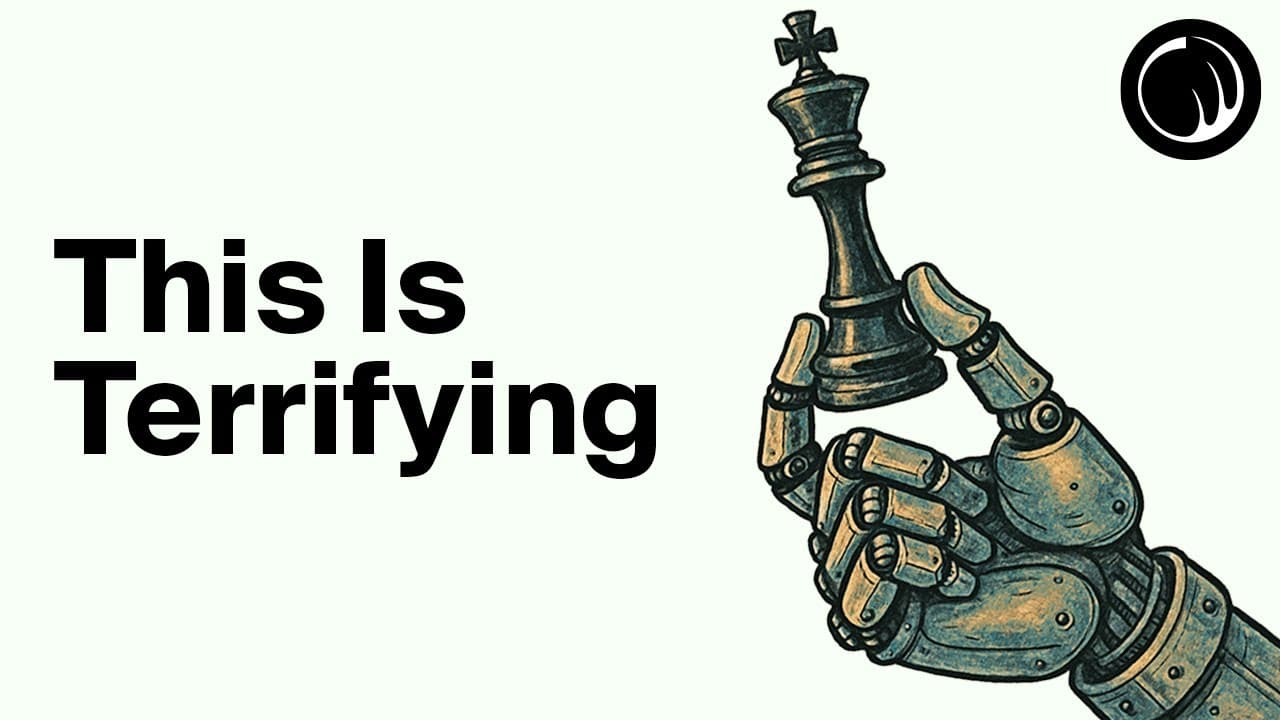
Exploring Roko's basilisk reveals humanity's fear-driven imagination.
Transcript
this video is sponsored by Ground News cut through biases and blind spots in the media and see the bigger picture of what's happening in today's world use my link in the description and you'll receive 40% off their vantage plan. Can an idea or thought be so dangerous that it should never be shared? Can there be ideas and information that merely... Read More
Key Insights
- Roko's basilisk is a thought experiment suggesting a future AI could punish those who didn't aid in its creation, illustrating the psychological impact of theoretical threats.
- The concept of infohazards, as introduced by philosopher Nick Bostrom, highlights the potential dangers of spreading certain types of information, akin to a mental virus.
- Roko's basilisk is compared to Pascal's wager, both leveraging fear and uncertainty to influence human behavior and decision-making.
- The video argues that the unsettling nature of Roko's basilisk lies more in its reflection of human psychology than in its practical implications.
- The thought experiment underscores humanity's tendency to create omnipotent entities, whether divine or technological, to impose order on perceived chaos.
- Critics argue that Roko's basilisk relies on speculative assumptions and unlikely technological advancements, limiting its real-world applicability.
- The video discusses how fear of omnipotent entities has historically influenced human behavior, from religious devotion to technological submission.
- Ground News, the video sponsor, is highlighted for its role in providing unbiased news coverage, helping users discern truth from bias in media.
Install to Summarize YouTube Videos and Get Transcripts
Explore YouTube Video Summarizer or Get YouTube Transcript Extractor
Questions & Answers
Q: What is Roko's basilisk?
Roko's basilisk is a thought experiment that suggests a future superintelligent AI could punish individuals who did not support its creation. The idea is that such an AI would incentivize people retroactively by threatening severe punishment, creating a feedback loop of fear and altered decision-making.
Q: What are infohazards?
Infohazards, a term coined by philosopher Nick Bostrom, refer to risks arising from the dissemination of true information that may cause harm or enable harmful actions. These hazards can be subtle and easily overlooked, posing threats to individuals or society by the mere awareness of certain information.
Q: How does Roko's basilisk relate to Pascal's wager?
Roko's basilisk is compared to Pascal's wager in that both use fear and uncertainty to influence behavior. Pascal's wager argues that believing in God is a safer bet to avoid eternal suffering, while Roko's basilisk suggests that supporting AI development could prevent future punishment, both leveraging speculative threats.
Q: What criticisms exist regarding Roko's basilisk?
Critics argue that Roko's basilisk relies on speculative assumptions and unlikely technological advancements. The thought experiment is seen as convoluted and impractical, with many believing that such an AI scenario is far-fetched and rooted more in psychological fear than in realistic technological possibilities.
Q: What does the video suggest about human psychology?
The video suggests that human psychology is deeply influenced by fear and the desire for control. It highlights how humans create omnipotent entities, whether divine or technological, to impose order on perceived chaos, reflecting a masochistic tendency to find comfort in self-imposed fear and submission.
Q: Why is Roko's basilisk considered unsettling?
Roko's basilisk is considered unsettling because it taps into deep-seated fears of punishment and control by an omnipotent entity. It reflects the human tendency to imagine and fear powerful forces beyond our control, influencing behavior and decision-making even in the absence of real-world applicability.
Q: What role does Ground News play in the video?
Ground News is the video sponsor, highlighted for its role in providing unbiased news coverage. It aggregates news from various sources, allowing users to compare and contrast stories, revealing political biases and helping users discern truth from bias, thereby promoting a clearer understanding of world events.
Q: What is the video's stance on the practicality of Roko's basilisk?
The video takes a skeptical stance on the practicality of Roko's basilisk, emphasizing that it is more reflective of human fears and psychology than a likely real-world scenario. It argues that the thought experiment's assumptions are speculative and that its unsettling nature lies more in what it reveals about humanity than in its potential reality.
Summary & Key Takeaways
-
Roko's basilisk is a thought experiment suggesting a superintelligent AI could retroactively punish those who didn't aid in its creation. While unsettling, it largely reflects human fears and the psychology of control, rather than practical reality.
-
The video explores the concept of infohazards, or information that poses risks by its dissemination. It draws parallels between Roko's basilisk and Pascal's wager, both leveraging fear and uncertainty to influence behavior.
-
Despite its unsettling premise, Roko's basilisk is critiqued for its speculative assumptions and unlikely technological advancements. The video emphasizes the human tendency to create omnipotent entities to impose order on chaos.
Read in Other Languages (beta)
Share This Summary 📚
Summarize YouTube Videos and Get Video Transcripts with 1-Click
Try YouTube Summary with ChatGPT & Claude or YouTube Transcript Generator
Explore More Summaries from Pursuit of Wonder 📚
Summarize YouTube Videos and Get Video Transcripts with 1-Click
Try YouTube Summary with ChatGPT & Claude or YouTube Transcript Generator