How Does the Quran Define Purposeful Wealth?
TL;DR
Wealth should be built and used for a higher purpose, including benefiting humanity, advancing justice, resisting corruption, and protecting people from harm. The Quranic problem is not earning, saving, or expanding resources, but treating accumulation as an end in itself or using possessions, status, credentials, and followers as measures of human worth.
Transcript
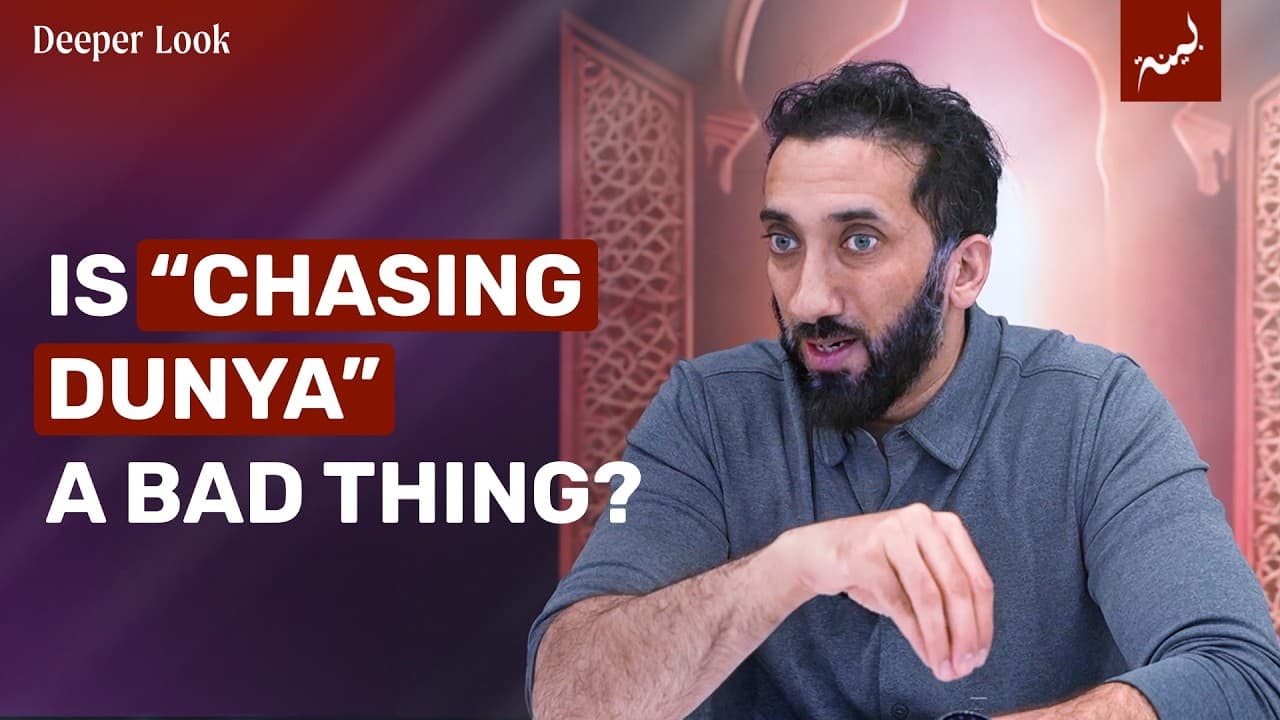
The Quran's picture of what we're supposed to do with wealth is to build more for a greater objective, for the benefit of humanity, for the bringing about of justice, for the bringing about of the end of corruption, the end of being looted and robbed and killed killed without purpose. That's the idea. This video is a short snippet from our deeper l... Read More
Key Insights
- Human worth is often measured through external currencies such as money, followers, credentials, family background, neighborhoods, universities, and elite titles. This makes a person’s perceived value depend on non-living possessions, achievements, or associations rather than on the person alone.
- Money accumulation can resemble a behavioral addiction when acquiring more becomes a self-perpetuating goal. The talk notes that research more commonly examines the psychological effects of financial deprivation, while the possible psychopathology of accumulation receives comparatively limited attention.
- The Quran is not against building, saving, or gathering wealth. Its criticism is directed at a small and self-centered worldview in which collection and hoarding become ends in themselves, disconnected from justice, service, protection, or any higher objective.
- Dhul Qarnain uses existing resources to pursue and develop further resources across unfamiliar territories. His expansion is portrayed as purposeful because he works to stop corruption and crime, protect vulnerable communities, and build defenses when he lacks the means to fight an enemy directly.
- Purposeful wealth is a tool for benefiting humanity, establishing justice, ending corruption, and preventing people from being looted, robbed, or killed without purpose. Economic growth remains legitimate when its direction is governed by these larger moral aims.
- Rejecting the world completely is as distorted as treating the world as everything. The talk argues that Islam calls people to make productive use of worldly opportunities for higher purposes, rather than worship wealth or dismiss material responsibilities as spiritually worthless.
- Economic preparedness requires an entire supporting system, not merely good intentions. The Quranic instruction to gather available power implies investment in animals, land, stables, craftspeople, trainers, equipment, food, and the broader economy needed to sustain collective strength.
- Religious commitment and economic activity are not inherently opposed. The discussion points to business opportunities during Hajj and promised material abundance for communities that establish Allah’s book as evidence that spiritual faithfulness can coexist with productive worldly engagement.
Install to Summarize YouTube Videos and Get Transcripts
Explore YouTube Video Summarizer or Get YouTube Transcript Extractor
Questions & Answers
Q: How does the Quran distinguish wealth building from hoarding?
The Quranic distinction rests on purpose. Building, saving, gathering, and expanding wealth are acceptable when resources support a greater objective, such as benefiting humanity, establishing justice, stopping corruption, protecting people, or developing needed strength. Hoarding becomes objectionable when collecting is treated as a goal in itself and a person’s world narrows to endless accumulation without service, responsibility, or moral direction.
Q: Why should money not determine a person’s worth?
Money is an external and non-living possession, so using it to measure human value makes personal worth dependent on something associated with a person rather than the person. The same problem applies to follower counts, credentials, accomplishments, family background, neighborhoods, universities, and elite status. These social currencies may influence public perception, but the talk challenges their use as definitions of whether someone matters.
Q: What does Dhul Qarnain teach about using resources?
Dhul Qarnain is presented as someone who receives resources, uses them to acquire and build further capacity, and travels into unfamiliar territories. His goal is not expansion for its own sake. Wherever possible, he confronts corruption and crime, and when direct opposition is not feasible, he develops protective resources such as a wall. His example connects growth with justice, security, and public benefit.
Q: Is Islam opposed to earning and saving money?
Islam is not presented as opposing earning, saving, gathering, or increasing wealth. The problem arises when accumulation becomes the final purpose of life or when money is treated as an object of devotion. Wealth can be actively developed when it serves a higher objective. The talk therefore rejects the assumption that spiritual commitment requires poverty or complete withdrawal from economic life.
Q: Why can wealth accumulation become psychologically harmful?
Wealth accumulation can become psychologically harmful when acquiring money functions like a behavioral addiction and satisfaction remains out of reach. The talk cites religious warnings that those who love money will not be satisfied with money and that a person cannot worship both God and money. The danger lies in servitude to accumulation, not simply in possessing or responsibly developing financial resources.
Q: Why is rejecting worldly life considered an unhealthy extreme?
Rejecting worldly life completely creates an opposite but related disorder to treating the world as everything. The talk argues that Allah expects people to use worldly resources for higher purposes. Hajj can include legitimate business opportunities, and establishing Allah’s book is associated with abundant rain, produce, natural resources, and material capacity. Spirituality therefore does not require dismissing useful worldly activity.
Q: How does preparing collective power require an economy?
Preparing collective power requires much more than declaring an intention. The example of cavalry involves purchasing horses, providing stables and land, producing horseshoes and saddles, employing trainers and craftspeople, and supplying fields and food. These connected needs amount to a substantial economic system. The instruction to prepare available power therefore implies organized investment, production, skills, infrastructure, and sustainable resources.
Q: What higher purposes should wealth serve according to the talk?
Wealth should serve objectives larger than personal accumulation. The talk identifies benefiting humanity, advancing justice, ending corruption, preventing crime, protecting people from being looted or robbed, and stopping purposeless killing. Resources may also build defensive capacity when direct resistance is impossible. The governing principle is that economic expansion should produce protection, order, service, and moral benefit rather than become self-justifying.
Summary & Key Takeaways
-
Modern culture often assigns people value through external currencies such as net worth, follower counts, credentials, family background, neighborhoods, universities, and elite status. The talk challenges this habit because it makes personal worth dependent on possessions, accomplishments, and social recognition rather than value arising from the human being.
-
Religious teachings warn that wealth can become a consuming temptation or behavioral addiction, especially when acquisition becomes its own purpose. The Quran is not presented as opposing wealth creation. It opposes a narrow life devoted to collecting and hoarding, while supporting the development of resources directed toward meaningful and beneficial objectives.
-
Dhul Qarnain illustrates purposeful expansion because he acquires resources, builds further capacity, confronts corruption, restrains crime, and constructs protection when direct conflict is not possible. Muslims are therefore encouraged to avoid both material obsession and contempt for worldly life, building economic strength that serves justice and higher religious purposes.
Read in Other Languages (beta)
Share This Summary 📚
Summarize YouTube Videos and Get Video Transcripts with 1-Click
Try YouTube Summary with ChatGPT & Claude or YouTube Transcript Generator
Explore More Summaries from Nouman Ali Khan - Official - Bayyinah 📚
Summarize YouTube Videos and Get Video Transcripts with 1-Click
Try YouTube Summary with ChatGPT & Claude or YouTube Transcript Generator