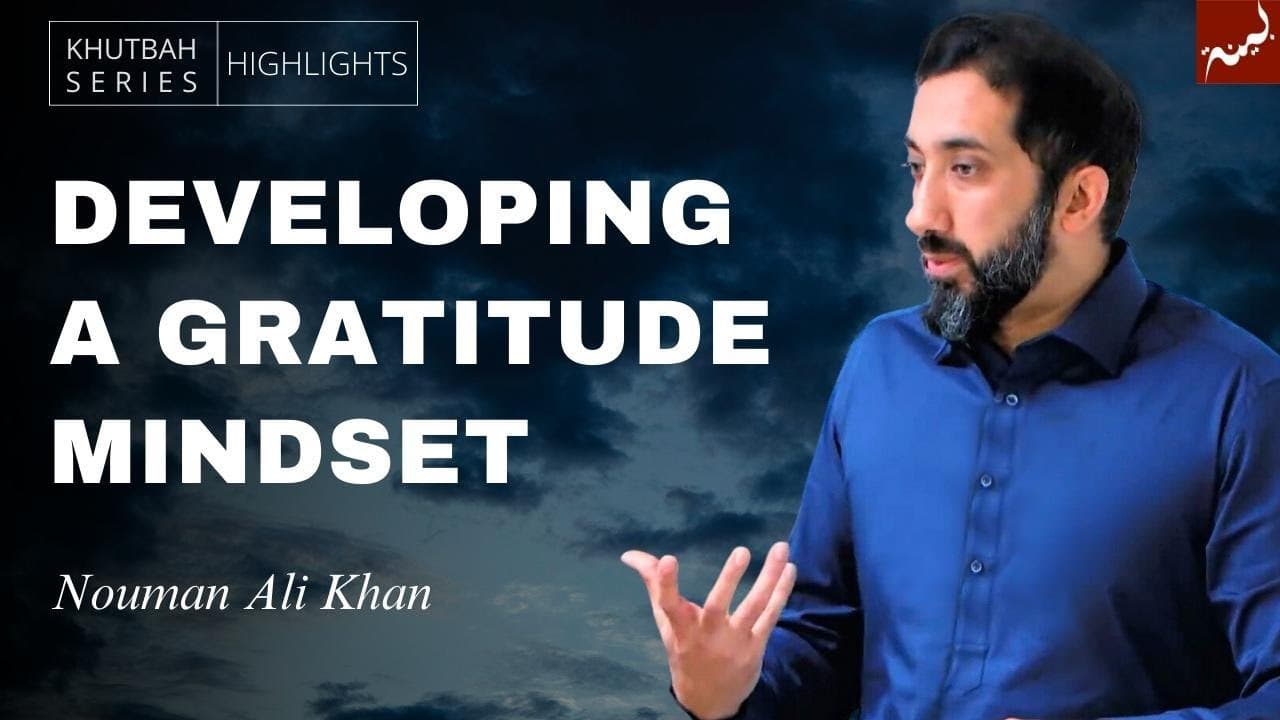
How Does Gratitude Transform Your Mindset?
TL;DR
Gratitude redirects attention from constant dissatisfaction toward the blessings and relief already present, freeing a person from paralyzing negativity. Thanking Allah benefits the grateful person by fostering optimism, energy, and constructive action, while praise and gratitude together form hamd. Even in hardship, identifying what could have been worse can help restore perspective and strengthen one’s relationship with Allah.
Transcript
human beings are very wrongdoing and they're extremely ungrateful and what what is one of the ways in which we're extremely ungrateful we always have reason to complain always if somebody says hey what's on your mind say nothing nothing okay no no you can talk to me all right here's a list and then there's a list of all the issues I mean it's too h... Read More
Key Insights
- Constant dissatisfaction is a harmful mental pattern that keeps attention fixed on problems involving health, money, relationships, work, education, appearance, and social judgment. When a person becomes immersed in these concerns, identifying anything worthy of gratitude can become a genuinely difficult exercise.
- Gratitude is an inward spiritual quality rather than a guaranteed result of religious knowledge or outward appearance. A person may know the Quran or visibly observe religious practices while remaining negative, frequently complaining, and unable to recognize what Allah has already provided.
- Praise and gratitude are distinct responses. Praise recognizes an admirable quality, such as the appeal of a nice car, while gratitude arises when someone provides a benefit. A person can praise without feeling thankful, or feel thankful toward someone whose conduct is not praiseworthy.
- Hamd is the combination of praise and gratitude directed toward Allah. The Quran begins with alhamdulillah, but the passage discussed emphasizes shukr, or gratitude alone, as an earlier and foundational step in developing a stronger relationship with Allah.
- Wisdom is beneficial understanding that changes behavior, outlook, and perception. Gratitude demonstrates wisdom by teaching a person to notice the water that is present instead of focusing only on why the glass is not full, cold, or otherwise exactly as desired.
- Gratitude benefits the grateful person by loosening the grip of negative thoughts. It can create optimism, energy, and greater capacity for constructive action, while habitual dissatisfaction can become paralyzing and prevent a person from using their abilities effectively.
- Parental negativity shapes how children understand gratitude. When children repeatedly see a father or mother complaining, appearing upset, and expressing little appreciation, they are not being shown how thankfulness should look in daily family life.
- Hardship does not remove every reason for gratitude. After the Israelites escaped Egypt, they remained homeless and uncomfortable in the desert, yet they were no longer enslaved, humiliated, threatened with drowning, or forced to watch their families suffer under degradation.
Install to Summarize YouTube Videos and Get Transcripts
Explore YouTube Video Summarizer or Get YouTube Transcript Extractor
Questions & Answers
Q: How can gratitude transform a negative mindset?
Gratitude transforms a negative mindset by redirecting attention from everything that is missing or disappointing toward benefits that are already present. According to the talk, constant dissatisfaction becomes paralyzing, while gratitude is liberating. It helps free a person from negative thoughts, encourages optimism, restores energy, and makes constructive action possible when complaining would otherwise keep the person emotionally stuck.
Q: What is the difference between praise and gratitude?
Praise is recognition of something admirable, while gratitude is appreciation for a benefit received. A person may praise a nice car without thanking it, but would feel grateful if someone gave them that car. The two responses can also separate in human relationships, since someone may appreciate a benefit from a person without considering that person’s conduct praiseworthy.
Q: What does hamd mean in relation to Allah?
Hamd combines praise and gratitude. The talk explains that these two qualities do not always appear together in relationships with people, but they always belong together when directed toward Allah. Alhamdulillah therefore expresses both praise and thanks. Shukr, meaning gratitude, is presented as a foundational step that comes before reaching this combined state of hamd.
Q: Why does gratitude benefit the person who practices it?
Gratitude benefits the person who practices it because it changes perception, emotional energy, and behavior. A grateful person becomes less consumed by dissatisfaction with relationships, possessions, work, appearance, education, or other people’s opinions. This shift reduces paralyzing negativity and supports optimism and productive action. The talk says that the grateful person is therefore acting for their own benefit.
Q: How can someone practice gratitude during hardship?
A person can practice gratitude during hardship by deliberately identifying what remains good, what danger has ended, and what could have been far worse. The Israelites in the desert still faced heat, hunger, homelessness, and uncertainty, but they had escaped slavery, death, humiliation, and degradation. Remembering what Allah has removed can reveal reasons for gratitude even when present conditions remain difficult.
Q: Why is religious knowledge alone insufficient for gratitude?
Religious knowledge alone is insufficient because gratitude is a condition within the heart that must shape a person’s outlook and behavior. The talk states that someone may possess extensive knowledge, memorize the Quran, or display visible religious practice while still complaining and focusing constantly on what is wrong. Genuine wisdom appears when knowledge produces thankfulness, perspective, and constructive conduct.
Q: How does parental negativity affect children?
Parental negativity teaches children through repeated example. If a father or mother constantly complains, appears angry, and rarely expresses appreciation, children do not see gratitude embodied in family life. The talk asks how parents can raise children with shukr when the household atmosphere communicates dissatisfaction. Teaching gratitude therefore requires visible appreciation, not merely verbal or religious instruction.
Q: What does Allah promise to those who are grateful?
Allah promises to give more to those who are grateful. The talk connects this increase with good in life, including guidance, health, and provision, and presents gratitude as a profound wisdom from Allah. The central point is that recognizing existing blessings is not merely passive appreciation. It strengthens a person spiritually while opening the way for further good.
Summary & Key Takeaways
-
Human beings can become consumed by complaints about money, health, family, education, careers, appearance, and personal worth. Religious knowledge or outward practice does not automatically produce gratitude because gratitude is an inward condition. Developing it requires an honest conversation with oneself about what deserves thanks and how one habitually interprets life.
-
Praise recognizes something admirable, while gratitude responds to a benefit received. Either can exist without the other when dealing with people, but praise and thanks always belong together in relation to Allah. Their combination is called hamd, while shukr focuses specifically on gratitude and represents an early step toward spiritual growth.
-
Gratitude changes outlook and behavior by interrupting dissatisfaction, negativity, and paralysis. Musa’s message to the Israelites illustrates that hardship does not eliminate reasons for thankfulness, since they had escaped slavery, death, humiliation, and degradation. The grateful person benefits personally, and Allah promises increased good to those who develop gratitude.
Read in Other Languages (beta)
Share This Summary 📚
Summarize YouTube Videos and Get Video Transcripts with 1-Click
Try YouTube Summary with ChatGPT & Claude or YouTube Transcript Generator
Explore More Summaries from Nouman Ali Khan - Official - Bayyinah 📚

Summarize YouTube Videos and Get Video Transcripts with 1-Click
Try YouTube Summary with ChatGPT & Claude or YouTube Transcript Generator