What Are the Key Cybersecurity Trends for 2025?
TL;DR
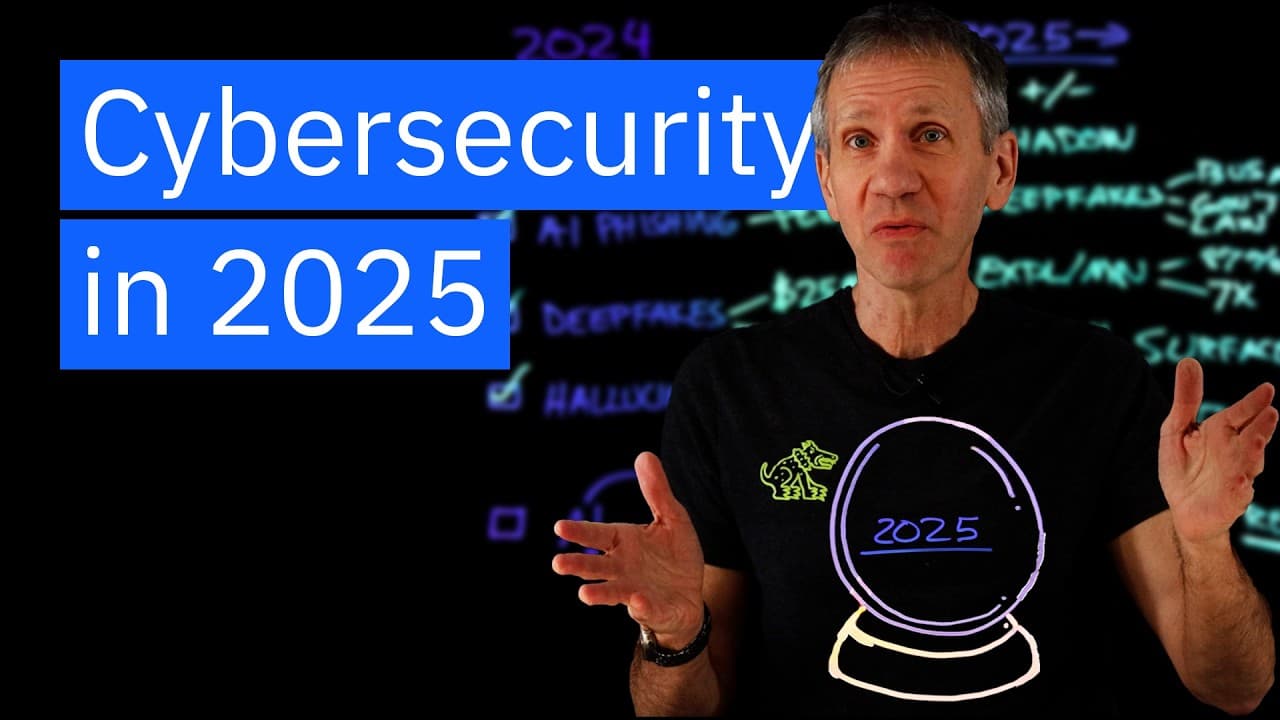
Key cybersecurity trends for 2025 include increasing adoption of pass keys over passwords, the rise of AI-generated phishing attacks, and the persistent threat of deepfakes. Organizations must focus on securing AI deployments against attacks while managing the challenges of shadow AI and transitioning to quantum-safe cryptography to protect sensitive data against future threats.
Transcript
Two years ago, I did a video on cybersecurity trends for 2023. Then last year I did another one for 2024. Well, let's dust off the crystal ball and take a look and see what I'm seeing for 2025 and beyond. But before we do that, let's take a quick look at what I predicted last year and see if it came true or not. That way you can decide whether you ... Read More
Key Insights
- The adoption of pass keys over passwords is increasing significantly, with more users and companies transitioning to this technology, enhancing security.
- Generative AI is improving phishing attacks by creating highly personalized and believable emails, eliminating traditional grammar and spelling error detection methods.
- Deepfakes pose a significant threat, as demonstrated by incidents where they have been used to impersonate individuals and manipulate actions, impacting businesses and politics.
- Generative AI continues to experience hallucinations, leading to inaccuracies, though improvements are ongoing to reduce these errors.
- Securing AI deployments is a major concern for companies, with a focus on using cybersecurity technologies to protect AI systems from attacks.
- Shadow AI, or unauthorized AI deployments, could lead to data leakage and misinformation, posing a challenge for organizations to manage.
- The potential for generative AI to write malware is increasing, with evidence showing its capability to generate exploit code effectively.
- Quantum computers present a future threat to cryptography, necessitating a shift towards quantum-safe cryptographic algorithms to protect sensitive data.
Install to Summarize YouTube Videos and Get Transcripts
Explore YouTube Video Summarizer or Get YouTube Transcript Extractor
Questions & Answers
Q: How has the adoption of pass keys over passwords changed recently?
The adoption of pass keys over traditional passwords has seen a significant increase. A password management company reported that 4.2 million pass keys were saved in their software over the past year, with one in three users storing pass keys. Additionally, twice as many companies now accept pass keys, indicating a shift towards more secure authentication methods.
Q: What role does AI play in enhancing phishing attacks?
AI plays a critical role in enhancing phishing attacks by generating highly personalized and legitimate-looking emails. These AI-generated phishing emails are crafted without the typical grammar and spelling errors, making them more believable. The use of publicly available information allows for targeted and convincing attacks, posing a significant challenge to traditional phishing detection methods.
Q: What are the implications of deepfakes in cybersecurity?
Deepfakes present serious implications for cybersecurity, as they can convincingly impersonate individuals, leading to fraudulent activities. For instance, deepfakes have been used to impersonate company executives, resulting in significant financial losses. Additionally, deepfakes can impact political events, such as elections, by spreading misinformation. The legal system also faces challenges in distinguishing real evidence from deepfakes, complicating legal proceedings.
Q: What issues does generative AI face with accuracy?
Generative AI faces issues with accuracy, often referred to as hallucinations, where it produces incorrect or misleading information. Despite improvements, these inaccuracies persist, as shown in a conversion error example where a chatbot incorrectly calculated a runner's pace. Ongoing efforts aim to reduce these hallucinations and enhance the reliability of AI-generated information.
Q: Why is securing AI deployments a major concern for companies?
Securing AI deployments is a major concern for companies because AI systems are increasingly integrated into business operations, making them potential targets for cyberattacks. Companies are focused on using cybersecurity technologies to protect AI systems from unauthorized access and manipulation, ensuring the robustness and security of AI deployments against potential threats.
Q: What is shadow AI and why is it a concern?
Shadow AI refers to unauthorized or unapproved AI deployments within an organization. It is a concern because these deployments can lead to data leakage and misinformation if not properly managed. As AI becomes more accessible and integrated into various systems, organizations must ensure that all AI usage is authorized and secure to prevent potential security risks associated with shadow AI.
Q: How can generative AI contribute to writing malware?
Generative AI can contribute to writing malware by generating exploit code based on descriptions of vulnerabilities. Studies have shown that AI chatbots can produce exploit code with high accuracy, even without the user having coding expertise. This capability allows attackers to leverage AI for malicious purposes, increasing the threat of AI-generated malware in cybersecurity landscapes.
Q: What steps should be taken to address the threat of quantum computers to cryptography?
To address the threat of quantum computers to cryptography, organizations should transition to quantum-safe cryptographic algorithms. Quantum computers have the potential to break current cryptographic methods, making sensitive data vulnerable. By adopting quantum-safe algorithms, companies can protect their data from future quantum attacks. Proactive measures, such as implementing these algorithms now, are crucial to safeguarding information against the anticipated capabilities of quantum computing.
Summary & Key Takeaways
-
The video discusses cybersecurity trends for 2025, focusing on the impact of AI on security threats and solutions. It reviews past predictions, highlighting the growing adoption of pass keys, the rise of AI-generated phishing attacks, and the implications of deepfakes. The need for securing AI deployments is emphasized.
-
Generative AI's role in cybersecurity is explored, noting its potential to write malware and its susceptibility to prompt injection attacks. The threat of shadow AI and the expansion of the attack surface are discussed, along with the importance of transitioning to quantum-safe cryptography to protect against future quantum computer threats.
-
The video highlights the dual nature of AI in cybersecurity, presenting both challenges and opportunities. While AI can enhance security measures, it also introduces new vulnerabilities. The importance of proactive measures, such as adopting quantum-safe algorithms and managing shadow AI, is stressed for future cybersecurity resilience.
Read in Other Languages (beta)
Share This Summary 📚
Summarize YouTube Videos and Get Video Transcripts with 1-Click
Try YouTube Summary with ChatGPT & Claude or YouTube Transcript Generator
Explore More Summaries from IBM Technology 📚





Summarize YouTube Videos and Get Video Transcripts with 1-Click
Try YouTube Summary with ChatGPT & Claude or YouTube Transcript Generator