Why Are Pointers Essential to a CPU? Hidden Pointers Explained, Computerphile
TL;DR
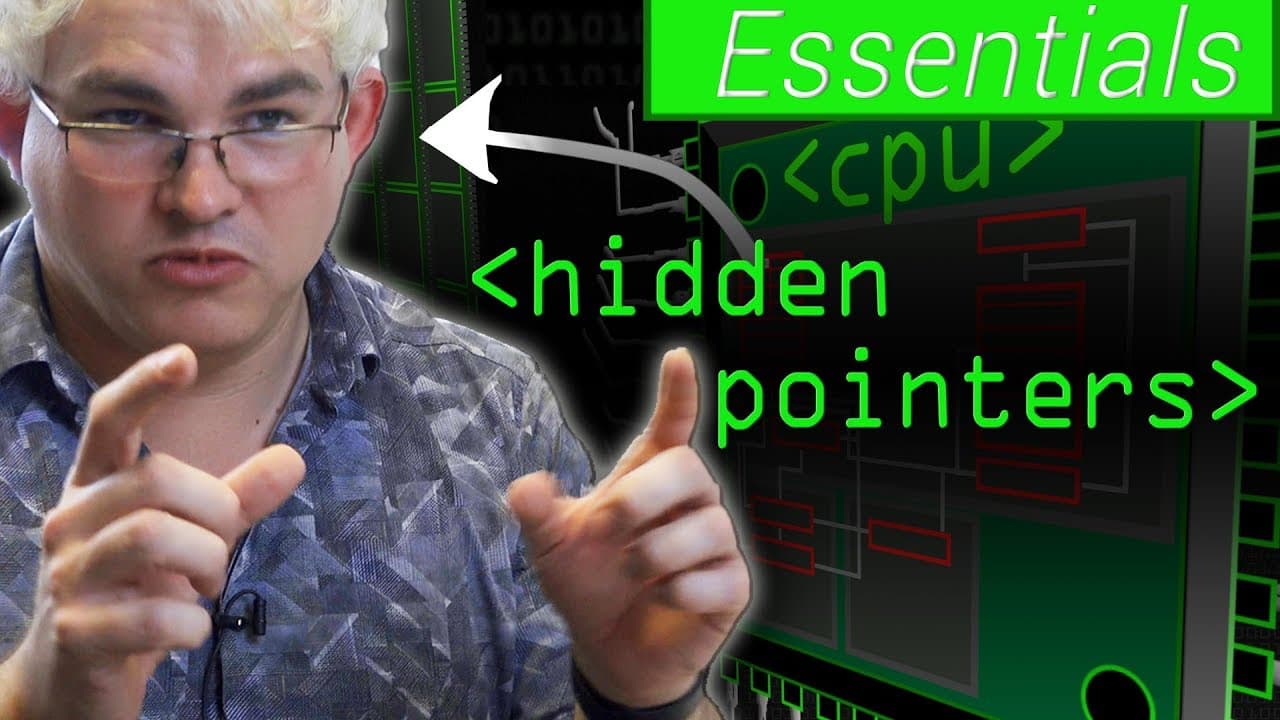
Pointers are essential because a CPU needs them to locate instructions and data in memory. In the 8088, the instruction pointer stores the address of the next instruction, while pointer and index registers identify where other information is stored. After executing an instruction, the CPU advances the instruction pointer by that instruction’s size. Read on to understand this process through the book-index analogy and concrete 8088 examples.
Transcript
so without pointers we'd find it really difficult to build a general purpose cpu that can do anything rather me drawing it let me get out my book back from the thing of the original ibm pcs 8088 and effectively when the mac boots up when the pc boots up they boot up like this now what do we have inside of cpu well there's there's a bit of it which ... Read More
Key Insights
- 💻 Pointers are vital for executing instructions and accessing data in computer memory.
- 🏪 CPU registers store values necessary for arithmetic and logic operations.
- 🫰 Pointer registers and indexes work similarly to an index in a book, directing the CPU to the location of data or instructions in memory.
- 👨💻 The instruction pointer determines the next instruction to be executed, facilitating the sequential execution of code.
- 🏛️ Pointers are necessary for building all computer systems, regardless of functional programming, algorithms, or data structures.
- 💁 Leakage of passwords and sensitive information is a frequent occurrence, emphasizing the need for secure coding practices.
Install to Summarize YouTube Videos and Get Transcripts
Explore YouTube Video Summarizer or Get YouTube Transcript Extractor
Questions & Answers
Q: Why are pointers essential to a CPU?
Pointers tell the CPU where instructions and data are stored in memory. Without them, the CPU could not fetch code, retrieve data from memory, or store data back into memory.
Q: How does a computer pointer work?
A pointer stores the memory address where particular information can be found. The transcript compares it to a book index: the index does not contain the subject itself but tells you which page to visit.
Q: What is an instruction pointer?
The instruction pointer is a special register that stores the memory address of the instruction the CPU will execute. On other CPUs, the same type of register may be called the program counter.
Q: How does the instruction pointer help the CPU execute code?
The CPU reads the address in the instruction pointer, fetches the instruction stored at that memory location, and executes it. It then advances the instruction pointer by the size of that instruction so it points to the next one.
Q: Where does an original IBM PC begin executing code?
The transcript says an original PC begins at the hexadecimal address FFFF0 when switched on. The CPU looks up that address in memory, reads the stored instruction, and starts processing it.
Q: Why does the instruction pointer advance by different amounts?
8088 instructions can vary in size, including one byte or two bytes. The instruction pointer therefore advances by the size of the instruction just executed so that it identifies the next instruction.
Q: How do pointers let a CPU access program data?
Registers can hold addresses pointing to data in memory. The CPU uses such an address to fetch data into a register, operate on it, and store data back into memory when needed.
Q: What are pointer and index registers in the 8088?
Pointer and index registers are registers used to hold locations in memory rather than the referenced information itself. For example, the stack pointer stores a value identifying where the stack is located in memory.
Summary & Key Takeaways
-
Pointers are essential for building a general-purpose CPU that can perform arithmetic, logic operations, and execute instructions.
-
CPU registers store 16-bit or 8-bit values, allowing for storage and manipulation of data.
-
Pointer registers and indexes are used to locate memory addresses where data and instructions are stored.
Read in Other Languages (beta)
Share This Summary 📚
Summarize YouTube Videos and Get Video Transcripts with 1-Click
Try YouTube Summary with ChatGPT & Claude or YouTube Transcript Generator
Explore More Summaries from Computerphile 📚



Summarize YouTube Videos and Get Video Transcripts with 1-Click
Try YouTube Summary with ChatGPT & Claude or YouTube Transcript Generator