How Does the Mind Draw a Boundary Around Itself?
TL;DR
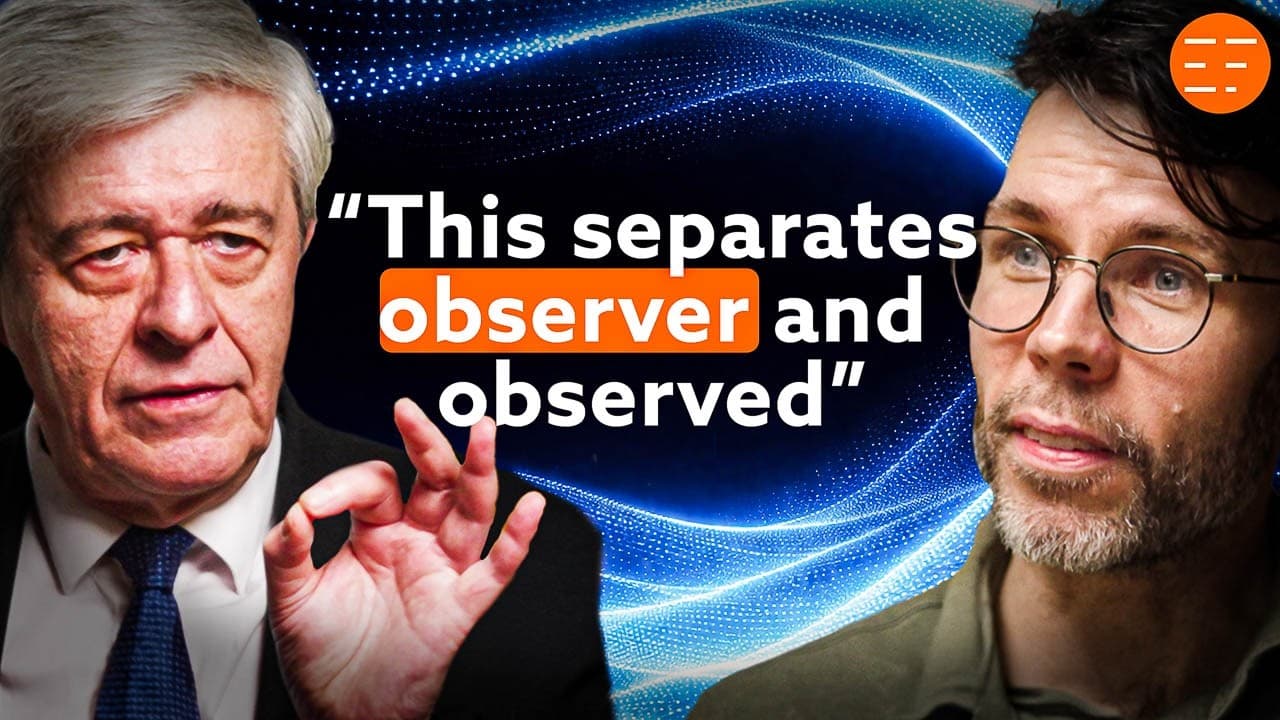
The mind does not passively mirror an external world. It constructs hypotheses that explain sensory data while actively choosing how to sample its environment. Friston’s free energy principle and Markov blanket describe how an observer can remain statistically distinct from, yet intimately coupled to, the surrounding world, while treating the self, space, and time as useful explanatory stories.
Transcript
Ever since my journey into non-jewism, I'm puzzled by this line from the poet Roomie. You're not a drop in the ocean, but the ocean and a drop. This paradox that we are both the whole universe and at the same time an infantessimally small drop located in space and time is something I can ponder on daily in a philosophical way. But what would the wo... Read More
Key Insights
- Perception is a constructive process in which the brain uses internal hypotheses, models, or fantasies to explain sensory data. This contrasts with the view that cognition simply extracts information from an external reality and reproduces that reality inside the brain.
- Unconscious inference requires perceptual possibilities to exist internally before something can be recognized or classified. The discussion traces this idea through Helmholtz and Kant to Plato, presenting the free energy principle as a continuation of a long intellectual history.
- Active inference joins perception and behavior by recognizing that an organism helps determine which sensory data it receives. It makes sense of evidence that it actively gathers by moving, sensing, and querying whether expected features of the world are present.
- The brain is an embodied and situated statistical organ that searches for the best explanation of its current sensory evidence. Its body, environment, sensory organs, and actions therefore participate in cognition rather than merely supplying inputs to an isolated processor.
- A Markov blanket is a statistical boundary that permits separation between an observer and the observed. It functions as a shared veil that belongs exclusively to neither side, allowing a system to remain distinct while also remaining coupled to its surroundings.
- The free energy principle offers a mathematical description of what living systems do within their boundaries. It does not claim to solve how cells emerged from primordial conditions or how selves emerged from brains, but it describes minimal conditions for statistical separation.
- Selfhood is presented as a useful story under the free energy principle rather than an independently measurable object. Space and time are treated similarly, as explanatory narratives that organize experience without providing direct access to whatever reality exists beyond phenomenal appearance.
- Markov blankets can be nested, allowing smaller bounded systems to exist within larger bounded systems. This possibility supports discussion of selves within larger selves and reframes individuality as a hierarchy of statistically separated yet mutually connected processes.
Install to Summarize YouTube Videos and Get Transcripts
Explore YouTube Video Summarizer or Get YouTube Transcript Extractor
Questions & Answers
Q: How does the brain perceive the world according to Friston?
The brain perceives by constructing hypotheses that explain the sensory data available to it, rather than by directly copying an external world. Percepts can therefore be understood as models, controlled fantasies, or interpretations brought to sensory evidence. The brain functions as a statistical organ that searches for the best explanation of its sensorium, continuing the tradition of unconscious inference associated with Helmholtz.
Q: What is a Markov blanket in the free energy principle?
A Markov blanket is a statistical boundary that establishes a separation between an observer and what is observed. It acts as a veil shared across that relationship while being identical to neither side. The concept describes how a system can be part of its surrounding world, remain intimately coupled to it, and still possess a mathematically expressible form of distinct identity.
Q: How does active inference connect perception and action?
Active inference connects perception and action by noting that an organism does not merely receive sensory evidence. It also moves and behaves in ways that determine which evidence becomes available. The organism then explains data that it has actively solicited by sampling or querying its environment. This creates circular causality between making sense of the world and acting within it.
Q: Why is perception described as unconscious inference?
Perception is described as unconscious inference because recognition requires an internal possibility or hypothesis before sensory input can be classified. The mind does not wait for a complete representation to arrive from outside. It brings prior structures to the sensorium and uses them to infer what could have produced the available evidence, often without conscious awareness of that inferential process.
Q: What does the free energy principle explain about living systems?
The free energy principle provides a mathematical way to describe what living systems do within a boundary. In the conversation, it is connected to the minimal probabilistic conditions needed for statistical separation between a system and its surroundings. It does not itself explain the historical emergence of cells from primordial conditions or selves from brains, but it describes an organizing principle applicable to both.
Q: Are Markov blankets nested within other Markov blankets?
Yes, Friston agrees that Markov blankets can exist within larger Markov blankets. This means a statistically bounded system may contain other bounded systems, allowing discussion of selves within a larger self. The idea does not erase individual distinctions. Instead, it presents identity as potentially hierarchical, with multiple boundaries separating systems while also coupling them at different levels.
Q: Why are the self, space, and time called stories?
The self, space, and time are called stories because they function as useful explanatory constructions rather than direct presentations of noumenal reality. Under the free energy principle, these concepts help organize observations and support sensemaking, but they do not provide unrestricted access to the world as it is independently of observation. Their usefulness and explanatory power do not require treating them as fully measurable realities.
Q: How does Friston’s view differ from the idea that brains mirror reality?
The mirroring view treats perception as information extracted from an external reality and reproduced inside the brain. Friston instead describes the brain as a constructive statistical organ that proposes explanations for sensory evidence. Because the organism is embodied and actively samples its environment, perception depends on both internal models and behavior, not simply on signals flowing inward from an independently given world.
Summary & Key Takeaways
-
Friston presents perception as unconscious inference rather than direct access to reality. The brain brings internal hypotheses or models to sensory data and seeks the explanation that best accounts for what it encounters. This constructive view continues a philosophical and scientific lineage associated in the discussion with Plato, Kant, and Helmholtz.
-
The account extends beyond passive perception because brains are embodied and situated in environments. An organism gathers the very sensory evidence it must explain by acting, sensing, and querying its surroundings. This circular relationship between inference and action motivates active inference and connects predictive processing with agency, intention, and situated behavior.
-
A Markov blanket mathematically expresses a boundary that separates an observer from what it observes while preserving their coupling. Such boundaries can characterize cells, conscious beings, and nested systems. Friston’s metaphysical interpretation treats the self, space, time, and even the free energy principle as useful stories rather than direct descriptions of noumenal reality.
Read in Other Languages (beta)
Share This Summary 📚
Summarize YouTube Videos and Get Video Transcripts with 1-Click
Try YouTube Summary with ChatGPT & Claude or YouTube Transcript Generator
Explore More Summaries from Essentia Foundation 📚
Summarize YouTube Videos and Get Video Transcripts with 1-Click
Try YouTube Summary with ChatGPT & Claude or YouTube Transcript Generator