How to Calculate Energy Stored in a Capacitor
TL;DR
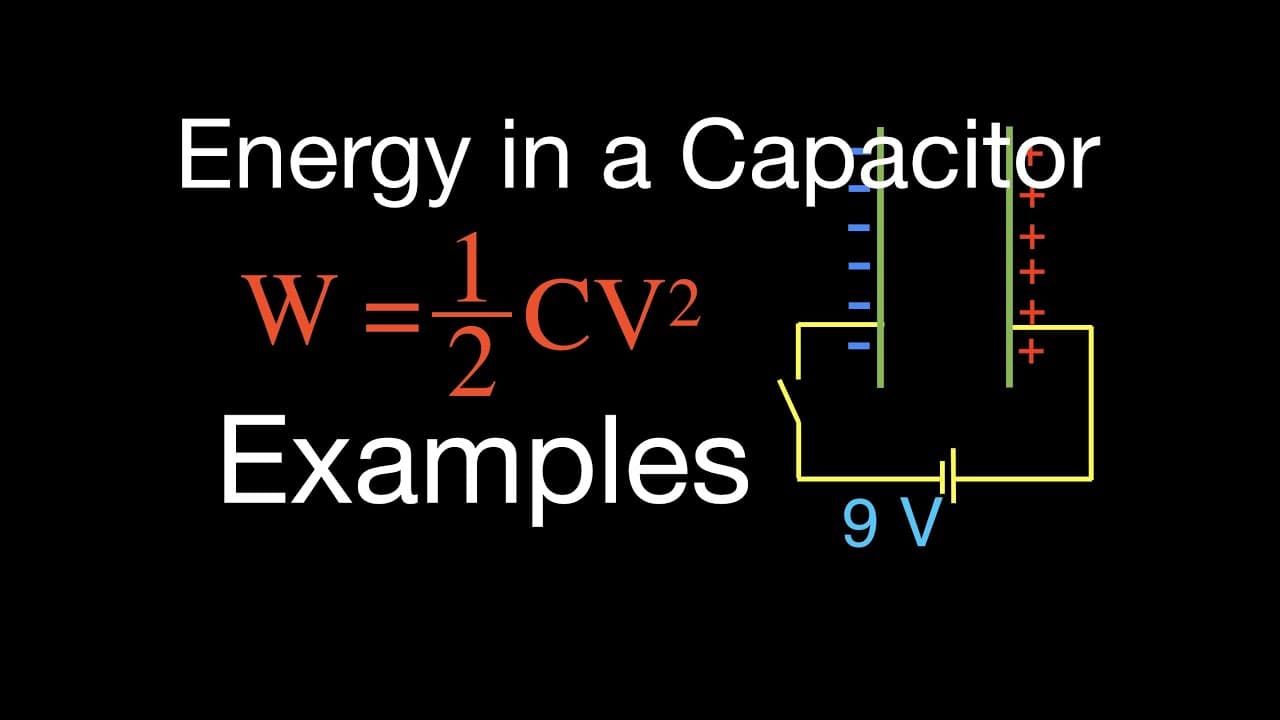
To calculate the energy stored in a capacitor, use the formula E = 1/2 CV^2, where C is capacitance and V is voltage. For example, a capacitor with a capacitance of 110 microfarads and a voltage of 330 volts stores 6 joules of energy. Understanding this is critical for applications in devices like cameras and defibrillators.
Transcript
okay interview I'm going to go over a few example problems for how we calculate the energy stored in a capacitor and I made a previous video where when I went to an explanation of how energy is store and what we mean by energy stored and how we derived the equations we're going to do a couple of example problems I think we're going to do three of t... Read More
Key Insights
- ⚡ Energy in capacitors is calculated using equations involving charge, voltage, and capacitance.
- 🏪 Capacitors store electric potential energy, equivalent to the work done to store charge.
- 🏪 Voltage affects the energy stored in capacitors significantly.
- 🎥 Different devices like cameras and defibrillators utilize capacitor energy for functions.
- 🪡 Calculating capacitance needed for energy storage is crucial for device operation.
- 🖐️ Capacitors play a crucial role in storing and delivering energy in various electronic devices.
- ❓ Understanding capacitor energy storage is fundamental in physics and electrical engineering.
Install to Summarize YouTube Videos and Get Transcripts
Explore YouTube Video Summarizer or Get YouTube Transcript Extractor
Questions & Answers
Q: How is energy stored in capacitors?
Energy is stored in capacitors as electrical potential energy, achieved by doing work to store charge on the plates.
Q: What equations are used to calculate work and energy stored in capacitors?
Equations like W = 1/2 * Q * V^2 and Q = C * V are used to calculate work and energy stored based on charge and voltage values.
Q: How does the voltage affect the energy stored in a capacitor?
The energy stored in a capacitor is proportional to the square of the voltage, meaning higher voltages lead to more energy stored.
Q: Why is it important to calculate energy stored in capacitors in devices like cameras and defibrillators?
Calculating energy stored helps in determining the capacity needed for devices to function efficiently and deliver the required output.
Summary & Key Takeaways
-
Explanation of how energy is stored in capacitors and deriving the equations.
-
Example problems solving for work and energy stored in capacitors using given values.
-
Applications of capacitor energy storage in devices like cameras and defibrillators.
Read in Other Languages (beta)
Share This Summary 📚
Summarize YouTube Videos and Get Video Transcripts with 1-Click
Try YouTube Summary with ChatGPT & Claude or YouTube Transcript Generator
Explore More Summaries from Step by Step Science 📚

Summarize YouTube Videos and Get Video Transcripts with 1-Click
Try YouTube Summary with ChatGPT & Claude or YouTube Transcript Generator