Why Do Schools Fail at Teaching Lifelong Learning?
TL;DR
Schools often fail because their competitive, test-focused structures conflict with their stated goals of literacy, collaboration, critical thinking, creativity, and lifelong learning. The lecture argues through game theory and a Shenzhen reform case that even successful innovations can provoke resistance when they disrupt routines, demand fairness, create short-term chaos, or challenge the interests of students, parents, teachers, and administrators.
Transcript
Okay, so welcome back to game theory and um as I discussed last class, our goal is able to is to use game theory to analyze global events to understand why they're happening as well as make certain predictions about how they should develop. But to do that, I first need to train your mind and how to and how to see the world using game theory. So las... Read More
Key Insights
- Schools are intended to build literacy, core competencies, and lifelong learning. Literacy enables people to absorb and convey information, while core competencies include critical thinking, cooperation, collaboration, and communication. Lifelong learning matters because school is only the beginning of an ongoing learning process.
- Many schools undermine their own educational mission by reducing reading, writing, attention, creativity, and enthusiasm for learning. The lecture claims that university professors increasingly assign short paragraphs or videos because students are unaccustomed to books and can lose focus during a long lecture.
- Competitive ranking can turn education into a perceived zero-sum game. When students believe that one person's advancement requires another person's loss, schools weaken the cooperation and collaboration they officially claim to teach, creating incentives that conflict with their stated educational goals.
- High-stakes examination culture can make learning feel like something students must escape. The lecture describes Chinese students completing the national entrance examination at age 18 and then tearing up or throwing away book pages as a symbolic celebration of liberation from studying and testing.
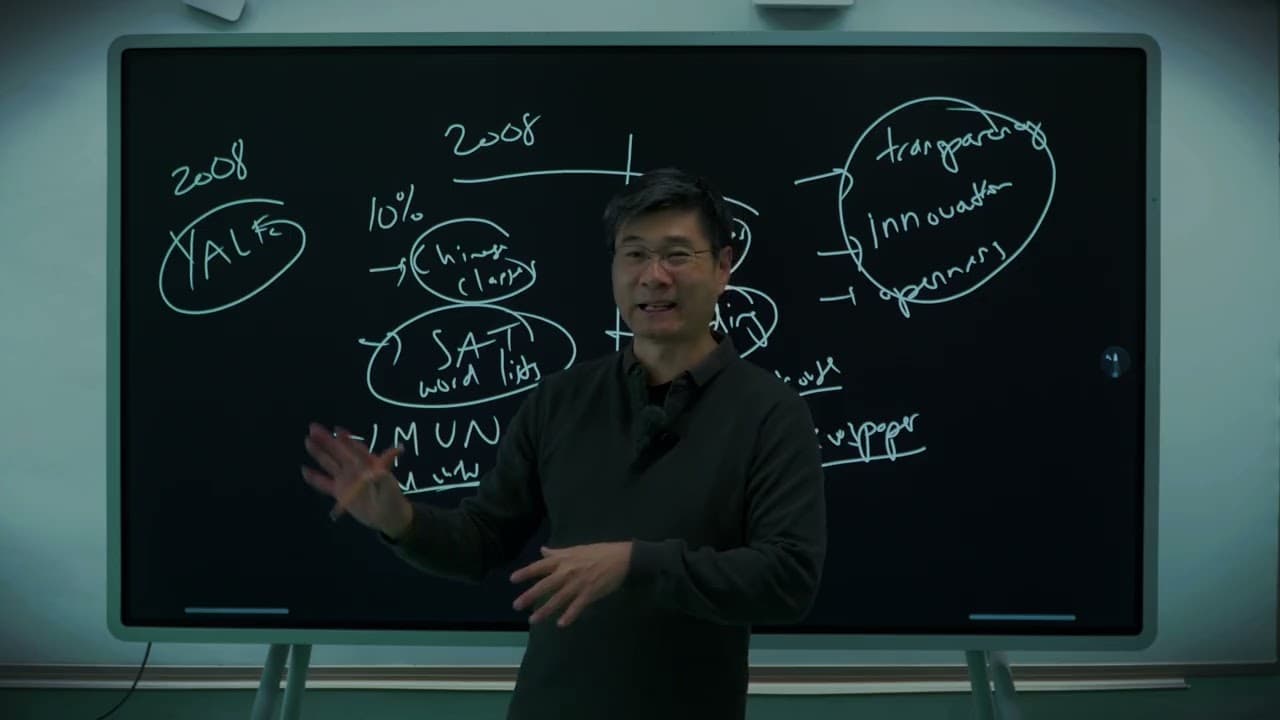
- The Shenzhen program initially relied on regular Chinese classes, SAT vocabulary memorization, and Model United Nations. Professor Jiang judged this preparation insufficient because students mainly took notes and tests, rarely debated or asked questions, did not read and write enough, and participated in an activity that offered little differentiation.
- Seminar teaching is presented as an alternative to passive classroom instruction. Groups of roughly 10 to 20 students discussed books they had read together, while a 5,000-book English library supported extensive reading and sought to help students experience the enjoyment of reading.
- Experiential activities can develop skills that classroom competition neglects. The student-run coffee house required teamwork, customer service, finance, and entrepreneurship, while the daily newspaper required students to collect information, report, write, edit, publish, and distribute an issue every day.
- Successful reform can still generate resistance when it changes incentives and expectations. Despite strong college admissions and recognition in South China, Professor Jiang was fired, welcomed out by teachers, parents, and students, and excluded from future management work after being described as a dictator for insisting on fairness.
Install to Summarize YouTube Videos and Get Transcripts
Explore YouTube Video Summarizer or Get YouTube Transcript Extractor
Questions & Answers
Q: Why do schools fail to achieve their stated goals?
Schools can fail when their operating incentives contradict their educational goals. They may claim to value literacy, critical thinking, creativity, collaboration, communication, and lifelong learning while emphasizing note-taking, tests, rankings, and competition. According to the lecture, these structures can reduce reading, discourage cooperation, shorten attention, and make students view learning as an obligation they want to escape.
Q: What are the three main purposes of school?
The lecture identifies literacy, core competencies, and lifelong learning as the three main purposes of school. Literacy includes reading and writing so people can absorb and convey information. Core competencies include critical thinking, cooperation, collaboration, and communication. Lifelong learning means enjoying learning and knowing how to continue learning independently because school begins the learning process rather than completing it.
Q: How can school competition undermine collaboration?
School competition can encourage students to interpret education as a zero-sum game in which one person's success requires another person's loss. Class ranking reinforces this perception by positioning classmates as rivals. This structure conflicts with the stated goal of teaching cooperation and collaboration because students may focus on getting ahead of peers instead of solving problems, sharing knowledge, or learning together.
Q: Why can examination culture make students dislike learning?
Examination culture can connect learning with pressure, repetition, and a single high-stakes endpoint rather than curiosity or continuing growth. The lecture describes students in China working until the national entrance examination at age 18, then tearing pages from their books and throwing them into the air. That symbolic liberation shows how schooling can make students want to avoid future books, tests, and learning.
Q: How did Professor Jiang change the Shenzhen curriculum?
Professor Jiang introduced small seminars in which approximately 10 to 20 students discussed books they had read together. He replaced SAT vocabulary-list memorization with substantial reading and established a 5,000-book English library. He also shifted extracurricular work away from Model United Nations toward activities that required students to run operations, publish work, collaborate, communicate, and take responsibility for real outcomes.
Q: What skills did the student-run coffee house teach?
The student-run coffee house gave participants direct experience with collaboration, customer service, finance, and entrepreneurship. Students had to operate a business, work as waiters, serve customers well, and coordinate their efforts. The lecture presents this activity as a practical way to develop competencies that conventional classes and competitive rankings often claim to value but may not effectively cultivate.
Q: How did the daily newspaper support student learning?
The daily newspaper required students to gather information, report events, write articles, edit material, publish an issue, and distribute it throughout the school every day. Students sometimes worked until midnight or 2 a.m. and then rose at 7 a.m. for delivery. The project developed writing, communication, collaboration, responsibility, and experience producing a concrete result under demanding deadlines.
Q: Why was Professor Jiang rejected despite the program's success?
Professor Jiang says he was fired even though the program became well known in South China and its students achieved strong college admissions, including admission to Yale, Wharton, and Cornell. Teachers, parents, and students were happy to see him leave, and he was later excluded from management work. He attributes the hostility partly to constant changes and his insistence on equal standards and hard work regardless of family identity.
Summary & Key Takeaways
-
Schools are supposed to develop literacy, core competencies, and lifelong learning, yet many produce the opposite results. Students read fewer books, struggle to sustain attention, compete through rankings, and may associate learning with exhausting examinations. The lecture frames this gap between educational goals and actual incentives as a game theory problem.
-
In 2008, Professor Jiang joined a Shenzhen middle school to build a program for students planning to study abroad. He replaced passive instruction and SAT vocabulary memorization with seminars, extensive reading, and a 5,000-book English library. His goal was to prepare students for university performance and life, not merely admission.
-
The reformed program added a student-run coffee house and daily newspaper to develop collaboration, communication, finance, entrepreneurship, reporting, writing, editing, and responsibility. Although the program gained strong admissions results and became well known in South China, Jiang was fired and widely disliked because his fairness requirements and constant changes disrupted existing expectations.
Read in Other Languages (beta)
Share This Summary 📚
Summarize YouTube Videos and Get Video Transcripts with 1-Click
Try YouTube Summary with ChatGPT & Claude or YouTube Transcript Generator
Explore More Summaries from Predictive History 📚




Summarize YouTube Videos and Get Video Transcripts with 1-Click
Try YouTube Summary with ChatGPT & Claude or YouTube Transcript Generator