Why Did Imperial China Become Less Innovative?
TL;DR
China became less creative after the Song dynasty because the Ming and Qing achieved national unity that protected the emperor and imperial bureaucracy while reducing openness and competition. Civil service examinations directed elite ambition toward mastering classical literary Chinese, while bureaucratic control over status, literacy, culture, and Confucian learning contributed to insularity and stagnation.
Transcript
okay good morning uh today we do China um obviously we are in China and we will we know a lot of Chinese history so I will go fairly quickly and deeply this is an opportunity for us to look back on the theories we've developed um over the course of this year and really think about how they apply to the Chinese context it's a chance for us to see if... Read More
Key Insights
- Chinese civilization developed along the Yellow River, whose agricultural suitability encouraged rapid population growth. The resulting conflicts contributed to the formation of settlements, fortified cities, states, civilization, and technology, connecting environmental conditions with the emergence of organized political authority.
- The Warring States period produced the intellectual foundations of Chinese civilization. Confucianism, Daoism, Legalism, the Hundred Schools of Thought, and Sun Tzu's Art of War emerged in an environment where decentralized states competed while continuing to trade, communicate, and intermarry.
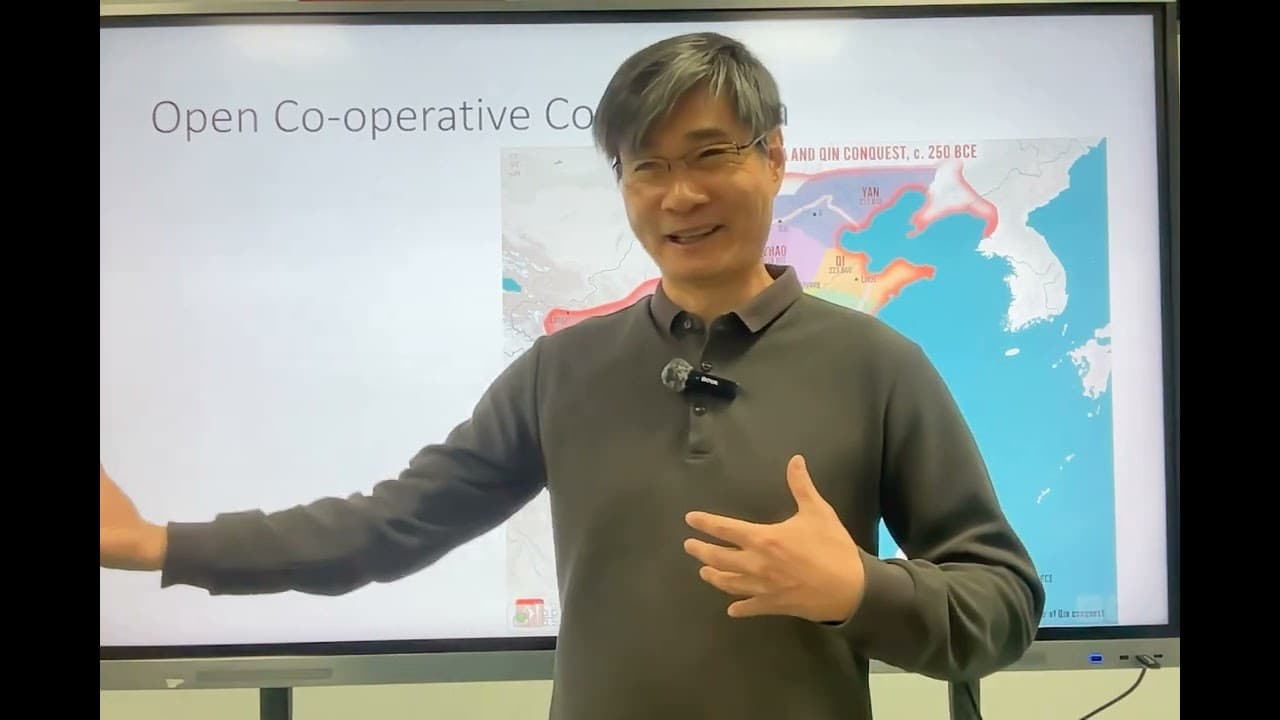
- Open, cooperative competition is presented as a major source of innovation. Openness meant the absence of one centralized authority, cooperation occurred through trade and social connections, and competition arose from persistent warfare among states seeking regional dominance.
- Regulated warfare protected the established social order because rival states and their elites still benefited from it. Shared culture, trade, communication, and intermarriage discouraged tactics that might unleash broader social revolution, even when such tactics could have weakened an enemy.
- The Qin succeeded by behaving as a revolutionary system on the margins of the existing order. It pursued total warfare, accepted talented contributors, adopted innovations for military conquest, and displayed the energy, ambition, openness, and opportunism needed to defeat wealthier rivals.
- Legalism strengthened Qin mobilization through strict laws and collective responsibility. Centralization, bureaucracy, and standardization then enabled the state to govern newly conquered territories and expand quickly, although the resulting system was sufficiently harsh to provoke rebellion after unification.
- The Han criticized the Qin while retaining much of its governing system. Han accounts describe book burning and buried scholars, although the lecture distinguishes confirmed heavy censorship and destruction of texts from the unverified claim that scholars were buried.
- Ming and Qing unity reduced the competitive conditions associated with earlier creativity. Civil service examinations focused local gentry ambition, classical literary Chinese required decades of mastery, and Confucian restrictions helped the imperial bureaucracy monopolize status, literacy, and culture.
- More videos from this channel:
- More from this channel: Predictive History
Install to Summarize YouTube Videos and Get Transcripts
Explore YouTube Video Summarizer or Get YouTube Transcript Extractor
Questions & Answers
Q: Why did China become less creative after the Song dynasty?
China became less creative after the Song dynasty because the Ming and Qing dynasties achieved a degree of national unity that earlier periods had not sustained. That unity promoted the longevity of the emperor and imperial bureaucracy, but it also reduced openness and competition. Bureaucratic control over status, literacy, culture, examinations, language, and Confucian learning made the country more insular and stagnant.
Q: How did the imperial bureaucracy limit innovation in China?
The imperial bureaucracy limited innovation by monopolizing status, literacy, and culture through three connected mechanisms. The civil service examination concentrated the energies and ambitions of local gentry. The examination required classical literary Chinese, a difficult language that demanded decades of study. Confucianism further restricted openness and innovation, directing talented people toward established imperial standards rather than competing intellectual paths.
Q: What was open, cooperative competition during the Warring States period?
Open, cooperative competition described a political environment without one centralized authority. The states remained connected through trade, communication, and intermarriage, which supplied the cooperative element, but they also fought for regional dominance. According to the lecture's model, this combination generated new ideas, technologies, values, and cultural traditions that shaped Chinese civilization for the following two thousand years.
Q: Why did the Warring States period produce major schools of thought?
The Warring States period produced major schools of thought because numerous connected states faced intense competition without being controlled by a single central authority. Their communication and exchange allowed ideas to circulate, while warfare created pressure for better political, ethical, and strategic systems. This environment generated the Hundred Schools of Thought, including Confucianism, Daoism, and Legalism, as well as Sun Tzu's Art of War.
Q: How did the Qin defeat richer and more developed rival states?
The Qin defeated stronger-looking rivals by combining greater energy and ambition with openness to useful innovations and talented outsiders. It opportunistically rejected the restrained warfare practiced by states invested in the existing order. Legalism, collective responsibility, centralized bureaucracy, standardization, and total warfare organized the entire society around conquest, while administrative capacity allowed rapid expansion and government of captured territory.
Q: Why was warfare regulated before Qin unification?
Warfare was regulated because competing states remained tied together by trade, communication, intermarriage, shared culture, and elite interests. They used war to negotiate power within the established social order rather than to destroy that order. The lecture illustrates this attitude with stories of commanders avoiding advantageous but ungentlemanly actions and compares it with Athens and Sparta declining tactics that could provoke wider social revolution.
Q: What role did Legalism play in the Qin state?
Legalism provided the Qin with strict laws designed to compel behavior and organize society for warfare. One important principle was collective responsibility, under which punishment for a crime could extend to the offender's entire family. Combined with centralization, bureaucracy, standardization, and total mobilization, this system increased military and administrative power, but its harshness also contributed to rebellions after China was unified.
Q: How did the Han dynasty relate to the Qin system?
The Han dynasty publicly disparaged the Qin but continued the governing system that Qin unification had introduced. Han historians shaped later images of the Qin by reporting book burning and the burial of scholars. The lecture accepts that the Qin practiced heavy censorship and destroyed many texts from the Hundred Schools of Thought, but it states that the burial of scholars is not established as fact.
Summary & Key Takeaways
-
Chinese civilization developed around the Yellow River, where favorable agricultural conditions supported population growth, conflict, fortified settlements, state formation, and technological development. During the Warring States period, decentralized but interconnected states generated the Hundred Schools of Thought, including Confucianism, Daoism, and Legalism, through open, cooperative competition.
-
The Qin rose from a poor and culturally less developed frontier position by combining ambition, openness to talented outsiders, opportunism, Legalism, centralization, standardization, bureaucracy, and total warfare. Its revolutionary system defeated states whose regulated warfare largely preserved an existing social order supported by trade, communication, intermarriage, and shared elite interests.
-
After unification, imperial institutions increasingly favored stability and longevity over creative competition. The Ming and Qing bureaucracy monopolized status, literacy, and culture through civil service examinations, difficult classical literary Chinese, and Confucian restrictions. These mechanisms absorbed the ambitions of local gentry while making a highly unified China more insular and stagnant.
Read in Other Languages (beta)
Share This Summary 📚
Summarize YouTube Videos and Get Video Transcripts with 1-Click
Try YouTube Summary with ChatGPT & Claude or YouTube Transcript Generator
Explore More Summaries from Predictive History 📚





Summarize YouTube Videos and Get Video Transcripts with 1-Click
Try YouTube Summary with ChatGPT & Claude or YouTube Transcript Generator