How Did Muhammad Launch a Global Revolution?
TL;DR
Muhammad united divided Arabian groups through monotheism, shared Abrahamic ancestry, religious tolerance, justice, and the promise of reclaiming land associated with Abraham. The movement expanded rapidly because revolutionary faith energized its followers while the Byzantine and Sasanian empires had been weakened by plague, prolonged war, and succession struggles.
Transcript
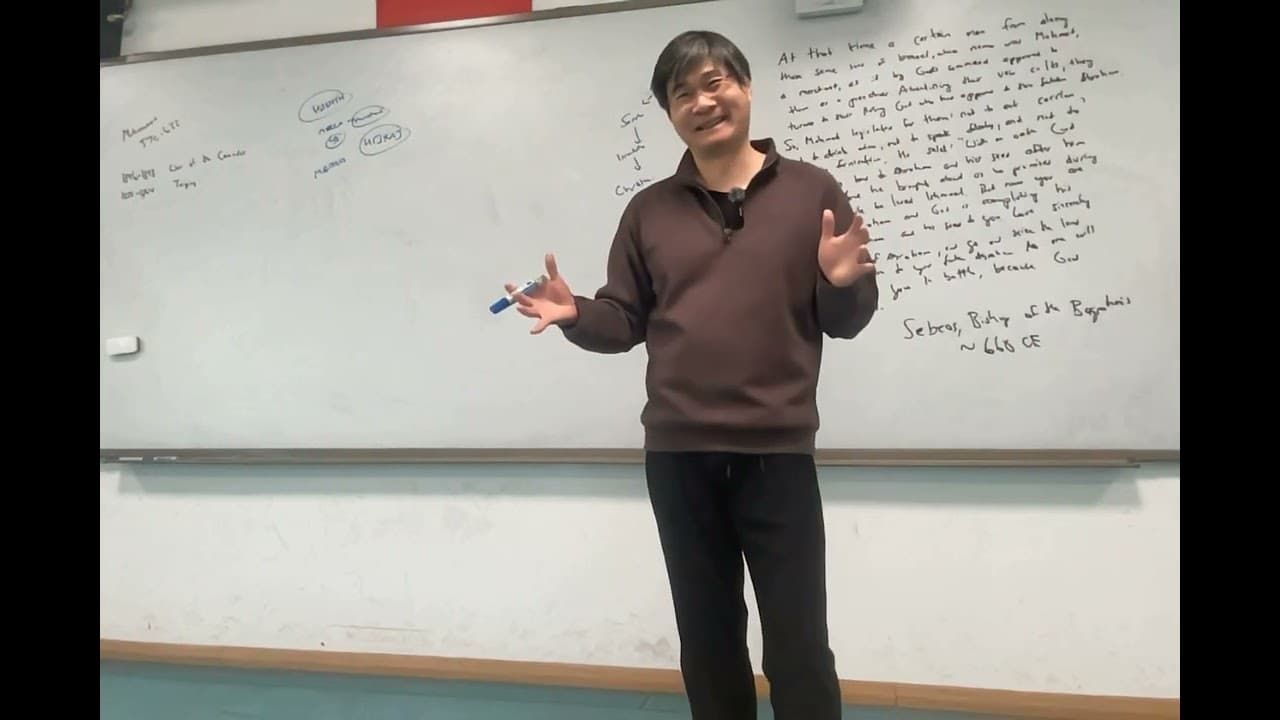
okay good morning um so we are doing Muhammad and the r of Islam Today Muhammad um as you know is one of the most important and influential figures in human history he is as important as Jesus um but ironically we actually don't know that much about Muhammad in fact fact we probably know more about Jesus than we know about Muhammad with Jesus at le... Read More
Key Insights
- Evidence about the historical Muhammad is limited because few early written sources survive, the Quran says little about him directly, and archaeology at Mecca and Medina is restricted by their status as Islam’s two holiest sites.
- An early Christian bishop described Muhammad roughly twenty or thirty years after his death in 632 CE as a merchant, preacher, and legislator who led Arabs away from polytheistic worship toward the God associated with Abraham.
- Shared descent from Abraham is central to the lecture’s interpretation of Muhammad’s message. Arabs descend from Abraham through Hagar and Ishmael, while Israelites descend through Sarah, making Muslims, Jews, and Christians members of one extended religious family.
- The Hijra is Muhammad’s migration with his followers from Mecca to Medina after thirteen years of rejected preaching. The event begins the Islamic calendar and marks the transition from a marginalized religious mission to an organized community with political authority.
- The Constitution of Medina is presented as an agreement guaranteeing freedom of religious expression without prejudice. Muhammad entered Medina as an invited arbiter among competing tribes, including a Jewish tribe, before his community attracted more followers and developed military power.
- Arabia is portrayed as a center of innovation rather than merely a primitive desert. Trade encouraged openness and cosmopolitan experience, tribal conflict cultivated courage and martial honor, and imperial religious persecution brought diverse dissident communities into the peninsula.
- The Byzantine and Sasanian empires appeared powerful but were weakened by decades of plague, warfare, and succession disputes. Their internal fragility helped a newly united Arabian movement defeat them and build territory stretching from Spain to India within less than a century.
- The Taiping Rebellion demonstrates the lecture’s historical analogy for Islam’s rise. A new religious movement nearly conquered China because faith and revolutionary zeal motivated ordinary fighters to risk death, although British intervention ultimately supported the Qing Dynasty.
- More videos from this channel:
- More from this channel: Predictive History
Install to Summarize YouTube Videos and Get Transcripts
Explore YouTube Video Summarizer or Get YouTube Transcript Extractor
Questions & Answers
Q: Who was the historical Muhammad according to the lecture?
Muhammad is presented as a real seventh-century merchant, preacher, political leader, and founder of the Islamic tradition, although the surviving evidence about him is limited. Traditional accounts say he was born in Mecca in 570, received revelations through Gabriel at age forty, preached monotheism, migrated to Medina, united Arabian groups, and died in 632 CE.
Q: Why is so little known about the early history of Islam?
The lecture attributes the uncertainty to a shortage of early written records and limited archaeological investigation. The Quran does not provide an extensive biography of Muhammad, while many familiar stories come from Hadith, meaning oral traditions passed between generations. Archaeological work is also limited because Mecca and Medina are the two holiest sites in the Islamic tradition.
Q: What message did Muhammad preach to the Arabs?
Muhammad’s message, as presented in the lecture, called Arabs to abandon polytheism and return to the worship of the living God associated with Abraham. He taught that Arabs descended from Abraham through Ishmael and therefore belonged to the same religious family as Jews and Christians. The movement also emphasized moral rules, justice, tolerance, and collective religious purpose.
Q: Why is Abraham important to Muhammad’s movement?
Abraham provides the common ancestry connecting Arabs, Jews, and Christians in the lecture’s interpretation. Hagar bore Abraham’s son Ishmael, identified as the ancestor of the Arabs, while Sarah later bore the line associated with the Israelites and Christians. This genealogy supported the claim that Arabs shared in God’s covenant and promise of land to Abraham’s descendants.
Q: What was the Hijra and why was it important?
The Hijra was Muhammad’s migration with his followers from Mecca to Medina after thirteen years of unsuccessful preaching in Mecca. Medina’s tribes invited him to arbitrate their disputes, giving his movement a new political and social foundation. The migration is treated as the beginning of the Islamic tradition and marks year zero in the Islamic calendar.
Q: What did the Constitution of Medina establish?
The Constitution of Medina is described as an agreement created after Muhammad arrived to judge disputes among the city’s tribes, one of which was Jewish. It promised freedom of religious expression and rejected religious prejudice. In the lecture’s account, this arrangement embodied Muhammad’s proposed Kingdom of God, which emphasized tolerance and justice while uniting previously competing communities.
Q: How did Islam defeat the Byzantine and Sasanian empires?
The lecture argues that Islamic expansion combined internal Arabian strengths with imperial weakness. Traders had made Arabs open-minded and cosmopolitan, tribal warfare had produced courageous fighters, and religious diversity had encouraged innovation. Muhammad then united competing groups through a shared faith and revolutionary mission, while plague, long wars, and succession struggles had left the Byzantine and Sasanian empires fragile.
Q: How does the Taiping Rebellion help explain Islam’s rise?
The Taiping Rebellion serves as an analogy showing how a new religion can become a powerful revolutionary force under favorable social, economic, and historical conditions. Hong Xiuquan built a movement after believing himself to be Jesus’s younger brother, and his followers nearly overthrew the Qing Empire. Their religious devotion and revolutionary zeal encouraged exceptional commitment in battle.
Summary & Key Takeaways
-
The lecture separates the historical Muhammad from later Islamic tradition because contemporary evidence is limited. It cites an early Christian bishop, the Quran’s emphasis on figures such as Moses, and orally transmitted Hadith accounts while asking what Muhammad believed, why Islam triumphed, and why its earliest history remains difficult to reconstruct.
-
Traditional accounts describe Muhammad as a Meccan merchant who received revelations through Gabriel at age forty, preached monotheism for thirteen years, and migrated to Medina after rejection in Mecca. In Medina, he served as an arbiter, established a constitution promising religious freedom, gained followers, and eventually united the Arabian Peninsula.
-
The lecture presents Islam as the first global revolution, combining religious devotion with a program of tolerance and justice. Arabia supplied cosmopolitan traders, experienced warriors, and persecuted religious communities, while the Byzantine and Sasanian empires were weakened. The Taiping Rebellion illustrates how revolutionary faith can mobilize unlikely imperial challengers.
Read in Other Languages (beta)
Share This Summary 📚
Summarize YouTube Videos and Get Video Transcripts with 1-Click
Try YouTube Summary with ChatGPT & Claude or YouTube Transcript Generator
Explore More Summaries from Predictive History 📚



Summarize YouTube Videos and Get Video Transcripts with 1-Click
Try YouTube Summary with ChatGPT & Claude or YouTube Transcript Generator