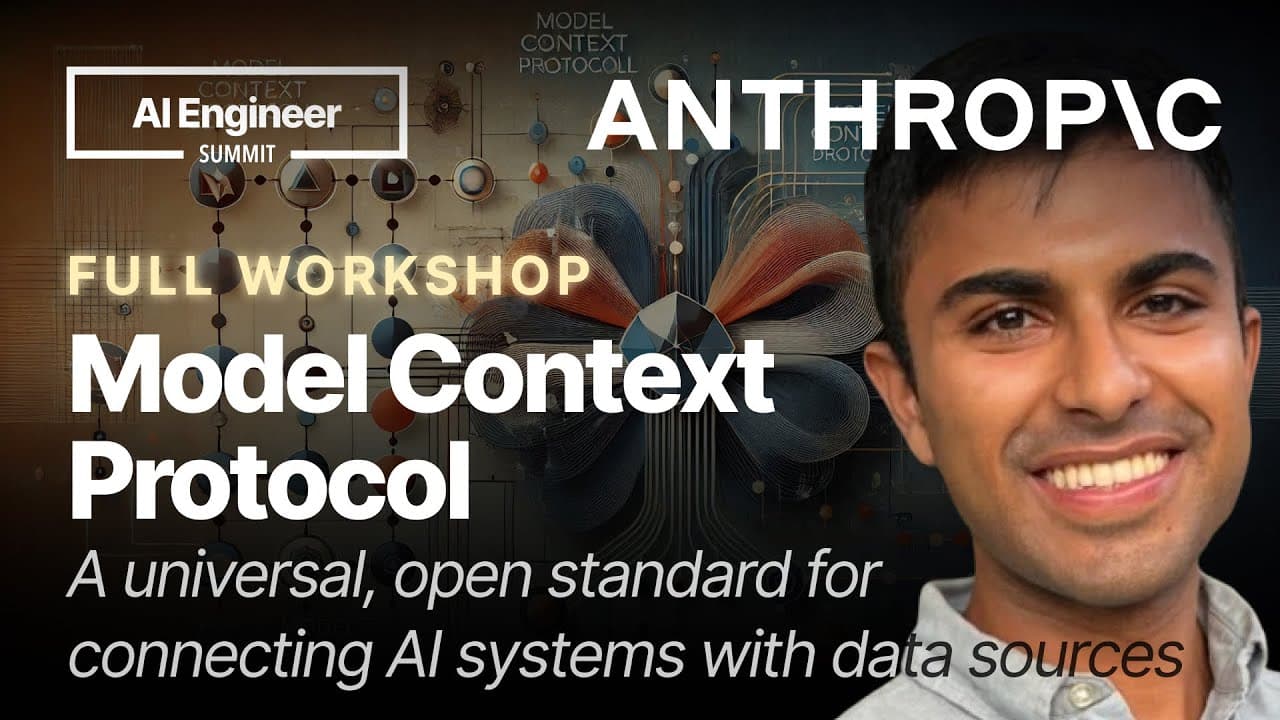
How Do You Build Agents with Model Context Protocol? Full Workshop with Anthropic’s Mahesh Murag
TL;DR
MCP connects AI agents to external data by placing a standard protocol between compatible client applications and servers that expose prompts, tools, and resources. Clients can connect to compatible servers with zero additional integration work, while providers can build one MCP server for use across multiple applications. The workshop explains how this reduces fragmented integrations and enables more context-rich systems. Read on to understand each interface and its practical role.
Transcript
hey everyone hello thank you all for coming uh my name is mahes and I'm on the applied AI team at anthropic um really excited to see a very full room and very excited that you chose me over open AI thank you very much so today we're going to be talking about mCP model context protocol um this is more of a talk than a workshop but I'll do my best to... Read More
Key Insights
- • MCP is an open protocol that standardizes how AI applications and agents connect to external tools and data sources, addressing the fragmented custom implementations that previously required each team or application to build its own integration logic.
- • Model performance is strongly shaped by the context supplied to it, and direct connections to relevant systems can make AI applications more powerful and personalized than workflows that depend on users manually copying, pasting, or typing information.
- • MCP is partly inspired by the Language Server Protocol, which lets compatible development environments connect to language-specific tooling through a standard interface instead of requiring a separate implementation for every combination of editor and programming language.
- • MCP clients are AI applications or agents that invoke tools, query resources, and interpolate prompts, while MCP servers expose those capabilities and data through standardized interfaces that any compatible client can consume.
- • MCP tools are model-controlled capabilities, meaning the server describes available tools and the language model decides when invoking them is appropriate. Tools can retrieve information, send data, update databases, or write files on a local system.
- • MCP resources are application-controlled data exposed by a server, meaning the client determines how to use them. Resources can include images, text files, JSON records, attachments, static files, or dynamic structures created from information supplied by the application.
- • MCP reduces the many-to-many integration problem by placing one shared protocol between application developers and tool or API providers. A compatible client can connect to different servers, while a provider can build one server for adoption across multiple applications.
- • Enterprise adoption can separate infrastructure ownership from AI application development. One team can maintain an MCP server for a vector database or retrieval system, document its interfaces, and let other teams use that shared capability without rebuilding access, prompting, or chunking logic.
Install to Summarize YouTube Videos and Get Transcripts
Explore YouTube Video Summarizer or Get YouTube Transcript Extractor
Questions & Answers
Q: How does MCP connect AI agents to external data?
MCP provides a standard interface between AI client applications and servers that expose relevant systems, tools, and data. A compatible client can query resources, invoke tools, and use prompts supplied through the protocol, avoiding a separate custom integration for every system.
Q: What is the Model Context Protocol?
The Model Context Protocol, or MCP, is an open protocol for integrating AI applications and agents with tools and data sources. It standardizes how AI applications interact with external systems through prompts, tools, and resources.
Q: Why did Anthropic create MCP for AI applications?
Anthropic saw teams building fragmented custom implementations with different prompt logic, tool definitions, data-access methods, and access controls. MCP was created to provide a shared layer for connecting models to context, making applications more powerful and personalized than workflows based on copying, pasting, or typing information.
Q: How does MCP reduce the many-to-many integration problem?
MCP places one shared protocol between AI application developers and tool or API providers. Once a client is MCP compatible, it can connect to compatible servers with zero additional work, while a provider can build one server for adoption across multiple applications.
Q: What are the three primary interfaces in MCP?
MCP defines three primary interfaces: prompts, tools, and resources. Client applications can interpolate prompts, invoke tools, and query resources, while servers expose these capabilities and data through a standardized interface.
Q: How do MCP tools work in an AI agent?
MCP tools are model-controlled capabilities exposed by a server. The server describes the available tools, and the language model decides when to invoke them; examples include retrieving or sending information, updating a database, acting in a remote service, and writing local files.
Q: What are MCP resources, and who controls them?
MCP resources are data objects exposed by a server and controlled by the client application. They can include images, text files, JSON records, attachments, static files, or dynamically generated data structures, with the application deciding how to use them.
Q: What systems can an MCP server expose to an AI agent?
An MCP server can wrap databases for querying records, remote services such as Salesforce for reading and writing data, and local capabilities such as version control, Git, and file operations. It can also expose vector databases or retrieval systems so teams can share access, prompting, and chunking logic.
Summary & Key Takeaways
-
Model Context Protocol is an open standard designed to connect AI applications and agents with relevant tools and data sources. Inspired partly by the Language Server Protocol, MCP creates a shared layer between client applications and servers, reducing the fragmented custom implementations previously used to provide models with context and capabilities.
-
MCP defines three primary interfaces: tools, resources, and prompts. Models decide when to invoke server-exposed tools, while applications control how exposed resources are used. These interfaces can support data retrieval, actions in remote services, database updates, local file operations, attachments, images, text files, JSON, and dynamically generated data structures.
-
MCP can benefit application developers, tool providers, end users, and enterprises. Compatible clients can connect to compatible servers without new custom integrations, while server builders can expose a system once for use across applications. Enterprises can assign teams to maintain shared interfaces, enabling other teams to build context-rich AI applications more independently.
Read in Other Languages (beta)
Share This Summary 📚
Summarize YouTube Videos and Get Video Transcripts with 1-Click
Try YouTube Summary with ChatGPT & Claude or YouTube Transcript Generator
Explore More Summaries from AI Engineer 📚


Summarize YouTube Videos and Get Video Transcripts with 1-Click
Try YouTube Summary with ChatGPT & Claude or YouTube Transcript Generator