How to build RAG agents with filters and SQL in n8n
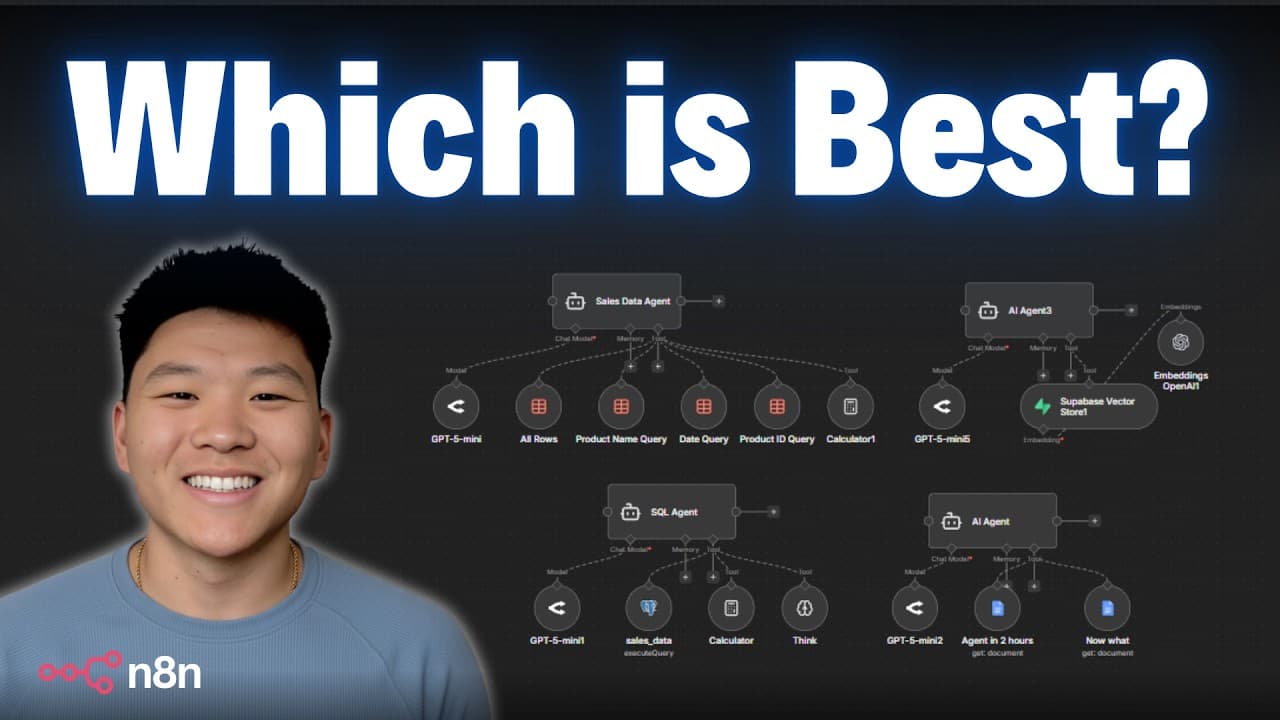
TL;DR
Three practical retrieval methods fix RAG agents: use filters to narrow context in tabular data, apply SQL queries to pass full structured context, and rely on vector search only when semantic matching is needed. Each method has clear use cases, limits, and setup steps to improve accuracy and efficiency in n8n.
Transcript
One of the most common questions I get is basically some form of, "Hey Nate, my agent is not answering me correctly. How do I fix it?" And I usually take a deep breath and say, "Oh boy, I've got a lot of questions." There are so many different levers to pull and there are so many different ways you can optimize agents to do different things. And it... Read More
Key Insights
- Chunk based retrieval can cause context loss because it only returns the most relevant chunks rather than entire documents.
- Filters allow explicit field based querying in tabular data, which is fast, cheap, and scalable to large data sets.
- SQL based context passes complete structured data to the agent, enabling more accurate calculations and summaries.
- Knowing the data schema is crucial for constructing effective queries and avoiding mismatches.
- Vector databases are useful for semantic search when whole document context matters, but come with tradeoffs like missing full document provenance.
- Designing prompts and constraints helps agents apply the correct filtering or querying strategy for each data source.
- Understanding the end goal guides whether to use filters, SQL, or vector search for RAG tasks.
- The speaker provides practical examples in Nadn and Postgres to illustrate when each method is appropriate.
Install to Summarize YouTube Videos and Get Transcripts
Explore YouTube Video Summarizer or Get YouTube Transcript Extractor
Questions & Answers
Q: How to implement filters for RAG in a tabular data scenario in n8n
Filters work by narrowing the dataset to rows that meet explicit criteria such as product name and date. This approach is fast, cheap, and scales well for structured data. Use it when the information can be answered by a subset of records and you want to avoid pulling the whole table into memory. Think of it as applying spreadsheet style filters in a database context.
Q: What is the advantage of using SQL queries for RAG in n8n
SQL queries allow the agent to operate on full and structured context by querying the database and aggregating results before passing them to the agent. This reduces token usage and improves accuracy for calculations like totals or averages across multiple columns. It is ideal when questions require more complex data relationships than simple filters can provide.
Q: When should vector search be used in a RAG workflow in n8n
Vector search is most appropriate when semantic matching is essential and chunk based retrieval would lose important context. It is useful for retrieving passages from large documents where you need flexible matching that goes beyond exact field filters or straightforward SQL. However, it may not preserve full document provenance without additional metadata handling.
Q: What is chunk based retrieval and why can it cause problems
Chunk based retrieval splits documents into pieces and searches those pieces. This can lead to context loss because the agent may only see fragments of the document and miss overall structure or critical connections between sections. As a result, answers can be incomplete or hallucinated if full context is not considered.
Q: How should one prepare data for a filter based approach in n8n
Prepare data by ensuring the schema is explicit and stable, with clear field names and formats. Provide the agent with exact value lists for fields like product names and date formats to avoid misinterpretation. This disciplined setup helps the agent apply precise filters and return accurate results with minimal data transfer.
Q: What role does data schema awareness play in SQL based RAG
Schema awareness is essential because the agent relies on column names and data types to construct valid queries. Knowing the table structure allows you to reference correct columns, join related tables if needed, and produce meaningful aggregations. This reduces errors and ensures that results reflect the actual data model.
Q: How do you decide which method to use for a given question
Start with the end goal and assess data structure. If the data is tabular and the question can be answered from a subset of rows, use filters. If a full and precise calculation across records is required, use SQL. If semantic matching across large documents is needed and context can be preserved, consider vector search with metadata.
Q: What are best practices for prompting when using these methods in n8n
Provide explicit instructions about valid values, formats, and filtering rules. Normalize input data to match schema expectations and supply sample queries that illustrate common use cases. Clearly separate data retrieval logic from reasoning steps and include metadata to help track provenance and reduce ambiguity in results.
Summary & Key Takeaways
-
Using filters in a tabular data context narrows the dataset to relevant rows, making results faster and cheaper while reducing hallucinations.
-
SQL queries can provide full structured context to the agent by querying the database directly and aggregating results before the agent processes them.
-
Vector search should be reserved for cases where semantic matching adds value and when chunk based retrieval would otherwise lose important global context.
Read in Other Languages (beta)
Share This Summary 📚
Summarize YouTube Videos and Get Video Transcripts with 1-Click
Try YouTube Summary with ChatGPT & Claude or YouTube Transcript Generator
Explore More Summaries from Nate Herk | AI Automation 📚






Summarize YouTube Videos and Get Video Transcripts with 1-Click
Try YouTube Summary with ChatGPT & Claude or YouTube Transcript Generator