How Higgsfield Hit $1B ARR and Scaled AI Spend
TL;DR
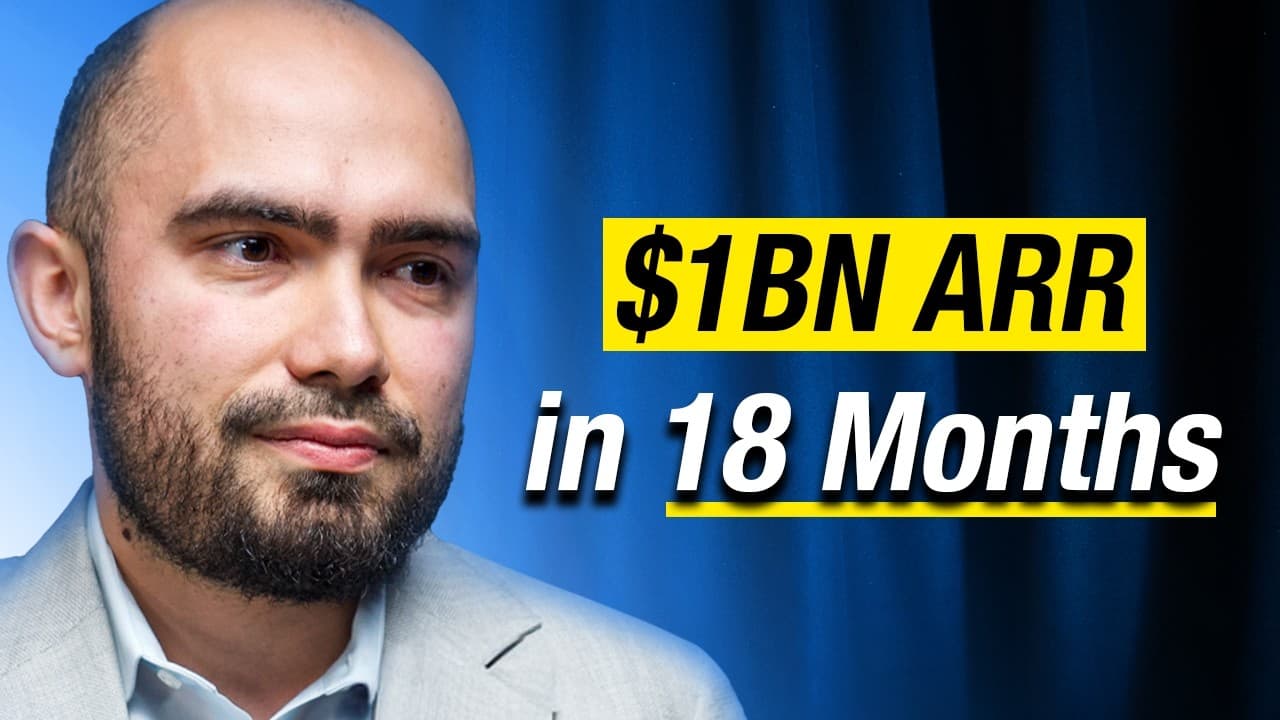
Higgsfield achieved rapid scale by focusing on product-led growth and solving camera control in AI for social media. The team burned significant funds during early pivots but found product-market fit after listening to eight creative directors and prioritizing user control over AI footage. The result was a fast rise to over a billion dollars in ARR with substantial monthly AI model spend.
Transcript
On average at Hicksfield, person on the team spends over $10,000 a month on various models. So internal usage of models a month is over 4 million. Hicksfield. This is the story that no one has told in startups yet. The company has just hit a billion in revenue. It is the fastest growing company in consumer land to hit this milestone. It even surpas... Read More
Key Insights
- Higgsfield spends over $4M per month on AI models, indicating the scale of model usage inside the business.
- Product-market fit arrived quickly once the team focused on camera control and storytelling within AI video creation.
- The founder emphasizes a pivot from hype to customer-led development, ultimately prioritizing a great product over paid or influencer-driven growth.
- Early entrepreneurship involved burning money and facing delusion before a decisive shift to PLG and customer interviews.
- The company believes that a strong moat can exist through effective AI tooling for brands, even as the market shifts toward open models.
- Higgsfield’s growth is framed as one of the fastest in consumer AI, second only to OpenAI and Anthropic in ARR scale in the context used.
- The leadership discussion highlights the importance of owning distribution and avoiding reliance on external marketing channels.
Install to Summarize YouTube Videos and Get Transcripts
Explore YouTube Video Summarizer or Get YouTube Transcript Extractor
Questions & Answers
Q: A real search query question about the video (e.g. 'How to...', 'What is...', 'Why does...', 'When should...'). Question 1
How did Higgsfield achieve rapid growth to $1B ARR and what were the turning points in its trajectory? Higgsfield reached $1B ARR by refocusing on a product driven approach after initial pivots failed to deliver, listening to eight creative directors about missing features like camera control, and committing to a PLG model without paid marketing. This shift emphasized a high quality product and direct customer feedback, which catalyzed user adoption and scale.
Q: What was the initial challenge before Product Led Growth (PLG) took hold at Higgsfield?
Before PLG took hold, Higgsfield burned through more than $10M out of $16M raised in seed funding, and they spent over a year searching for a viable product. The team realized they were chasing hype rather than solving a core customer problem, which led to a strategic pivot to prioritize product quality, customer input, and direct user experiences.
Q: How does Higgsfield approach distribution and marketing according to the interview?
Higgsfield emphasizes owning distribution and avoiding paid marketing. They state that they do not rely on paid acquisition and instead focus on product-led growth, customer feedback, and authentic word of mouth. This approach is intended to build durable demand without the volatility of paid channels, leveraging strong product experiences to drive growth.
Q: What was the significance of camera control in Higgsfield’s AI video tools?
Camera control emerged as a critical bottleneck when eight creative directors described what was missing in AI production. By solving camera control, Higgsfield created a capability that better enables storytelling in AI-generated videos, addressing a key gap between automated generation and user-directed cinematic quality, which contributed to rapid product-market fit.
Q: What does the transcript say about Higgsfield’s early model and founder background?
The founder, Alex Mashrabov, comes from a background in competitive programming in Kazakhstan and later built a company that was sold to Snap for $166M. This experience in high-growth tech and the insights from Silicon Valley influenced Higgsfield’s approach to scaling and distribution, emphasizing meritocracy, real product impact, and strategic pivots away from hype.
Q: What lessons does Higgsfield highlight about spending vs value creation in AI startups?
Higgsfield notes that excessive early spending without clear product-market fit can be detrimental, citing their burn of over $10M before finding traction. The lesson is to invest strategically in capabilities that directly address customer needs, such as camera control for AI video, and to validate product-market fit before aggressively scaling marketing spend.
Q: How does Higgsfield view the role of open models versus proprietary models?
Higgsfield acknowledges the cost structure differences between open models and closed, proprietary models, noting margins of 80% on open models versus 20-30% on closed models. This viewpoint underlines a strategic consideration: leveraging open models where feasible to optimize margins while developing unique, defensible capabilities for differentiation.
Q: What are Higgsfield’s aspirations for the future, according to the interview?
Higgsfield expresses belief that it can become a multi-hundred-billion-dollar company by continuing to scale, investing in AI tooling for brands, and maintaining a focus on product-led growth and durable distribution. The interview frames these ambitions within a competitive landscape where Europe can compete with Silicon Valley for AI talent and innovation.
Summary & Key Takeaways
-
Higgsfield pivoted from an earlier startup and found traction by prioritizing camera control in AI to tell stories, leading to rapid growth and ARR over $1B.
-
The company spent heavily in the early phase, burning over $10M before achieving product-market fit, then shifted to a product-led growth model with strong customer feedback.
-
Higgsfield emphasizes owning distribution, avoiding paid growth, and leveraging influencer strategies carefully, while aiming to build proprietary advantages and scale with open models where possible.
Read in Other Languages (beta)
Share This Summary 📚
Summarize YouTube Videos and Get Video Transcripts with 1-Click
Try YouTube Summary with ChatGPT & Claude or YouTube Transcript Generator
Explore More Summaries from 20VC with Harry Stebbings 📚

Summarize YouTube Videos and Get Video Transcripts with 1-Click
Try YouTube Summary with ChatGPT & Claude or YouTube Transcript Generator