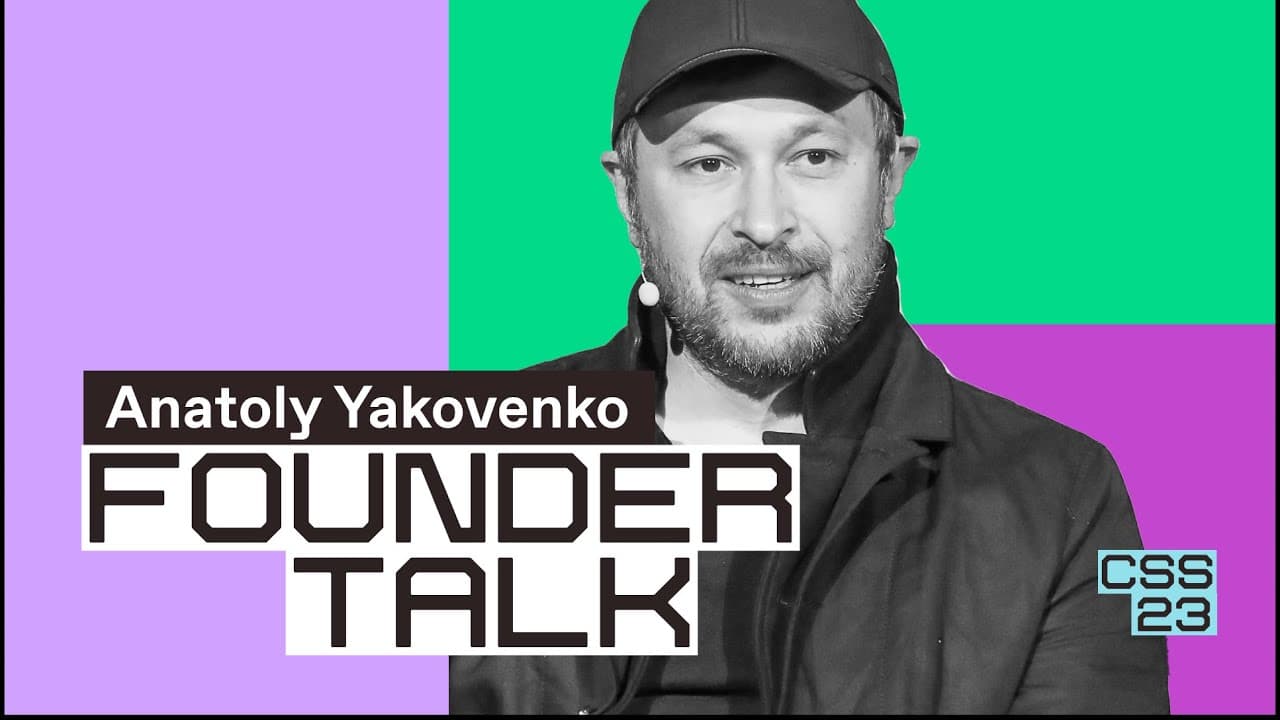
How Anatoly Yakovenko built Solana
TL;DR
Anatoly Yakovenko built Solana after connecting his Qualcomm experience in wireless systems with a way to encode the passage of time as a data structure. Bitcoin fees of roughly $60–$70 per transaction pushed him to investigate scalability, while his operating-system background convinced him that smart-contract platforms could become important developer ecosystems. Read on for the technical insight, career experience, and co-founder relationships behind Solana’s creation.
Transcript
thank you thank you Jeff I'm Anatoly I find that everyone in crypto has some interesting story for how they first fell down the rabbit hole will you tell us yours and perhaps how your prior background at Qualcomm had influenced the way you saw crypto and why it mattered yeah for sure yeah first first of all thank you for having me so I kind of hear... Read More
Key Insights
- 🫚 Solana's roots in GPU mining and deep learning systems shaped its focus on scalability and performance from the start.
- 🏍️ Anatoly emphasizes the importance of balancing innovation with stability and scalability, especially during market cycles.
- 😫 Solana's approach to building relationships, fostering developer communities, and prioritizing product-market fit sets it apart in the blockchain space.
- 🚗 Explore partnerships with giants like Apple while focusing on mobile-first adoption and decentralized moderation for wide industry impact.
- 😒 Solana's focus on social finance, gaming, and payments showcases potential use cases for broadening blockchain adoption.
- ✋ Leveraging Rust and LLVM, Solana bridges the gap between Ethereum compatibility and high-performance blockchain features.
- 🏍️ Anatoly's advice for builders focuses on seizing opportunities in challenging market cycles, fostering community support, and prioritizing real product signals over growth hype.
Install to Summarize YouTube Videos and Get Transcripts
Explore YouTube Video Summarizer or Get YouTube Transcript Extractor
Questions & Answers
Q: How did Anatoly Yakovenko build Solana?
Yakovenko connected a data structure representing the passage of time with time division multiple access, a technique familiar from his work in wireless systems. He believed this could prevent simultaneous block production from leaving a network in a noisy state and enable a fast network. His operating-system experience and Ethereum’s smart-contract ecosystem then persuaded him to quit his job and pursue the idea.
Q: How did Anatoly Yakovenko first become interested in cryptocurrency?
He heard about Bitcoin shortly after the 2008 crisis and initially wanted to build a GPU-accelerated miner. His first direct experience included ordering an ASIC whose maker delayed shipment for six months while using its mining advantage. He found crypto interesting but did not take it seriously until around 2017.
Q: What problem inspired the idea behind Solana?
Yakovenko was investigating why proof of work was necessary and why Bitcoin could have high fees. When fees rose to roughly $60–$70 per transaction, even the Bitcoin conference stopped accepting Bitcoin as payment. That experience contributed to a late-night realization that passage of time could be encoded as a data structure.
Q: How did Qualcomm influence Anatoly Yakovenko’s approach to Solana?
At Qualcomm, Yakovenko worked in the wireless industry, where towers transmitting simultaneously on the same frequency can create noise. He compared that problem with two Bitcoin block producers creating blocks at the same time, leaving the network uncertain about the correct fork. This analogy led him to envision using time division multiple access to build a fast network.
Q: What was Anatoly Yakovenko’s eureka moment?
While awake until about four in the morning, he realized there was a way to encode the passage of time as a data structure. He later identified the concept as a verifiable delay function, a term he had not known and therefore could not initially search for. He saw it as a permissionless way to generate a proof of time.
Q: Why did Anatoly Yakovenko’s operating-system background matter?
Yakovenko spent much of his career building operating systems and was among the first engineers on Brew, which ran on many flip phones and cell phones using Qualcomm chips. He watched that ecosystem grow from little interest in phone applications beyond ringtones into an important platform. Ethereum’s smart contracts made him view blockchain as another operating-system opportunity suited to his experience.
Q: How did Anatoly Yakovenko meet Solana co-founder Raj?
Yakovenko met Raj through a close friend he had known for more than 20 years. That friend had worked with Raj at Armada Health and recommended him when Yakovenko decided to start the company. Raj brought experience raising money and founding companies that Yakovenko’s deeply technical network lacked.
Q: What made the relationship between Anatoly Yakovenko and Raj effective?
Raj initially offered six months to help raise money and assemble the team, but they had been working together for about five years at the time of the interview. Yakovenko emphasized trust, particularly the ability to hand work to engineers and know they would build it. He also described starting a company and finding product-market fit as nonlinear and unpredictable.
Summary & Key Takeaways
-
Anatoly's journey began with GPU mining Bitcoin post-2008 crisis, leading him to explore crypto further.
-
His experience with ASIC miners and deep learning systems sparked his interest in proof-of-work and scalability.
-
Solana's focus on high throughput, performance, and unique features like compressed NFTs showcase its disruptive potential.
Read in Other Languages (beta)
Share This Summary 📚
Summarize YouTube Videos and Get Video Transcripts with 1-Click
Try YouTube Summary with ChatGPT & Claude or YouTube Transcript Generator
Explore More Summaries from a16z crypto 📚

Summarize YouTube Videos and Get Video Transcripts with 1-Click
Try YouTube Summary with ChatGPT & Claude or YouTube Transcript Generator