How Does BlockSTM Parallelize Blockchain Execution?
TL;DR
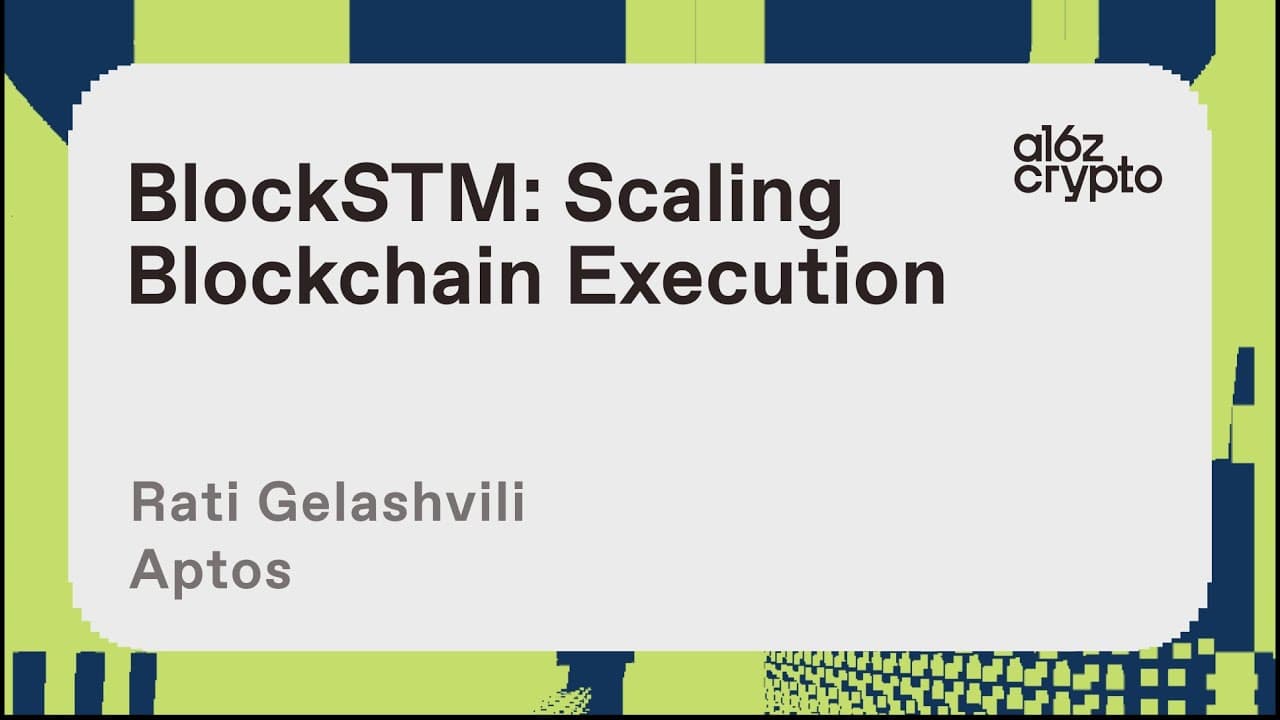
BlockSTM accelerates smart contract execution by running transactions speculatively in parallel while preserving the deterministic result of their preset sequential order. It dynamically discovers dependencies and conflicts instead of requiring users to declare state access in advance, and its collaborative scheduler coordinates execution and validation while keeping overhead low when transactions offer little inherent parallelism.
Transcript
welcome everyone to today's uh a16z crypto research seminar I'm very happy to welcome ratty Gillis vealy he's going to be telling us about black STM I'm very excited because I've heard so much about this paper over recent months I really want to looking forward to learning more about the details so Roxy over to you thanks sir uh very happy to be he... Read More
Key Insights
- Block execution is a potential blockchain bottleneck because consensus, execution, and storage form a layered pipeline whose total performance is constrained by its slowest component. Even when consensus scales, sequentially executing every transaction can prevent validators from fully using available multicore hardware.
- Deterministic execution is mandatory because every validator receives the same ordered block and must produce a consistent effect on the global blockchain state. Parallel processing therefore cannot simply reorder transactions for convenience, since its output must remain consistent with executing transactions according to their preset order.
- BlockSTM is a Software Transactional Memory based engine that executes smart contract transactions speculatively in parallel. It uses the preset transaction order to detect dependencies dynamically, avoid or resolve conflicting work, and preserve the same outcome expected from ordered sequential execution.
- User transparency is a central design goal because transaction submitters do not need to declare dependencies, provide state-access hints, or know that execution is parallel. From their perspective, submitting a transaction should remain the same experience as using a sequential execution engine.
- Declared write sets can simplify scheduling, but they limit ergonomics and flexibility. A user may not know exactly where a transaction will write, and an incorrect declaration can require a transaction to be divided or retried, making advance dependency specification burdensome.
- Robust performance is required for adversarial or highly dependent workloads. If every transaction depends on data written by the preceding transaction, little parallelism exists, so BlockSTM aims to keep its extra scheduling and speculative-execution overhead low relative to straightforward sequential processing.
- Miner replay can help validators execute faster by attaching metadata derived from an earlier execution, such as observed reads, writes, and dependencies. Its limitations include trusting the block creator's information, handling potentially adversarial metadata, and retaining latency because someone must still perform the initial blind execution.
- Static write-set estimation permits overestimation but cannot safely underestimate without rerunning the algorithm described in the talk. Although this assumption can be reasonable for restricted database stored procedures, obtaining reliable estimates for smart contracts may require static analysis or pre-execution and can reduce practical flexibility.
Install to Summarize YouTube Videos and Get Transcripts
Explore YouTube Video Summarizer or Get YouTube Transcript Extractor
Questions & Answers
Q: How does BlockSTM parallelize blockchain transactions?
BlockSTM executes transactions speculatively across multiple processor cores while respecting the preset order of transactions in a block. During execution, it dynamically identifies dependencies and conflicts from actual transaction behavior rather than relying on declarations from users. Execution and validation tasks are coordinated by a low-overhead collaborative scheduler, and the validated result remains consistent with ordered sequential execution.
Q: Why must BlockSTM preserve a preset transaction order?
Every validator receives an ordered block after consensus and must execute its transactions so that the same deterministic change is applied to the global blockchain state. If parallel execution produced results that differed according to timing or processor scheduling, validators could disagree. BlockSTM therefore uses parallel speculation while enforcing an outcome consistent with executing transactions in the block's preset order.
Q: Why is sequential blockchain execution a bottleneck?
Sequential execution processes transactions one by one in their given order, leaving the additional cores of a multiprocessor machine underused. Because a blockchain has layered components such as consensus, execution, and storage, a slow execution stage can become the weakest link for the entire system. Parallel execution seeks to increase throughput by using available hardware more fully.
Q: Do BlockSTM users need to declare transaction dependencies?
BlockSTM is designed so users do not need to declare dependencies or provide hints about which parts of state their transactions will write. They submit the same transactions they would submit to a sequential engine. The execution system observes transaction behavior and discovers relevant dependencies dynamically, making the mechanics of parallel execution effectively invisible to users.
Q: How does BlockSTM handle transactions with little parallelism?
BlockSTM is designed to remain close to sequential execution performance when a workload contains unavoidable dependencies, such as when every transaction depends on a value written by the preceding transaction. It still incurs some overhead from dispatching threads, scheduling tasks, speculation, and validation, but keeping that overhead low is a critical design goal for dependent or adversarial workloads.
Q: What problem does miner replay have for blockchain execution?
Miner replay lets a block creator execute transactions first and attach metadata describing reads, writes, or dependencies so validators can replay the block efficiently. The approach creates a trust concern because the supplied information could be adversarial or misleading. It also does not remove initial execution latency, since someone must still execute the block without that prior knowledge.
Q: Why are advance transaction write-set estimates limiting?
Advance write-set estimates can simplify parallel scheduling by identifying likely conflicts before execution, but users or analysis tools may not know every location a transaction will modify. Overestimation can introduce overhead by suggesting conflicts that never occur, while underestimation can force the described algorithm to restart. Requiring such estimates also makes transaction submission less ergonomic and less transparent.
Q: What role does the BlockSTM scheduler perform?
The BlockSTM scheduler collaboratively coordinates execution and validation tasks needed for speculative parallel processing. It helps available workers execute transactions, check whether speculative results remain valid, and respond to dynamically discovered dependencies or conflicts. Its design emphasizes low overhead so the engine can exploit substantial parallelism without becoming dramatically slower when the workload is inherently sequential.
Summary & Key Takeaways
-
BlockSTM addresses execution as a potential bottleneck in layered blockchain systems. After consensus establishes an ordered block, every validator must execute its transactions and produce the same state transition. Sequential processing preserves that requirement but cannot fully use multicore processors, motivating parallel execution that remains deterministic and consistent with the block's preset transaction order.
-
The system makes parallelism invisible to users. Transactions can be submitted as they would be to a sequential engine, without dependency declarations or hints about which state locations they will write. BlockSTM instead speculates, observes actual behavior, dynamically detects dependencies and conflicts, then validates work so the final outcome matches ordered sequential execution.
-
The design targets both favorable and adversarial workloads. It seeks to exploit available parallelism fully, yet remain close to sequential performance when every transaction depends on the preceding one. Compared with miner-replay and static-analysis approaches, BlockSTM avoids trusting leader-supplied execution metadata and does not require perfect advance overestimates of transaction write sets.
Read in Other Languages (beta)
Share This Summary 📚
Summarize YouTube Videos and Get Video Transcripts with 1-Click
Try YouTube Summary with ChatGPT & Claude or YouTube Transcript Generator
Explore More Summaries from a16z crypto 📚



Summarize YouTube Videos and Get Video Transcripts with 1-Click
Try YouTube Summary with ChatGPT & Claude or YouTube Transcript Generator