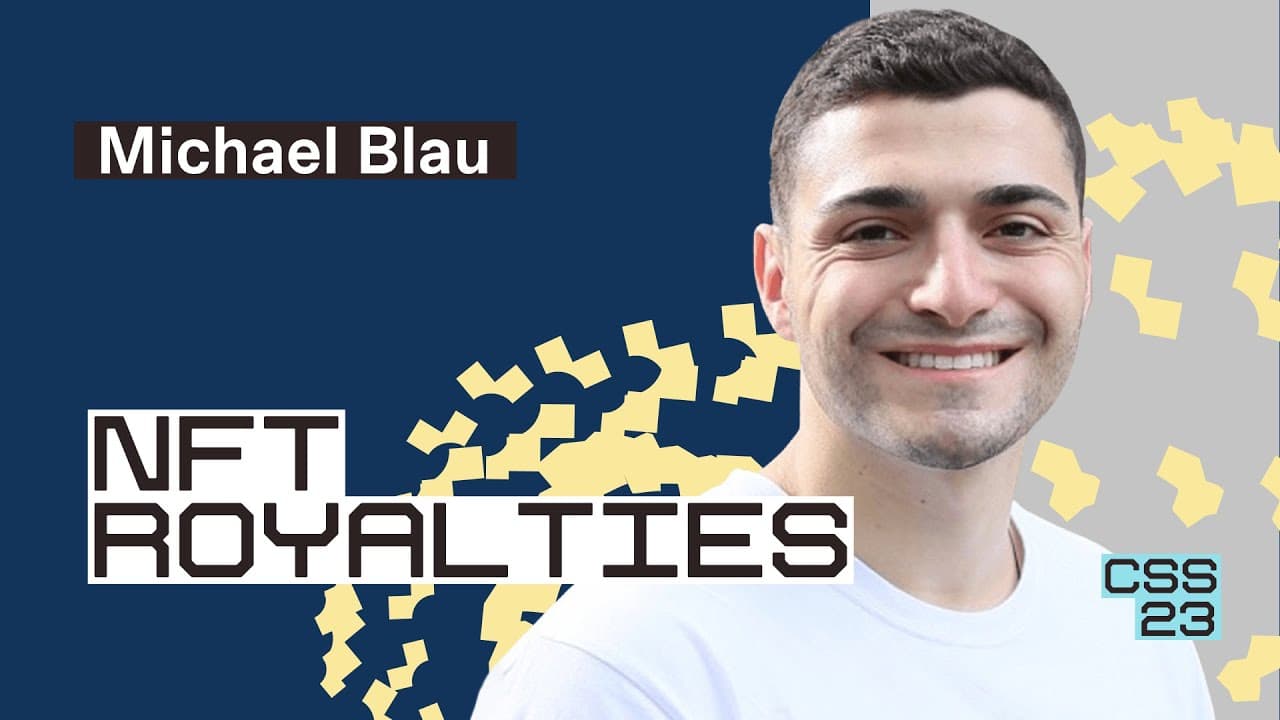
Understanding NFT royalties | Michael Blau
TL;DR
NFT royalties are payments to creators from secondary sales, but ERC-721 smart contracts do not automatically enforce them on chain. The ERC-721 transfer function contains no required sale price, royalty percentage, or creator payment, and transfer fees can be bypassed by wrapping an NFT. Options such as EIP-2981, the Manifold Royalty Registry, and operator filters offer partial solutions, so read on to understand their roles and limitations.
Transcript
thank you so there is a fundamental misunderstanding about the about the mechanics of energy royalties and in the ecosystem there are many ideas a lot of people that have a lot of different theories and Concepts and maybe even a little bit of drama around how nft royalties work but that is not what we're going to talk about today instead we're goin... Read More
Key Insights
- 🥺 NFT smart contracts do not enforce royalties on chain, leading to the need for alternative solutions.
- 💁 The manifold royalty registry provides a decentralized registry for creators to store their royalty information, making it more accessible for marketplaces.
- 🎮 Operator filters can be used to block unwanted applications or marketplaces from interacting with NFTs, offering some control for creators.
- 👤 There are challenges in enforcing royalties on chain, such as users wrapping NFTs or transferring them between their own wallets.
- 👻 Creators can take advantage of extensible NFT standards that allow for the addition of plugins or optional features, providing flexibility for future developments.
- ❓ The NFT royalty ecosystem is evolving rapidly, and creators should stay informed and evaluate their options before implementing royalty frameworks.
Install to Summarize YouTube Videos and Get Transcripts
Explore YouTube Video Summarizer or Get YouTube Transcript Extractor
Questions & Answers
Q: How do NFT royalties work?
An NFT royalty is intended to give the original creator a percentage of the sale price when the NFT changes hands on a secondary marketplace. However, the NFT smart contract does not automatically enforce that payment on chain, so royalties depend on supporting standards, registries, and marketplaces.
Q: Do NFT smart contracts enforce royalties on chain?
No. ERC-721 does not require royalty enforcement, and its transfer function does not inherently reference a sale price, deduct a percentage, or send payment to the creator.
Q: Why is on-chain NFT royalty enforcement difficult?
A user can pay a transfer fee once, lock the NFT in another smart contract, and receive a wrapped NFT without the original royalty restrictions. Enforcement also struggles to distinguish a sale from a person moving an NFT between their own wallets, such as from a hot wallet to a cold wallet.
Q: Can an NFT project add a fee to its transfer function?
Yes, the ERC-721 standard permits a project to put a fee into the transfer function. Without a shared standard, however, each project could implement the fee differently, undermining composability and interoperability.
Q: What is the Manifold Royalty Registry?
The Manifold Royalty Registry lets creators register royalty information on chain. Marketplaces can access that information and choose to honor the specified royalties.
Q: What is EIP-2981's role in NFT royalties?
EIP-2981 is a standard intended to improve how NFT royalty information is managed and accessed. It does not itself guarantee payment because enforcement still relies on marketplaces honoring the royalty information.
Q: How can creators restrict marketplaces or applications from interacting with NFTs?
Creators can add operator filters to NFT contracts. These filters can block addresses or code hashes associated with particular marketplaces or applications, giving creators some control over NFT interactions.
Q: What should creators consider when choosing an NFT royalty framework?
Creators should recognize that royalty information and royalty enforcement are different: registries and standards can communicate payment terms, while marketplaces still decide whether to honor them. They should also weigh operator filters and extensible NFT standards that support plugins or optional features as the royalty ecosystem evolves.
Summary & Key Takeaways
-
NFT smart contracts do not automatically enforce royalties on chain, despite the initial belief that they did.
-
The manifold royalty registry allows creators to register their royalty information on chain, making it easier for marketplaces to access and honor their royalties.
-
Operator filters can be implemented in NFT contracts to block certain marketplaces or applications from interacting with the NFT, providing some control for creators.
Read in Other Languages (beta)
Share This Summary 📚
Summarize YouTube Videos and Get Video Transcripts with 1-Click
Try YouTube Summary with ChatGPT & Claude or YouTube Transcript Generator
Explore More Summaries from a16z crypto 📚

Summarize YouTube Videos and Get Video Transcripts with 1-Click
Try YouTube Summary with ChatGPT & Claude or YouTube Transcript Generator