How Does Temporal Reward Transport Improve RL?
TL;DR
Temporal reward transport helps reinforcement learning agents connect delayed rewards to the earlier actions that caused them. It uses attention to identify significant state-action pairs, then splices distant rewards onto those pairs to strengthen the learning signal. In a three-phase grid environment, adding this method to advantage actor-critic improved learning as delays, distractor reward sizes, and distractor reward variance increased.
Transcript
the first graphic I wanted to share with you guys was a graphic of reinforcement learning agent playing an Atari breakout video game and that's an example of a case where standard RL can learn in a certain environment very well but the problem I'll be focusing on is specifically a problem with delayed rewards and this is very relevant to real life ... Read More
Key Insights
- Standard reinforcement learning uses discounted returns, which sum rewards along a trajectory while reducing the influence of future rewards through the discount factor gamma. This introduces a timescale that favors rewards received sooner and weakens learning signals from outcomes separated from their causes by long delays.
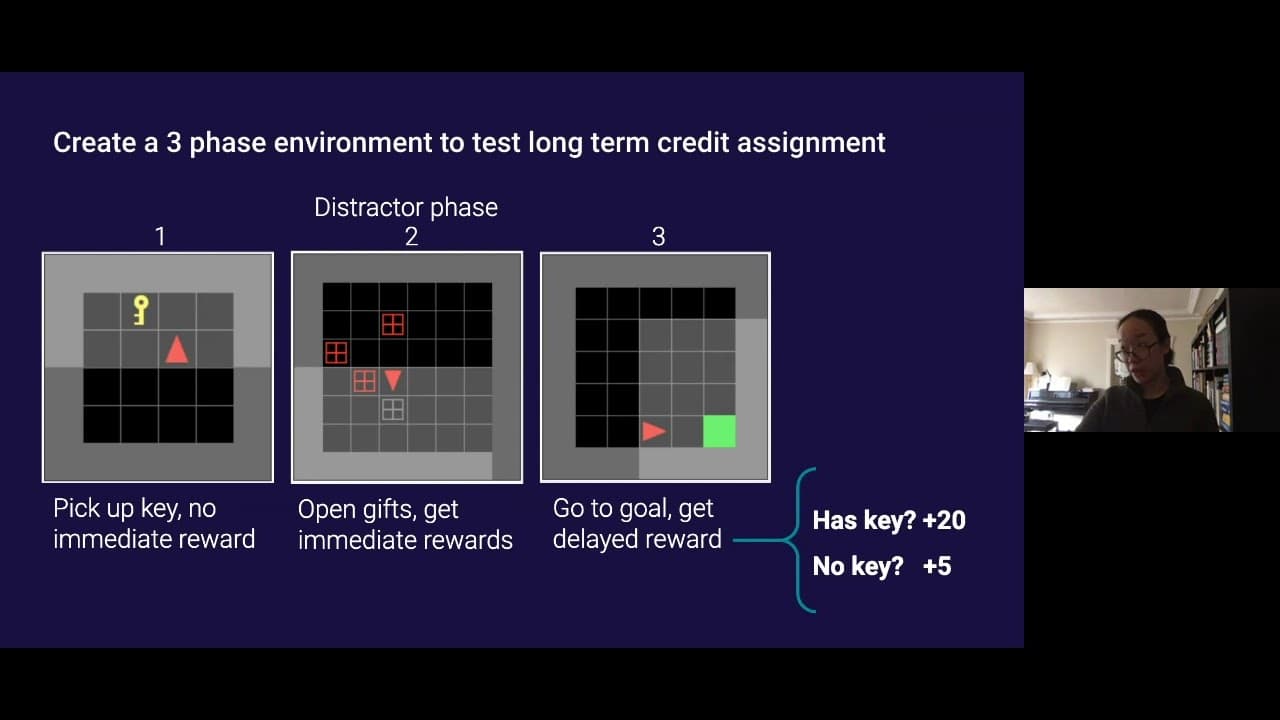
- Delayed credit assignment is difficult when an early action produces no immediate reward but determines a later outcome. In the example task, collecting a key initially gives zero points, yet it enables a 20-point reward at the final green goal instead of the five points available without the key.
- Temporal reward transport strengthens learning by splicing a distant reward onto an earlier state-action pair judged responsible for that reward. Assigning the later 20-point outcome to the key-collection moment provides a much stronger signal for increasing the probability that the agent collects the key again.
- Attention identifies significant state-action pairs after the agent completes a full episode. The entire sequence of states and actions is passed to a binary classifier, and the attention scores show which moments received the greatest attention from other frames in the trajectory.
- The attention heat map provides a sanity check on credit assignment because its bright stripes correspond to highly attended states and actions. In the demonstrated example, one such observation showed the triangular agent next to the key, matching the action expected to matter for the later reward.
- The experimental environment separates causal behavior from delayed consequences through three phases. The agent first decides whether to collect an unrewarded key, then encounters immediately rewarding gifts during a distractor phase, and finally reaches a goal that pays 20 points with the key or five points without it.
- Temporal reward transport improved performance when the forced delay in the distractor phase increased. At the longest demonstrated delay, the advantage actor-critic baseline plateaued at five points, indicating that it reached the goal without learning to collect the key, while the augmented agent continued progressing.
- The modular implementation separates attention-based identification into its own classifier, making temporal reward transport easier to add to another model. Results also favored the augmented agent when distractor reward size or variance increased, although the demonstrated experiments used only a simple grid environment.
Install to Summarize YouTube Videos and Get Transcripts
Explore YouTube Video Summarizer or Get YouTube Transcript Extractor
Questions & Answers
Q: Why do delayed rewards cause problems in reinforcement learning?
Delayed rewards create a weak connection between an early action and its eventual consequence because standard reinforcement learning discounts future rewards using gamma. The farther a reward lies from an action, the more attenuated its contribution becomes. If collecting a key gives no immediate reward but produces bonus points only at the end, the signal reinforcing key collection can be very small, making learning slow.
Q: What is temporal reward transport in reinforcement learning?
Temporal reward transport is a method for improving long-term credit assignment by moving, or splicing, information from a distant reward onto an earlier state-action pair that significantly contributed to it. In the example, the agent receives no immediate points for collecting a key, so the later 20-point reward is attached to that earlier action to create a stronger reinforcement signal.
Q: How does attention support temporal reward transport?
Attention supports temporal reward transport by helping identify which earlier state-action pairs deserve credit for a later reward. After a complete episode, the full sequence of states and actions is passed to a binary classifier. Attention scores are then examined to find highly attended moments. In the demonstration, these moments included the agent standing next to the key, which was relevant to the final bonus.
Q: How was the temporal reward transport experiment structured?
The experiment used a grid environment divided into three phases. First, the agent encountered a key and could collect it without receiving an immediate reward. Second, it entered a distractor phase containing gifts that provided immediate rewards. Third, it navigated to a green goal, receiving 20 points if it had collected the key and five points if it had not.
Q: How did longer delays affect the reinforcement learning agents?
Longer delays made it harder for the standard advantage actor-critic agent to learn that collecting the key was valuable. At the most difficult demonstrated delay, the baseline plateaued at five points, meaning it learned to reach the goal but not to collect the key. The agent using advantage actor-critic plus temporal reward transport continued making progress toward the 20-point outcome.
Q: How did distractor rewards affect temporal reward transport results?
The distractor phase contained gifts that gave immediate rewards, making it harder to connect the earlier key action with the later goal reward. Experiments increased the size of these distractor rewards and separately increased their variance. Across both conditions, advantage actor-critic combined with temporal reward transport performed better than advantage actor-critic alone on the final-phase reward evaluation.
Q: What makes the demonstrated temporal reward transport architecture modular?
The architecture is modular because the attention component is separated into a distinct binary classifier that identifies significant state-action pairs. This design preserves the two core concepts, using attention for credit assignment and splicing distant rewards onto important moments, while keeping the implementation simpler. The separation also makes it easier to imagine adding temporal reward transport to another reinforcement learning model.
Q: What are the limitations and future directions of this approach?
The presented temporal reward transport method remains a heuristic, so one future direction is to develop an approach that moves beyond heuristic reward splicing. The reported evidence also comes from a simple grid environment specifically designed around delayed credit assignment. Further work would need to examine how well the algorithm holds up in more complex situations and with different models.
Summary & Key Takeaways
-
Standard reinforcement learning discounts future rewards using gamma, giving rewards less influence as their distance from an action increases. This can make learning slow when an important early action, such as collecting a key, produces no immediate reward but determines whether the agent receives a larger reward much later in an episode.
-
Temporal reward transport addresses delayed credit assignment by identifying significant state-action pairs and splicing distant rewards onto them. A separate binary classifier processes the complete sequence of states and actions after an episode. Its attention scores reveal which earlier moments were important, allowing stronger reinforcement of actions associated with later rewards.
-
Experiments used a three-phase grid environment containing a key phase, a gift-filled distractor phase, and a final goal phase. An agent earned 20 points at the goal after collecting the key, but only five otherwise. Adding temporal reward transport to advantage actor-critic performed better as distractor difficulty increased.
Read in Other Languages (beta)
Share This Summary 📚
Summarize YouTube Videos and Get Video Transcripts with 1-Click
Try YouTube Summary with ChatGPT & Claude or YouTube Transcript Generator
Explore More Summaries from OpenAI 📚






Summarize YouTube Videos and Get Video Transcripts with 1-Click
Try YouTube Summary with ChatGPT & Claude or YouTube Transcript Generator