Why Do Software Developers Stop Learning and Become Expert Beginners?
TL;DR
Software developers stop learning when an initially successful method reaches its ceiling, but comfort, recognition, or authority discourages them from rebuilding their skills. The expert beginner protects a narrow approach rather than accepting temporary regression, while the Dead Sea effect can leave deteriorating teams with less marketable developers. The author’s bowling average near 160 illustrates this trap, and why stronger fundamentals are worth examining.
Transcript
all right how developers stop learning the rise of the expert beginner we call these influencers oh damn look at this I click one page and I'm back at the turd Brown we're back at turd Brown let's go let's go turd Brown all right the rise let's see beyond the Dead Sea when good software groups go bad okay okay I recently posted what turned out to b... Read More
Key Insights
- The Dead Sea effect is a workplace pattern in which talented, marketable developers leave when conditions deteriorate, while less talented developers are more likely to remain because finding another position may be harder for them.
- Software group dysfunction is not explained solely by collecting weak individuals in one organization. Internal dynamics can transform external mistakes into pervasive incompetence, making the group itself a mechanism that reinforces poor judgment and professional toxicity.
- Persuasive advocacy can push a team toward a technology before its practical costs are understood. When authority follows confident language, a complicated technical direction can accumulate work, create organizational swirl, and eventually make contributors unwilling to continue.
- An improvised technique can create rapid early progress while concealing a fixed performance ceiling. The bowling example shows that natural ability and shortcuts may produce respectable results, but they cannot always support the transition from acceptable performance to mastery.
- The cost of rebuilding a skill is temporary regression. Replacing a familiar but limited method with proper fundamentals can make performance worse at first, and improvement may require significant time before the learner returns to and surpasses the previous level.
- Stagnation becomes permanent when a person refuses the discomfort of starting over. A learner who protects current performance, confidence, or status may preserve a respectable result while giving up the possibility of reaching a substantially higher level.
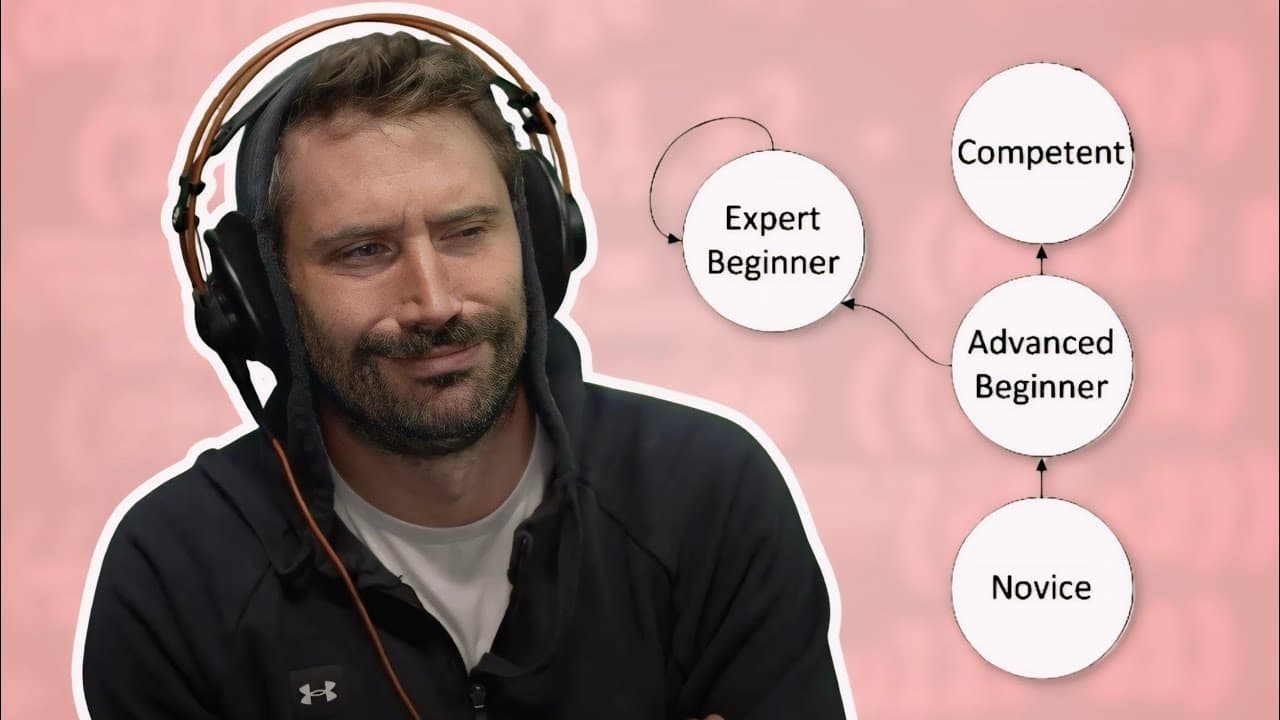
- Skill acquisition progresses through novice, advanced beginner, competent, proficient, and expert stages. The early stages emphasize rules and limited context, while continued development requires moving beyond narrow methods and gaining a broader understanding of the activity.
- An expert beginner is implied to be someone whose early success becomes arrested development. Such a person may acquire an impressive title, compensation, or authority without developing the practical competence expected from genuine expertise, particularly when the surrounding organization rewards confidence.
Install to Summarize YouTube Videos and Get Transcripts
Explore YouTube Video Summarizer or Get YouTube Transcript Extractor
Questions & Answers
Q: Why do software developers stop learning at work?
Some developers stop learning because an early method produces acceptable results, recognition, or authority. Advancing further would require abandoning comfortable habits and accepting a temporary decline in performance, so they protect their current status instead of pursuing mastery.
Q: What is an expert beginner in software development?
An expert beginner is someone whose early success turns into arrested development. The person may accumulate experience, compensation, an impressive title, or authority while continuing to rely on limited methods that have already reached their ceiling.
Q: What is the Dead Sea effect in software teams?
The Dead Sea effect occurs when the most talented and marketable developers leave after workplace conditions deteriorate. Less talented developers are more likely to remain because they may have difficulty convincing another company to hire them.
Q: How does the bowling story explain arrested development?
An unconventional bowling throw helped the author improve quickly and reach an average near 160, but the technique eventually imposed a ceiling. Further progress required different equipment, conventional technique, and a willingness to perform worse temporarily while rebuilding the fundamentals.
Q: Why can stronger fundamentals make performance worse at first?
A familiar shortcut is practiced and reliable within its limited range, while a stronger method initially feels unfamiliar. Replacing the old approach requires new equipment, movements, and repetition, so performance can decline before the learner recovers and surpasses the previous ceiling.
Q: What are the five stages of skill acquisition mentioned?
The five stages are novice, advanced beginner, competent, proficient, and expert. The sequence frames arrested development as reaching enough competence to gain confidence or rewards, then stopping before developing the broader understanding associated with expertise.
Q: How can persuasive advocates damage a software team’s technical direction?
A persuasive advocate can use confident technical language to convince developers and stakeholders that a technology is essential. If the team builds extensively on that choice before understanding its costs, the resulting complexity and organizational swirl can make contributors unwilling to continue.
Q: How do dysfunctional software groups reinforce poor technical decisions?
The Dead Sea effect can act as both a catalyst for and an outcome of group dysfunction. As marketable developers leave, internal dynamics can convert external mistakes, persuasive advocacy, and accumulated technical complexity into pervasive incompetence and professional toxicity.
Summary & Key Takeaways
-
Software groups can deteriorate through more than poor hiring or external management decisions. The Dead Sea effect removes marketable developers when conditions worsen, while less marketable employees remain. Internal group dynamics can then convert bad decisions, persuasive advocacy, and accumulated technical complexity into lasting incompetence, dysfunction, and professional toxicity.
-
The bowling story illustrates how an improvised method can deliver rapid early progress but impose a hard ceiling. The author reached an average near 160 by using an unconventional throw. Improving further required proper equipment, conventional technique, and a willingness to perform worse temporarily while rebuilding the fundamentals needed for greater mastery.
-
The skill acquisition model describes movement through novice, advanced beginner, competent, proficient, and expert stages. The central danger is arrested development: a person gains enough success, status, or authority to appear experienced, but stops accepting corrective learning. That combination can produce expert beginners who defend limited methods and influence entire teams.
Read in Other Languages (beta)
Share This Summary 📚
Summarize YouTube Videos and Get Video Transcripts with 1-Click
Try YouTube Summary with ChatGPT & Claude or YouTube Transcript Generator
Explore More Summaries from The PrimeTime 📚





Summarize YouTube Videos and Get Video Transcripts with 1-Click
Try YouTube Summary with ChatGPT & Claude or YouTube Transcript Generator