Why Salesforce Pulled Back From AI Automation
TL;DR
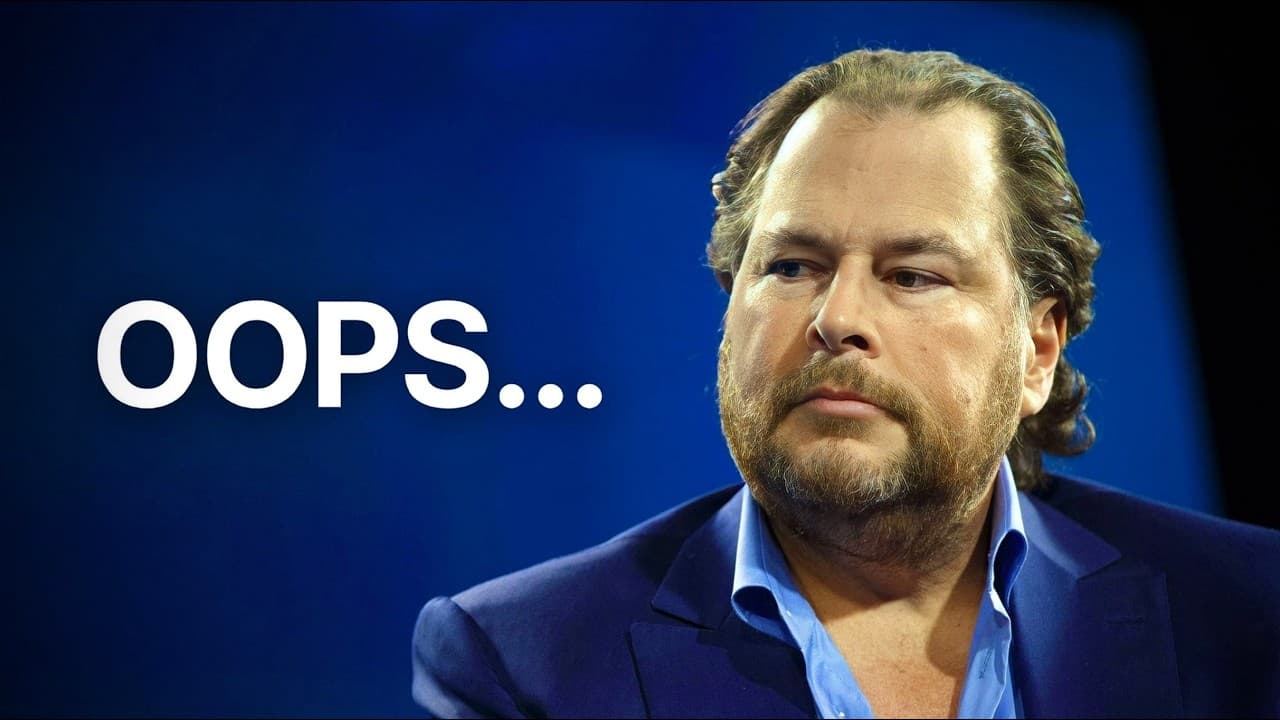
Salesforce reportedly reduced its reliance on large language models after reliability problems exposed the limits of using probabilistic AI for consequential customer workflows. The central lesson is to test AI on real tasks, measure tolerable error rates, and keep deterministic programming for actions that must occur every time, while reserving human support for complicated or unusual cases.
Transcript
I love to say, "I told you so." I know. Unlike the popular phrase, I actually think it's hilarious when you look at something, you go, "Hey, this is probably a bad idea." And then a couple months later, it turns out, yes, yes, it was actually a horrible idea. But you know what's even better, is not only do you get to say, "I told you so." You also ... Read More
Key Insights
- Salesforce reportedly pulled back from heavy reliance on large language models because reliability problems weakened executives' confidence. The reversal suggests that impressive text generation does not automatically translate into dependable performance when AI controls consequential business processes or communicates directly with customers.
- Developers can gain unusually practical insight into AI limitations by using it across large projects. Long-running work requires maintained context, repeated questions, and corrections, revealing how a small wording change can send a model toward an unexpected or incorrect result.
- Executive confidence in AI may be distorted by shallow use cases such as rewriting corporate emails or generating a basic application. Success on limited demonstrations does not prove that a model can reliably replace experienced employees handling complex, ambiguous, and high-impact work.
- Vivant's Agentforce deployment sometimes failed to send satisfaction surveys after customer interactions, despite clear instructions. Vivant and Salesforce added deterministic triggers so survey delivery occurred consistently, demonstrating that mandatory events should be implemented as explicit programmed behavior rather than left to model judgment.
- Deterministic programming is better suited to simple actions that must happen every time. When a customer interaction ends and a survey must be sent, a direct trigger removes unnecessary interpretation and prevents the unexplained omissions that can arise from probabilistic AI behavior.
- AI deployments should be tested against previous customer conversations before replacing established processes or employees. Organizations need to identify failure patterns and decide whether they can tolerate the resulting error rate, including accidental discounts, incorrect cancellations, free items, or other customer-impacting mistakes.
- The claim that Salesforce publicized 4,000 layoffs to promote Agentforce and benefit its stock-market narrative is explicitly presented as speculation, not confirmed fact. The criticism focuses on the ethical implications if employee dismissals were used as evidence that other companies could also replace workers with AI.
- AI may successfully handle many routine customer calls while still failing on a meaningful minority of unusual cases. A safer strategy is to automate predictable requests and preserve human involvement for exceptions where mistakes could create financial losses, incorrect orders, or frustrating customer experiences.
Install to Summarize YouTube Videos and Get Transcripts
Explore YouTube Video Summarizer or Get YouTube Transcript Extractor
Questions & Answers
Q: Why did Salesforce pull back from large language models?
Salesforce reportedly reduced its heavy reliance on large language models after encountering reliability problems that weakened executive confidence. The transcript highlights a customer-support deployment in which Agentforce sometimes failed to send required satisfaction surveys despite receiving clear instructions. The broader conclusion is that fluent text generation is not enough when a system must execute consequential business actions consistently.
Q: What happened after Salesforce linked AI to 4,000 layoffs?
The transcript contrasts a September 2, 2025 report that Salesforce's CEO confirmed 4,000 layoffs because AI reduced the need for workers with a December 27, 2025 report that Salesforce regretted firing experienced staff and replacing them with AI. The commentary treats this sequence as evidence that the company acted before establishing whether its technology was dependable enough.
Q: What did Vivant's Agentforce deployment reveal?
Vivant, a home security company serving 2.5 million customers, used Agentforce for customer support and instructed it to send satisfaction surveys after every interaction. The system sometimes failed to send those surveys for unexplained reasons. Vivant then worked with Salesforce to add deterministic triggers, ensuring that survey delivery followed the end of an interaction consistently.
Q: Why are deterministic triggers better for mandatory tasks?
Deterministic triggers execute a defined action whenever a specified event occurs, so they are appropriate when there is only one acceptable result. If every completed customer interaction must produce a survey, the system can directly connect the ended interaction to survey delivery. Asking a language model to decide introduces unnecessary uncertainty into an otherwise straightforward programmed workflow.
Q: How should companies test AI customer support systems?
Companies should run AI systems against previous customer conversations and inspect where their responses or actions fail. The transcript recommends asking whether the business can tolerate the observed error rate and considering concrete harms, such as unintended discounts, incorrect cancellations, free products, wrong items, or deliveries sent to the wrong address. Strategy should change when those risks are unacceptable.
Q: Can AI replace all customer support workers?
The commentary does not argue that AI is incapable of displacing customer-support work. It suggests that AI could successfully handle a large share of routine calls, including simple order cancellations. However, a remaining portion of unusual interactions may go off course, creating mistakes that require judgment and recovery. Human support therefore remains important for exceptions and consequential cases.
Q: Why might executives misunderstand AI reliability?
Executives may form unrealistic expectations when their personal experience is limited to low-risk tasks, such as rewriting corporate emails or generating a simple application. Those demonstrations show that AI can produce plausible text, but they do not expose the context loss, wording sensitivity, and unpredictable errors that developers encounter while using models repeatedly on large, consequential projects.
Q: Was Salesforce's layoff announcement intended to promote AI?
The transcript alleges, but does not confirm, that publicizing 4,000 layoffs may have supported Salesforce's stock-market narrative and promoted Agentforce to other companies. The idea is explicitly framed as a tinfoil-hat theory rather than an established fact. The ethical criticism is conditional: if true, workers' lives were used to advertise automation before its reliability was validated.
Summary & Key Takeaways
-
Salesforce reportedly fired 4,000 experienced employees while presenting AI as a reason it needed fewer workers, then pulled back from heavy reliance on large language models after reliability problems weakened executive confidence. The critique argues that leaders embraced replacement claims without developing enough practical experience using AI in consequential, context-heavy workflows.
-
Vivant used Salesforce Agentforce for customer support involving 2.5 million customers, but the system sometimes failed to send required satisfaction surveys. Salesforce and Vivant responded with deterministic triggers that sent surveys consistently after interactions. The example shows that ordinary programming is more appropriate than language models when a workflow has a simple, mandatory outcome.
-
The commentary accepts that AI could handle many routine calls, such as straightforward order cancellations, while warning that a smaller set of unusual cases could produce serious mistakes. It also speculates, without claiming proof, that publicizing layoffs may have promoted Salesforce's AI products and appealed to investors rather than reflected validated automation performance.
Read in Other Languages (beta)
Share This Summary 📚
Summarize YouTube Videos and Get Video Transcripts with 1-Click
Try YouTube Summary with ChatGPT & Claude or YouTube Transcript Generator
Explore More Summaries from The PrimeTime 📚





Summarize YouTube Videos and Get Video Transcripts with 1-Click
Try YouTube Summary with ChatGPT & Claude or YouTube Transcript Generator