How to Build AI Models with Foundation Models
TL;DR
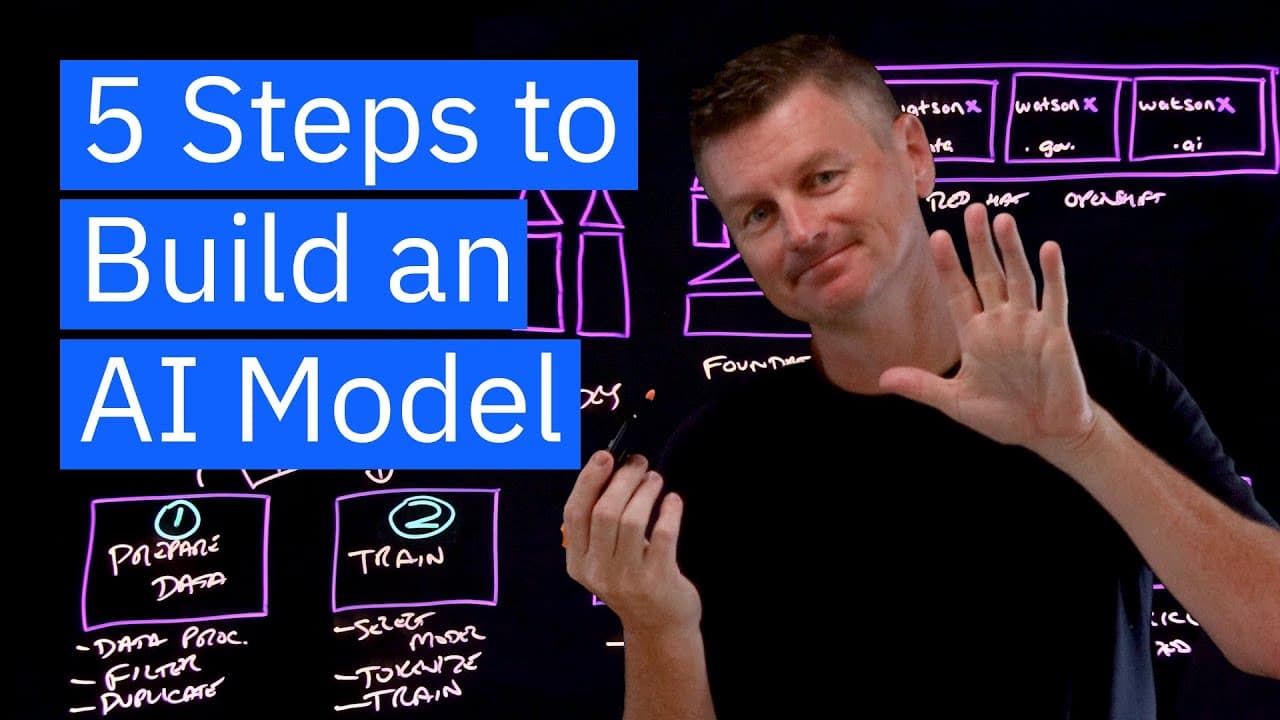
Foundation models enable rapid AI development by starting from a base model and adapting it to specific tasks through fine tuning. The workflow has five stages: prepare data, train, validate, tune, and deploy, with governance through model cards. IBM watsonx supports all five stages and helps manage data piles, filters, and deployment options.
Transcript
Deep learning has enabled us to build detailed specialized AI models, and we can do that provided we gather enough data, label it, and use that to train and deploy those models. Models like customer service chatbots or fraud detection in banking. Now, in the past if you wanted to build a new model for your specialization - so, say a model for predi... Read More
Key Insights
- Foundation models act as a centralized base that can be adapted to many tasks through fine tuning.
- Data preparation produces a base data pile with versioning and tagging to support governance and reproducibility.
- Training aligns the chosen foundation model with the prepared data pile, using tokenization and large-scale compute when needed.
- Validation benchmarks the model against predefined criteria and results are captured in a model card.
- Tuning shifts the focus from AI experts to application developers, enabling faster, local fine tuning with additional data.
- Deployment options include running as a cloud service or embedding the model near the network edge for latency-sensitive use cases.
- The IBM watsonx platform coordinates all five stages through watsonx.data, watsonx.governance, and watsonx.ai.
- Governance artifacts ensure responsible AI development by tracking filters, data provenance, and benchmark scores.
Install to Summarize YouTube Videos and Get Transcripts
Explore YouTube Video Summarizer or Get YouTube Transcript Extractor
Questions & Answers
Q: How do foundation models speed up AI development?
Foundation models speed up AI development by providing a reusable base that can be adapted to a wide range of specialized tasks. Teams start from a central model rather than building from scratch, then fine tune with task-specific data. This reduces development time, enables quicker iteration, and lowers the barrier to deploying capable models across domains.
Q: What is the first stage in the five-stage workflow?
The first stage is preparing the data. This involves collecting a large data set that may include both open source and proprietary sources, then processing it through categorization, filtering for harmful or sensitive content, and removing duplicates. The result is a base data pile that can be versioned and tagged for governance.
Q: How is the data processed in Stage 1 handled for governance?
Stage 1 results in a base data pile that is versioned and tagged, creating a traceable record of what data was used and what filters were applied. This enables governance by documenting the data sources, preprocessing steps, and filtering criteria, which supports reproducibility and accountability in model development.
Q: What happens during Stage 2, training the model?
Stage 2 involves selecting an appropriate foundation model for the use case, tokenizing the base data pile, and training the model on trillions of tokens if necessary. The process can take months on large hardware setups, but once completed, the costly training phase is largely finished and the model is ready for validation.
Q: Why is validation important in Stage 3?
Validation benchmarks the model against predefined criteria to measure performance and quality. It involves running standardized tests, comparing results to benchmarks, and documenting scores in a model card. This stage ensures the model meets expected standards before proceeding to tuning and deployment.
Q: Who performs Stage 4 tuning and why is it faster?
Stage 4 tuning is performed by the application developer persona rather than AI experts. They generate prompts, incorporate local data, and fine tune the model to improve performance for specific applications. This approach significantly reduces time to deployment, often achieving improvements in hours or days instead of weeks or months.
Q: What deployment options are described in the video?
Deployment options include running the model as a service in the public cloud or embedding it into an application that operates at the network edge. Both approaches allow ongoing iteration and refinement based on real-world use, ensuring the model stays aligned with user needs and system constraints.
Q: What is the role of governance tools in the IBM watsonx platform?
Governance tools in watsonx provide a framework for managing data and model cards, enabling traceability of data preprocessing, filters used, and benchmark results. This ensures a well-governed lifecycle for AI systems, promoting transparency, accountability, and compliance as models evolve.
Summary & Key Takeaways
-
Foundation models provide a base that can be specialized through fine tuning to fit particular use cases, reducing from-scratch effort and enabling faster deployment.
-
The five-stage workflow starts with data preparation, including filtering, de-duplication, and categorization, then moves to training on tokenized data piles, followed by validation, tuning by application developers, and final deployment.
-
Governance is maintained via model and data cards that document filters used, benchmarks achieved, and lifecycle details, supported by IBM watsonx components that cover data, governance, and AI tools.
Read in Other Languages (beta)
Share This Summary 📚
Summarize YouTube Videos and Get Video Transcripts with 1-Click
Try YouTube Summary with ChatGPT & Claude or YouTube Transcript Generator
Explore More Summaries from IBM Technology 📚
Summarize YouTube Videos and Get Video Transcripts with 1-Click
Try YouTube Summary with ChatGPT & Claude or YouTube Transcript Generator