How to Think Clearly Using First Principles
TL;DR
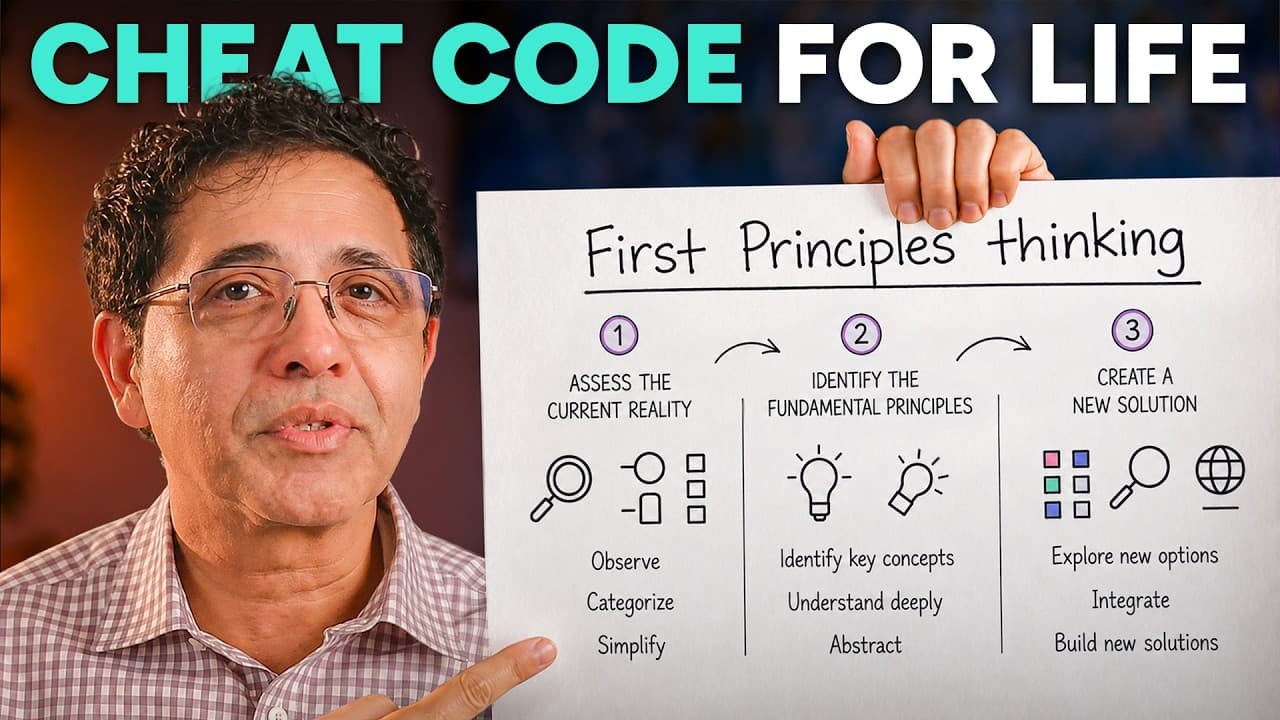
First principles thinking clarifies problems by separating their essential parts from inherited assumptions, rebuilding possible solutions, and testing them cheaply and quickly. The DARE framework uses decomposition, assumption auditing, recombination, and experimentation, while carefully constrained AI prompts can support each stage without defaulting to familiar answers or conventional playbooks.
Transcript
First principles thinking is the closest thing to a cheat code for life. Successful people from Elon Musk all the way to Kobe Bryan used it to break conventions and become one of a kind. First principles make you stand apart. I got to use it too. From MIT all the way to billion-dollar boardrooms. If you're not careful, AI will make your thinking mo... Read More
Key Insights
- First principles thinking starts by asking what is certainly known, what is assumed, what alternative causes could produce the result, and which element can be tested. These questions expose stories and conventions that may be hiding the actual structure or root cause of a problem.
- Persistent exhaustion can have a hidden physical cause rather than an obvious scheduling cause. The creator assumed insufficient sleep, demanding work, and a need for coffee explained his fatigue, but a sleep study showed he was waking 34 times each hour because his airway was blocked.
- Decomposition is the process of breaking a problem into its smallest useful constituent parts without immediately evaluating them or proposing solutions. A clear decomposition shows the overall problem, its major components, the smaller elements within them, and how every component connects to the whole.
- Starting a YouTube channel can be reduced to a phone and a story. Studios, professional cameras, lighting, editors, creative directors, and production agencies may improve the product or save time, but they are conventional additions rather than essential requirements for beginning.
- Assumption auditing is the most important first principles skill in the framework. It treats obvious requirements and established practices as possible conventions until evidence supports them, creating room to discard inherited rules and rebuild a solution from components that survive skeptical examination.
- Toyota challenged assumptions underlying American mass production because Japan offered less capital, fewer resources, and a smaller market after the Second World War. Questions about car size, production batches, inventory, defects, processes, and people helped form just-in-time production, which American companies later implemented.
- Recombination builds new possibilities from the pieces that remain after unsupported assumptions are removed. The music analogy shows that creativity does not require discovering a secret new note, because different traditions can organize and combine available pitches according to different systems.
- AI is a pattern-matching tool that tends to return familiar answers, so fluent output can discourage careful checking. First principles prompts should constrain the model to one stage at a time, prevent premature advice, demand structural clarity, and explicitly challenge conventional playbooks and unsupported assumptions.
Install to Summarize YouTube Videos and Get Transcripts
Explore YouTube Video Summarizer or Get YouTube Transcript Extractor
Questions & Answers
Q: What is first principles thinking?
First principles thinking is a method for examining a problem from its most basic, defensible elements instead of relying on convention or analogy. It asks what is known for sure, what is being assumed, what other cause could produce the same outcome, and which part can be tested. The goal is to identify the real structure of the problem and rebuild a better response from evidence.
Q: How does the DARE framework improve clear thinking?
The DARE framework organizes first principles thinking into four stages: decompose, audit assumptions, recombine, and experiment. First, break the problem into essential parts. Next, separate supported facts from inherited conventions. Then rebuild possible solutions from the pieces that remain. Finally, design the cheapest and fastest test that can reveal whether the resulting idea actually holds up.
Q: How do you decompose a problem using first principles?
Decompose a problem by identifying the overall issue, its major components, and the smaller elements inside each component. Use only relevant dimensions, such as people, processes, time, resources, or costs. Explain how each part connects to the larger problem, and stop when further division would no longer improve understanding. During this stage, avoid evaluation, recommendations, standard playbooks, and premature solutions.
Q: Why should assumptions be audited before solving a problem?
Assumptions should be audited because many apparent requirements are conventions inherited from colleagues, family, industries, experts, or previous experience. Treating those conventions as facts can lock a solution into the wrong structure. A skeptical audit asks what evidence supports each building block and what happens if it is removed. Challenging unsupported assumptions creates freedom to construct a better solution from the ground up.
Q: How can AI support first principles thinking?
AI can support first principles thinking by decomposing problems, identifying hidden questions, auditing assumptions, and helping structure possible tests. It needs precise constraints because it is eager to solve problems and tends to produce familiar answers. Effective prompts assign a specific analytical role, provide the necessary context, define exactly what completion looks like, and prohibit advice or evaluation during stages devoted only to structural analysis.
Q: Why can AI make human thinking more average?
Large language models are described as mathematical models that match patterns rather than physically observing the world or gaining real-world experience. When asked a question, they tend to select the answer that best matches familiar patterns. As their responses become more fluent and convincing, users may check them less carefully. Without deliberate constraints, AI can therefore reinforce conventional wisdom instead of challenging underlying assumptions.
Q: What does the exhaustion example reveal about root causes?
The exhaustion example shows that a persistent symptom may come from a cause outside the story used to explain it. For years, the creator attributed fatigue to executive work, limited sleep, travel, long hours, and a need for coffee. Even after his schedule improved, the exhaustion continued. A sleep study found 34 awakenings per hour caused by his jaw structure blocking his airway.
Q: How should an AI decomposition prompt be structured?
An AI decomposition prompt can use the AIM structure: actor, input, and mission. Assign the model the role of a first principles analyst, provide the exact problem and relevant context, and define decomposition as the sole mission. Require it to identify a possible deeper question before continuing, show a hierarchy of components, explain their connections, stop at the smallest useful parts, and avoid assumptions, evaluation, advice, or solutions.
Summary & Key Takeaways
-
First principles thinking begins with what is known, what is merely assumed, what else could cause the observed result, and what can be tested. The creator’s persistent exhaustion illustrates the method: a sleep study revealed that he woke 34 times an hour because his jaw structure blocked his airway.
-
The DARE framework breaks clear thinking into four practical stages: decompose the problem into useful constituent parts, audit each part for inherited assumptions, recombine the surviving elements into better possibilities, and design the cheapest and fastest test. This process replaces reasoning from convention with investigation grounded in evidence and experimentation.
-
AI can strengthen first principles analysis when its role is tightly constrained. Because large language models match patterns and tend to provide familiar, helpful answers, prompts should define the actor, input, and mission. The model should decompose before solving, challenge unsupported assumptions, show its reasoning structure, and avoid default playbooks.
Read in Other Languages (beta)
Share This Summary 📚
Summarize YouTube Videos and Get Video Transcripts with 1-Click
Try YouTube Summary with ChatGPT & Claude or YouTube Transcript Generator
Explore More Summaries from Sandeep Swadia 📚



Summarize YouTube Videos and Get Video Transcripts with 1-Click
Try YouTube Summary with ChatGPT & Claude or YouTube Transcript Generator