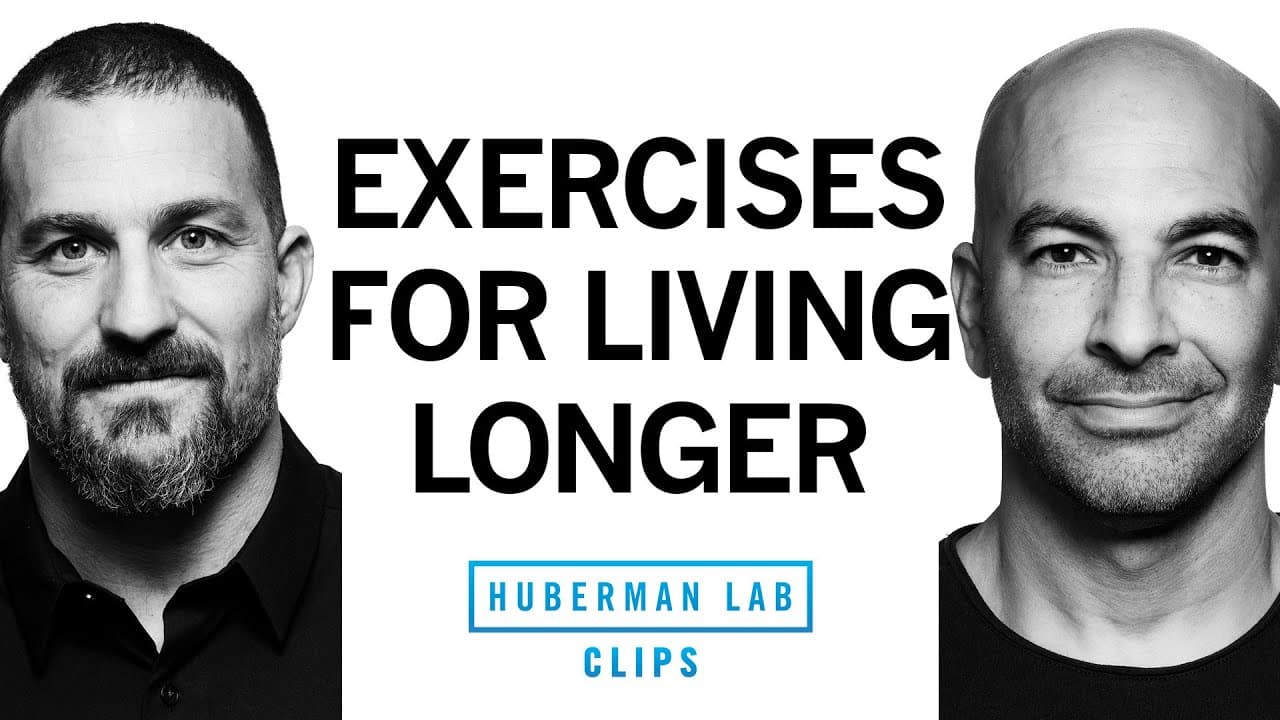
Best Exercises for Overall Health & Longevity | Dr. Peter Attia & Dr. Andrew Huberman
TL;DR
The best exercise-related markers for health and longevity are high cardiorespiratory fitness and strength. Compared with the top 2.5% for age and sex, the bottom 25% in VO2 max has roughly five times the all-cause mortality risk, while low strength carries about 3.5 times the risk of high strength. Read on for the comparisons and tests Dr. Peter Attia and Dr. Andrew Huberman discuss.
Transcript
- I've heard you talk before about some of the prime movers for longevity and all risk mortality. And I'd love for you to review a little bit of that for us. I think we all know that we shouldn't smoke because it's very likely that we'll die earlier, if we smoke nicotine. I'm neither a marijuana nor a nicotine smoker, So I feel on stable ground the... Read More
Key Insights
- ✋ Smoking increases the risk of all-cause mortality by 40%, while high blood pressure increases it by 20 to 25%.
- ✋ High muscle mass is associated with a 3x decrease in all-cause mortality risk, primarily due to its correlation with strength.
- 😘 Individuals with high cardiorespiratory fitness have a 2x to 5x lower risk of all-cause mortality.
- 💀 Strength and mobility tests, such as dead hangs and squats, can be used as indicators of overall health and longevity.
Install to Summarize YouTube Videos and Get Transcripts
Explore YouTube Video Summarizer or Get YouTube Transcript Extractor
Questions & Answers
Q: What are the best exercise-related indicators of overall health and longevity?
Cardiorespiratory fitness and strength show the strongest associations discussed by Dr. Peter Attia and Dr. Andrew Huberman. The transcript reports roughly a fivefold difference in all-cause mortality risk between the bottom 25% and top 2.5% for VO2 max, while low strength has about a 3.5-fold hazard ratio compared with high strength.
Q: How does cardiorespiratory fitness affect all-cause mortality risk?
People in the bottom 25% for VO2 max by age and sex have roughly twice the all-cause mortality risk of those in the 50th to 75th percentile. Comparing the bottom 25% with the top 2.5% produces about a fivefold difference, or a 400% difference in risk.
Q: Does an elite VO2 max require running fast marathons?
Not necessarily. “Elite” here refers to having a VO2 max in the top range for a person’s age, rather than being an elite athlete or marathon runner.
Q: How does strength relate to longevity?
Low strength is associated with about a 3.5-fold hazard ratio compared with high strength. That represents roughly a 250% greater risk of all-cause mortality for people with low strength.
Q: How does muscle mass affect all-cause mortality risk?
As people age, those with low muscle mass have about a threefold hazard ratio compared with those who have high muscle mass. The transcript says closer analysis suggests this relationship may be driven less by muscle mass itself and more by its strong association with strength.
Q: Which tests can be used to measure strength for longevity research?
Studies commonly use grip strength, leg extensions, wall sits, and squats because they are practical experimental measures. One example is holding a 90-degree squat without support; another measures how much weight a person can hold during a leg extension and for how long relative to body weight.
Q: What is the Strength Metrics Assessment discussed by Dr. Peter Attia?
The Strength Metrics Assessment, or SMA, is an 11-test program used with patients. One of its difficult tests is a dead hang, which measures how long someone can hang while supporting their body weight.
Q: How do smoking and high blood pressure compare with fitness-related mortality risks?
Smoking is associated with an approximately 40% higher risk of all-cause mortality at any point in time than never smoking; it does not mean lifespan is shortened by 40%. High blood pressure is associated with about a 20% to 25% increase, while the fitness comparisons discussed reach roughly threefold for low muscle mass, 3.5-fold for low strength, and fivefold between the lowest and highest VO2 max groups.
Summary & Key Takeaways
-
Smoking increases the risk of all-cause mortality by approximately 40%.
-
High blood pressure is linked to a 20 to 25% increase in all-cause mortality.
-
High muscle mass and strength are associated with a 3x decrease in the risk of all-cause mortality, while high cardiorespiratory fitness can reduce the risk by up to 5x.
Read in Other Languages (beta)
Share This Summary 📚
Summarize YouTube Videos and Get Video Transcripts with 1-Click
Try YouTube Summary with ChatGPT & Claude or YouTube Transcript Generator
Explore More Summaries from Huberman Lab Clips 📚



Summarize YouTube Videos and Get Video Transcripts with 1-Click
Try YouTube Summary with ChatGPT & Claude or YouTube Transcript Generator