How Zipline Revolutionized Drone Deliveries
TL;DR
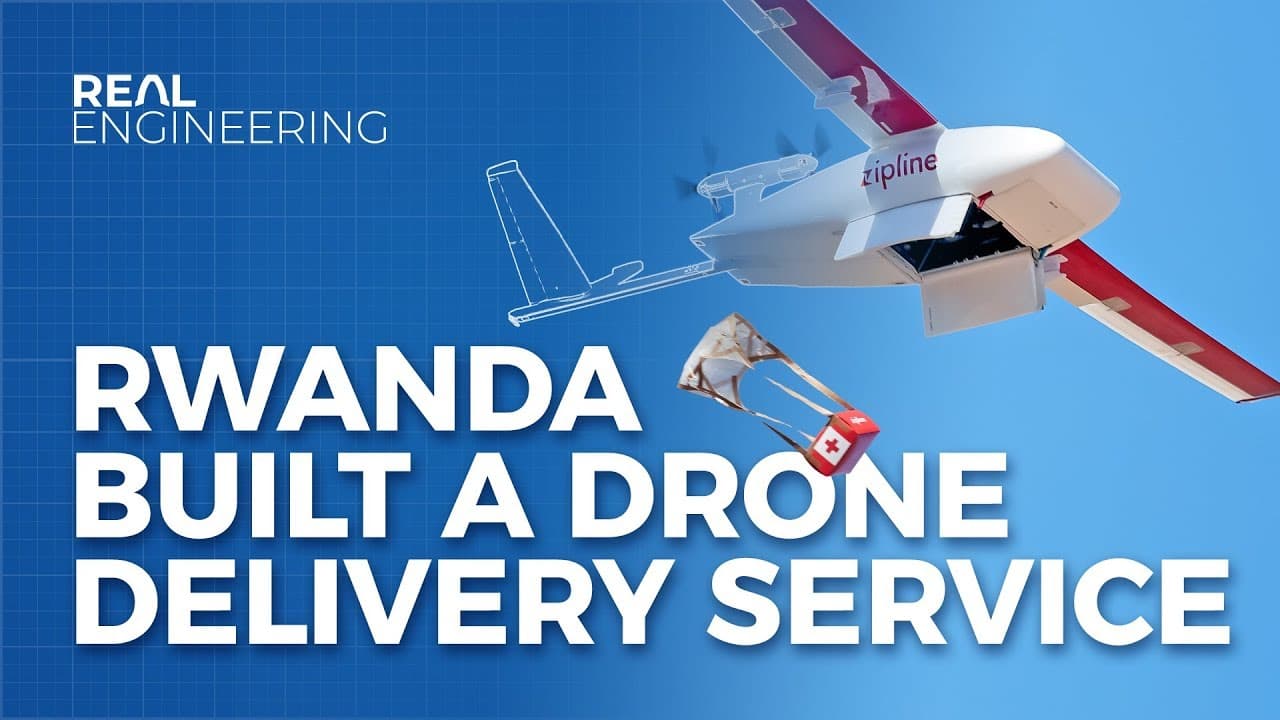
Zipline has created a groundbreaking drone delivery system in Rwanda, addressing the challenge of delivering essential medical supplies to remote areas. Their drones, designed for rapid deployment and efficiency, can deliver supplies quickly without needing complex infrastructure. This innovation not only improves healthcare access but also offers a potential model for future logistics in both developing and developed regions.
Transcript
This episode of Real Engineering is brought to you by Brilliant, a problem solving website that teaches you to think like an engineer. In the past few years there has been a lot of buzz around the possibility of drone delivery services. Most think companies like Amazon will be the first to deploy them in their distribution centres, but few realize ... Read More
Key Insights
- Zipline operates a fleet of autonomous drones to deliver medical supplies in Rwanda.
- The drones can be launched within 5 minutes of receiving an order, optimizing response time in emergencies.
- Innovative design features, such as moving GPS circuitry to the battery, reduce launch delays.
- The modular design of the drones allows for easy assembly and maintenance, enhancing operational efficiency.
- Drones use a pulley and electric motor system for rapid take-off, reaching 100 km/h in 0.3 seconds.
- Supplies are delivered via parachuted boxes, eliminating the need for landing infrastructure at delivery sites.
- Zipline's drones incorporate redundancy in critical systems, ensuring safety and reliability.
- Rwanda serves as a valuable testbed for integrating autonomous drones into national airspace systems.
Install to Summarize YouTube Videos and Get Transcripts
Explore YouTube Video Summarizer or Get YouTube Transcript Extractor
Questions & Answers
Q: How does Zipline's drone delivery system work?
Zipline's system operates by deploying autonomous drones to deliver medical supplies quickly to remote areas. Orders are processed and launched within minutes, with drones reaching speeds of 100 km/h. The supplies are dropped via parachuted boxes, requiring no landing infrastructure. This system is efficient, reliable, and adaptable to various terrains and conditions.
Q: What makes Zipline's drones unique?
Zipline's drones feature several unique design elements, such as modular components for easy assembly, GPS circuitry integrated into the battery for constant connectivity, and a pulley-based launch system for rapid take-off. These innovations allow the drones to be highly efficient and responsive, critical for emergency medical deliveries.
Q: Why is Rwanda an ideal location for Zipline's operations?
Rwanda is ideal due to its challenging terrain and infrastructure limitations, which highlight the need for efficient delivery systems. Additionally, Rwanda's regulatory environment allows for testing and integrating autonomous drones into national airspace, providing valuable insights for potential expansion into more complex airspaces globally.
Q: What safety measures are implemented in Zipline's drones?
Safety is ensured through redundancy; each drone has two of every critical component, such as motors and actuators. If any component fails, the drone can deploy a parachute for a safe landing. This focus on redundancy has resulted in zero injury-causing accidents since the service began in 2016.
Q: How does Zipline ensure quick deployment of drones?
Zipline ensures quick deployment by designing drones with modular components that can be assembled rapidly. The GPS circuitry is integrated into the battery, maintaining constant connectivity. The launch system uses a pulley and electric motor to quickly accelerate the drone to cruising speed, minimizing delays from order to launch.
Q: What are the benefits of Zipline's drone delivery system?
The benefits include rapid delivery of medical supplies to remote areas, improved healthcare access, reduced waste of perishable medical supplies, and minimized human exposure during disease outbreaks. The system's efficiency and adaptability make it a potential model for logistics in both developing and developed regions.
Q: How does Zipline's drone delivery impact healthcare in Rwanda?
Zipline's drones significantly impact healthcare by ensuring timely delivery of essential medical supplies, such as blood and vaccines, to remote areas. This reduces the risk of medical emergencies becoming critical due to supply delays, thus improving overall healthcare outcomes and access in underserved regions.
Q: What future potential does Zipline's technology have?
Zipline's technology has the potential to revolutionize logistics by providing a scalable model for rapid delivery systems. It could be applied in disaster relief, centralized supply management, and even in developed countries with complex regulatory environments. The ongoing data collection and testing in Rwanda will aid in refining and expanding these capabilities.
Summary & Key Takeaways
-
Zipline's drone delivery service in Rwanda addresses the critical need for quick medical supply deliveries in remote areas. Their drones, capable of rapid deployment, use innovative design features to minimize launch time and maximize efficiency. This system not only improves healthcare access but also provides a model for future logistics solutions worldwide.
-
The drones are designed with modular components for ease of assembly and maintenance. They launch using a pulley system, reaching cruising speed almost instantly. Supplies are delivered via parachuted boxes, negating the need for complex infrastructure at delivery sites, making the service highly adaptable to various environments.
-
Safety and reliability are prioritized through redundant systems in the drones, which have two of every critical component. Rwanda's airspace serves as a testbed for integrating such autonomous systems, offering valuable insights for potential expansion into other regions with busier airspaces.
Read in Other Languages (beta)
Share This Summary 📚
Summarize YouTube Videos and Get Video Transcripts with 1-Click
Try YouTube Summary with ChatGPT & Claude or YouTube Transcript Generator
Explore More Summaries from Real Engineering 📚






Summarize YouTube Videos and Get Video Transcripts with 1-Click
Try YouTube Summary with ChatGPT & Claude or YouTube Transcript Generator