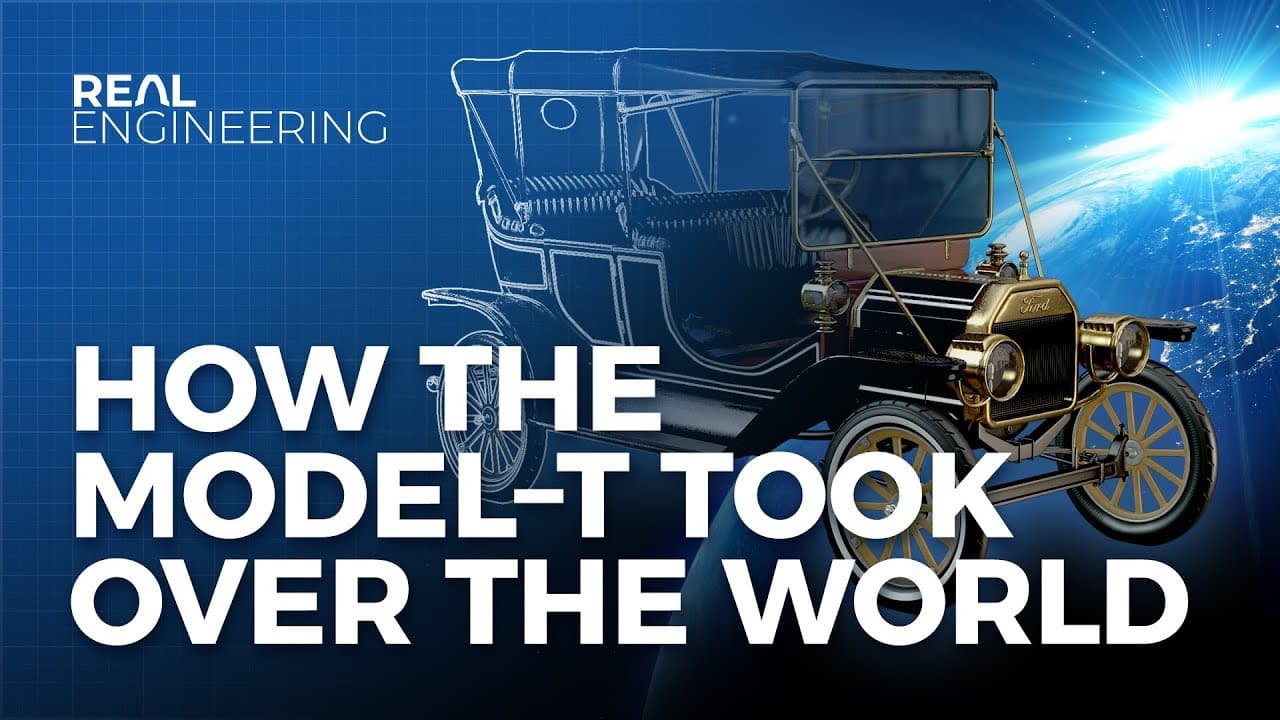
How The Ford Model T Took Over The World
TL;DR
Ford's manufacturing innovations revolutionized the automotive industry and modern society.
Transcript
This Episode of Real Engineering is brought to you by Skillshare, home to over 20,000 classes that could teach you a new lift skill. The Ford Model T was not the first car. Not even close. Depending on how you define what a car is, that honour was achieved 100 years before Henry Ford was even born in 1769, when French engineer Nicolas-Joseph Cugnot... Read More
Key Insights
- Henry Ford did not invent the automobile but revolutionized its manufacturing, making cars affordable for the masses and changing modern society.
- Before Ford, automotive manufacturing was a craft industry with highly skilled workers; Ford's techniques transformed it into mass production.
- Ford's obsession with manufacturing speed led to innovations like the moving assembly line, drastically reducing production times.
- The standardization of parts, facilitated by new technologies, allowed Ford to produce interchangeable components, reducing costs and increasing efficiency.
- Ford's mass production techniques led to the decline of craft manufacturing and the rise of industrial engineering.
- Ford's methods were eventually adopted globally, leading to the proliferation of mass manufacturing and the rise of companies like Toyota.
- Despite paying workers well, Ford's focus on single-task jobs made employees easily replaceable, impacting job stability and skills transferability.
- Ford's innovations laid the groundwork for modern manufacturing, but also contributed to economic challenges like Detroit's decline.
Install to Summarize YouTube Videos and Get Transcripts
Explore YouTube Video Summarizer or Get YouTube Transcript Extractor
Questions & Answers
Q: What was Henry Ford's major contribution to the automotive industry?
Henry Ford's major contribution was the development and implementation of mass production techniques, particularly the moving assembly line. This innovation drastically reduced the time and cost of manufacturing automobiles, making them affordable for the general public and transforming the automotive industry from craft-based to mass production.
Q: How did Ford's manufacturing techniques impact skilled workers?
Ford's manufacturing techniques reduced the need for skilled workers by simplifying tasks and focusing on mass production. This shift meant that workers were no longer required to have a broad skill set, as tasks were broken down into simple, repeatable actions. As a result, jobs became more specialized, reducing the demand for highly skilled craftsmen.
Q: What role did standardization of parts play in Ford's success?
Standardization of parts was crucial to Ford's success as it allowed for interchangeable components, reducing variability and production costs. This was facilitated by advancements in precision measurement and manufacturing technologies, enabling Ford to produce cars efficiently and at a lower cost, contributing to the affordability and popularity of the Model T.
Q: Why was the Model T significant in automotive history?
The Model T was significant because it was the first automobile to be mass-produced using assembly line techniques, making it affordable to the average consumer. This democratization of car ownership transformed transportation, facilitated urban expansion, and changed the social and economic fabric of society, establishing the car as a central element of modern life.
Q: How did Ford's innovations influence global manufacturing?
Ford's innovations in manufacturing, particularly the moving assembly line and standardization of parts, set a new benchmark for efficiency and cost-effectiveness. These techniques were adopted by manufacturers worldwide, leading to the global proliferation of mass production and influencing industries beyond automotive, shaping modern industrial practices and economies.
Q: What were the economic consequences of Ford's manufacturing model?
Ford's manufacturing model led to significant economic consequences, including the decline of craft manufacturing and the rise of industrial jobs that were more specialized and less skilled. While it boosted production and economic growth, it also contributed to job instability, as workers became easily replaceable, and impacted cities like Detroit, which eventually faced economic decline.
Q: How did Ford's approach to employee management differ from his competitors?
Ford paid his workers relatively well for the time, recognizing that higher wages would enable them to afford the products they made and reduce turnover. However, his approach also involved simplifying tasks to make workers easily replaceable, leading to a workforce that was less skilled and more vulnerable to economic downturns compared to his competitors who employed craft-based techniques.
Q: What long-term impact did Ford's innovations have on society?
Ford's innovations had a profound long-term impact on society by facilitating the widespread availability of automobiles, which transformed transportation, urban development, and economic structures. His manufacturing techniques set the stage for modern industrial practices, influencing various sectors and contributing to the development of consumer culture and the global economy.
Summary & Key Takeaways
-
Henry Ford's innovations in manufacturing, particularly the moving assembly line, revolutionized the automotive industry by making cars affordable for the masses and changing modern society's structure.
-
Ford's focus on manufacturing speed and standardization of parts allowed for unprecedented production efficiency, leading to the decline of craft manufacturing and the rise of mass production.
-
While Ford's methods were adopted worldwide, leading to global manufacturing growth, they also contributed to economic challenges, such as job instability and the decline of cities like Detroit.
Read in Other Languages (beta)
Share This Summary 📚
Summarize YouTube Videos and Get Video Transcripts with 1-Click
Try YouTube Summary with ChatGPT & Claude or YouTube Transcript Generator
Explore More Summaries from Real Engineering 📚





Summarize YouTube Videos and Get Video Transcripts with 1-Click
Try YouTube Summary with ChatGPT & Claude or YouTube Transcript Generator