Tesla's Battery Supply Problem
TL;DR
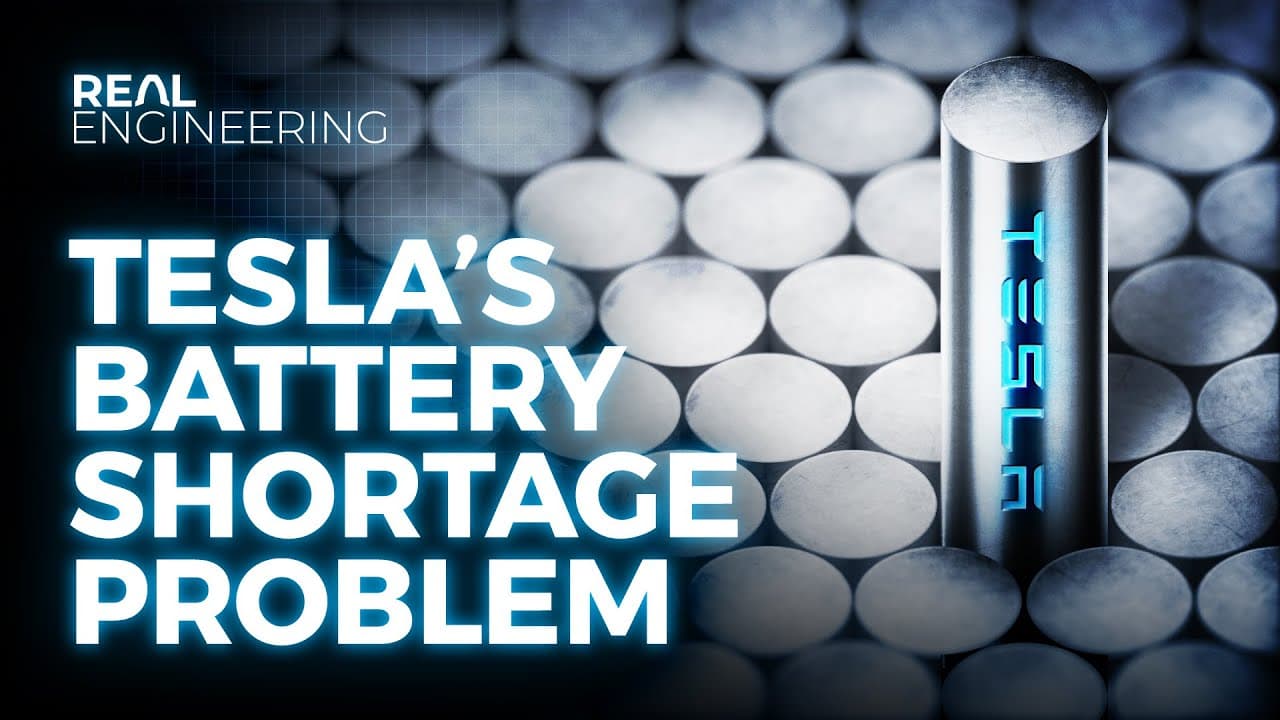
Tesla faces significant supply chain challenges in scaling battery production.
Transcript
This episode of Real Engineering is brought to you by Brilliant, the problem solving website that teaches you to think like an engineer. Last month Elon Musk and Drew Baglino took to the stage to share the latest developments in Tesla’s battery technology with investors and tech enthusiasts around the world. If we were to boil the theme of this pre... Read More
Key Insights
- Tesla's primary challenge is scaling its battery production to meet the global demand for electric vehicles, requiring a massive increase in supply chain logistics.
- The company aims for a 100-fold increase in battery production to transition the global vehicle market to electric, highlighting the need for 10 TWh of battery production annually.
- Tesla's battery technology primarily relies on lithium-ion chemistry, with lithium, nickel, and cobalt being crucial materials that face supply chain constraints.
- Silicon is being researched as an alternative anode material to graphite, offering significantly higher energy capacity, but poses challenges due to volume expansion during charging.
- Cobalt, sourced mainly from the Democratic Republic of the Congo, presents ethical and geopolitical challenges, prompting Tesla to reduce its cobalt dependency.
- Nickel is another critical material, with Tesla seeking environmentally friendly extraction methods due to the high demand from both the battery and steel industries.
- Recycling of lithium-ion batteries is essential for a sustainable supply chain, with companies like Redwood Materials leading efforts in battery recycling.
- Tesla's innovative tabless battery design improves manufacturing efficiency, reducing the need for additional factories and speeding up production.
Install to Summarize YouTube Videos and Get Transcripts
Explore YouTube Video Summarizer or Get YouTube Transcript Extractor
Questions & Answers
Q: What is the primary challenge Tesla faces in scaling its battery production?
Tesla's primary challenge in scaling its battery production is overcoming supply chain logistics. The company needs to significantly increase its production capacity to meet the global demand for electric vehicles, requiring a 100-fold increase in battery production to transition the global vehicle market to electric.
Q: Why is silicon considered as an alternative anode material in Tesla's batteries?
Silicon is considered as an alternative anode material because it offers significantly higher energy capacity compared to graphite. A silicon atom can bind 4.4 lithium ions, providing 11.3 times the energy capacity of graphite. However, silicon poses challenges due to volume expansion during charging, which can damage the battery.
Q: What ethical and geopolitical challenges are associated with cobalt in Tesla's supply chain?
Cobalt is primarily sourced from the Democratic Republic of the Congo, which presents ethical and geopolitical challenges due to issues like child labor and dangerous mining practices. These challenges have prompted Tesla to reduce its dependency on cobalt and seek alternative materials for its battery production.
Q: How does Tesla's tabless battery design improve manufacturing efficiency?
Tesla's tabless battery design improves manufacturing efficiency by eliminating the need to stop the production process to weld tabs to the current collectors. This design increases the factory's throughput, allowing for faster production and reducing the number of factories needed to meet production goals.
Q: What role does recycling play in Tesla's battery supply chain strategy?
Recycling plays a crucial role in Tesla's battery supply chain strategy by providing a sustainable source of materials. As the number of batteries available for recycling increases, a more cyclical supply chain will emerge, reducing the reliance on raw material mining and helping to overcome supply chain constraints.
Q: What are the potential bottlenecks in Tesla's battery supply chain?
The potential bottlenecks in Tesla's battery supply chain include the supply of critical materials like lithium, nickel, and cobalt. Cobalt, in particular, presents ethical and geopolitical challenges, while nickel is in high demand from both the battery and steel industries. Tesla is working to mitigate these bottlenecks through material diversification and recycling.
Q: How does Tesla plan to address the supply chain challenges associated with nickel?
Tesla plans to address the supply chain challenges associated with nickel by seeking environmentally friendly extraction methods and encouraging nickel producers to sign exclusive contracts. The company aims to reduce its reliance on cobalt by increasing the use of nickel in its batteries, despite the high demand from other industries.
Q: What are the limitations of lithium-ion batteries for grid storage?
Lithium-ion batteries have limitations for grid storage, including limited life cycles and unsuitability for long-term storage. They are not ideal for large-scale grid storage due to their high cost and the need for high energy density, which is unnecessary for stationary applications. Alternative, cheaper grid storage technologies are needed to complement lithium-ion batteries.
Summary & Key Takeaways
-
Tesla's battery day presentation highlighted the company's ambitious goal to significantly scale battery production to meet the global demand for electric vehicles. The focus is on overcoming supply chain challenges, particularly with critical materials like lithium, nickel, and cobalt.
-
Silicon is being explored as a potential anode material to replace graphite due to its higher energy capacity, but it presents challenges such as volume expansion. Tesla is working on solutions to incorporate small amounts of silicon in its batteries.
-
Recycling of lithium-ion batteries is crucial for a sustainable supply chain, with startups like Redwood Materials working on large-scale recycling solutions. Tesla's tabless battery design also enhances manufacturing efficiency, crucial for meeting production goals.
Read in Other Languages (beta)
Share This Summary 📚
Summarize YouTube Videos and Get Video Transcripts with 1-Click
Try YouTube Summary with ChatGPT & Claude or YouTube Transcript Generator
Explore More Summaries from Real Engineering 📚

Summarize YouTube Videos and Get Video Transcripts with 1-Click
Try YouTube Summary with ChatGPT & Claude or YouTube Transcript Generator