The V-22 Osprey and why it keeps crashing
TL;DR
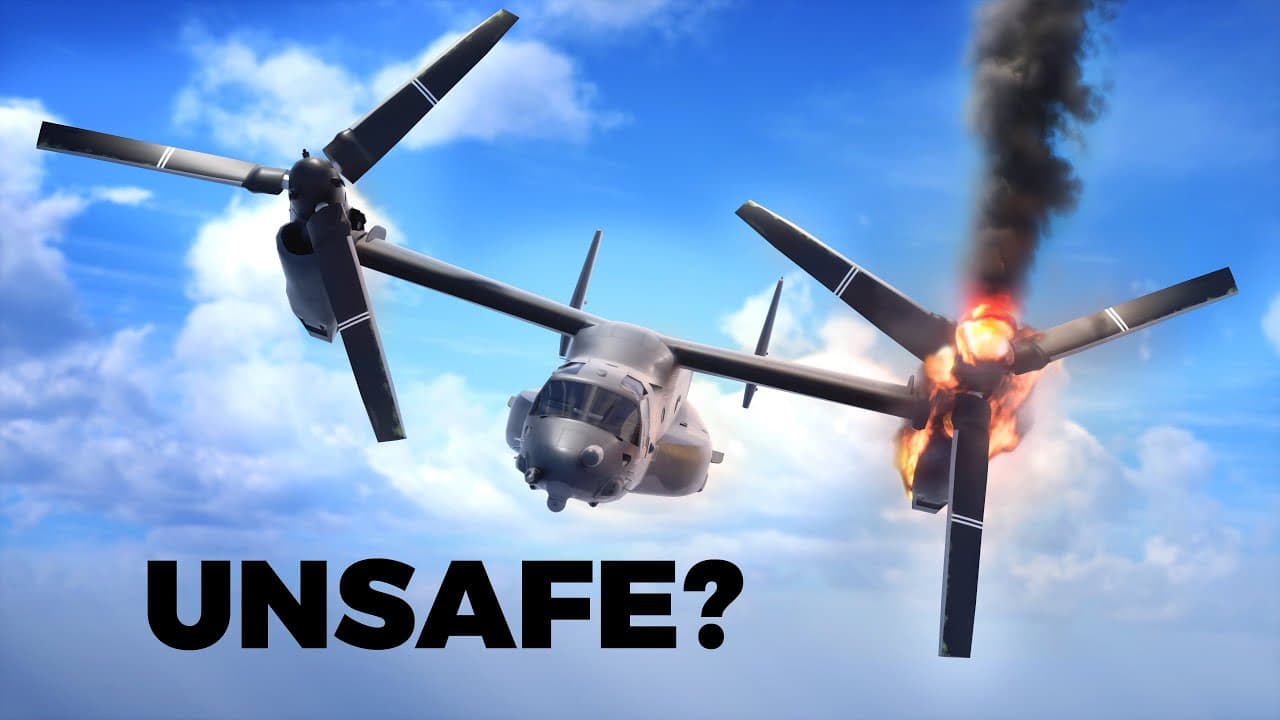
The V-22 Osprey's safety concerns are analyzed after recent crashes.
Transcript
Off the coast of Japan in November 2023 three CV22 Ospreys were preparing for what should have been a routine training mission. After a refueling and maintenance stop in Iwakuni, two of the three Ospreys took off to practice refueling with a C130 and perform a free fall water jump, with the third Osprey trailing one hour behind in support. The t... Read More
Key Insights
- The V-22 Osprey combines helicopter and airplane features, allowing for vertical takeoff and high-speed flight, but its complex mechanics pose significant safety risks.
- The recent crash in Japan involved a CV-22 Osprey experiencing gearbox failure, leading to a catastrophic crash and grounding of the fleet.
- The aircraft's tiltrotor system is intricate, requiring precise control to avoid crashes, and any mechanical failure in this system can have dire consequences.
- Historical context reveals the Osprey was developed in response to the failed Operation Eagle Claw, which highlighted the need for an aircraft with extended range and hovering capabilities.
- Despite its innovative design, the V-22 has a history of mechanical failures and accidents, earning it a reputation as a 'widow maker' among some military personnel.
- Comparative data shows the V-22's incident rate per airframe is relatively low, but its death rate per flight hour is higher due to its larger capacity.
- The Osprey's high disk loading results in inefficient hovering, making ground operations challenging due to its intense downwash.
- The series of crashes has prompted a reevaluation of the V-22's safety protocols and mechanical reliability, with ongoing investigations into recent incidents.
Install to Summarize YouTube Videos and Get Transcripts
Explore YouTube Video Summarizer or Get YouTube Transcript Extractor
Questions & Answers
Q: What is the main feature of the V-22 Osprey?
The V-22 Osprey's main feature is its tiltrotor system, which allows it to take off and land vertically like a helicopter and fly at high speeds like an airplane. This unique capability provides greater operational flexibility, enabling it to perform a wide range of missions, including transport, rescue, and special operations.
Q: What caused the recent crash of the V-22 Osprey in Japan?
The recent crash of the V-22 Osprey in Japan was caused by a gearbox failure. The aircraft experienced multiple chip burn advisories during the flight, indicating mechanical wear. Despite attempts to address these issues, the left nacelle caught fire during the landing approach, leading to a catastrophic failure of the propulsion system and the subsequent crash into the water.
Q: Why was the V-22 Osprey developed?
The V-22 Osprey was developed in response to the failed Operation Eagle Claw during the Iranian Revolution, which highlighted the need for an aircraft capable of long-range missions and hovering. Traditional helicopters lacked the necessary range and speed, prompting the development of a hybrid aircraft that could overcome these limitations and perform complex military operations.
Q: What are the challenges associated with the V-22 Osprey's design?
The V-22 Osprey's design presents several challenges, primarily due to its complex tiltrotor system. The intricate mechanics require precise control to avoid crashes, and any mechanical failure can have severe consequences. Additionally, the aircraft's high disk loading results in inefficient hovering, making ground operations challenging due to its intense downwash, which can reach speeds of 80 knots.
Q: How does the V-22 Osprey compare to other military helicopters in terms of safety?
In terms of safety, the V-22 Osprey has a relatively low incident rate per airframe compared to other military helicopters like the Sikorsky H-60 and the Chinook H-47. However, its death rate per flight hour is higher due to its larger capacity, which increases the risk per crash. The Osprey's complex design and history of mechanical failures have contributed to its mixed safety record.
Q: What role does the tiltrotor system play in the V-22 Osprey's operation?
The tiltrotor system is crucial to the V-22 Osprey's operation, allowing it to transition between helicopter and airplane modes. In helicopter mode, the rotors provide lift for vertical takeoff and landing, while in airplane mode, they function as propellers for forward flight. This system provides the Osprey with its unique versatility but also introduces significant mechanical complexity and risks.
Q: What historical event influenced the development of the V-22 Osprey?
The development of the V-22 Osprey was influenced by the failure of Operation Eagle Claw during the Iranian Revolution. The mission's failure highlighted the limitations of traditional helicopters in terms of range and speed, prompting the need for a new type of aircraft that could perform long-range missions and hover for extractions, leading to the creation of the hybrid V-22 Osprey.
Q: What safety measures are in place for the V-22 Osprey's gearbox system?
The V-22 Osprey's gearbox system includes safety measures such as chip detectors that monitor for metallic particles indicating gear wear. These detectors can burn off small chips, but if larger chips are detected, the system alerts the pilots to land as soon as possible. Despite these measures, gearbox failures have been a recurring issue, as seen in the recent crash off Japan.
Summary & Key Takeaways
-
The V-22 Osprey, a hybrid aircraft, is designed to combine the capabilities of helicopters and airplanes, allowing for vertical takeoff and high-speed flight. However, its complex mechanics have led to safety concerns, with recent crashes prompting a reevaluation of its reliability and safety protocols.
-
The Osprey's development was driven by the need for a versatile aircraft capable of long-range missions and hovering, as highlighted by the failure of Operation Eagle Claw. Despite its innovative design, the V-22 has faced mechanical challenges and a history of accidents, earning it a mixed reputation.
-
Recent incidents, including a crash off Japan, have raised questions about the V-22's safety. The aircraft's high disk loading and intricate tiltrotor system require precise control, and any mechanical failure can lead to catastrophic outcomes, as seen in the latest crash involving gearbox failure.
Read in Other Languages (beta)
Share This Summary 📚
Summarize YouTube Videos and Get Video Transcripts with 1-Click
Try YouTube Summary with ChatGPT & Claude or YouTube Transcript Generator
Explore More Summaries from Real Engineering 📚






Summarize YouTube Videos and Get Video Transcripts with 1-Click
Try YouTube Summary with ChatGPT & Claude or YouTube Transcript Generator