How Does Von Neumann Architecture Work?
TL;DR
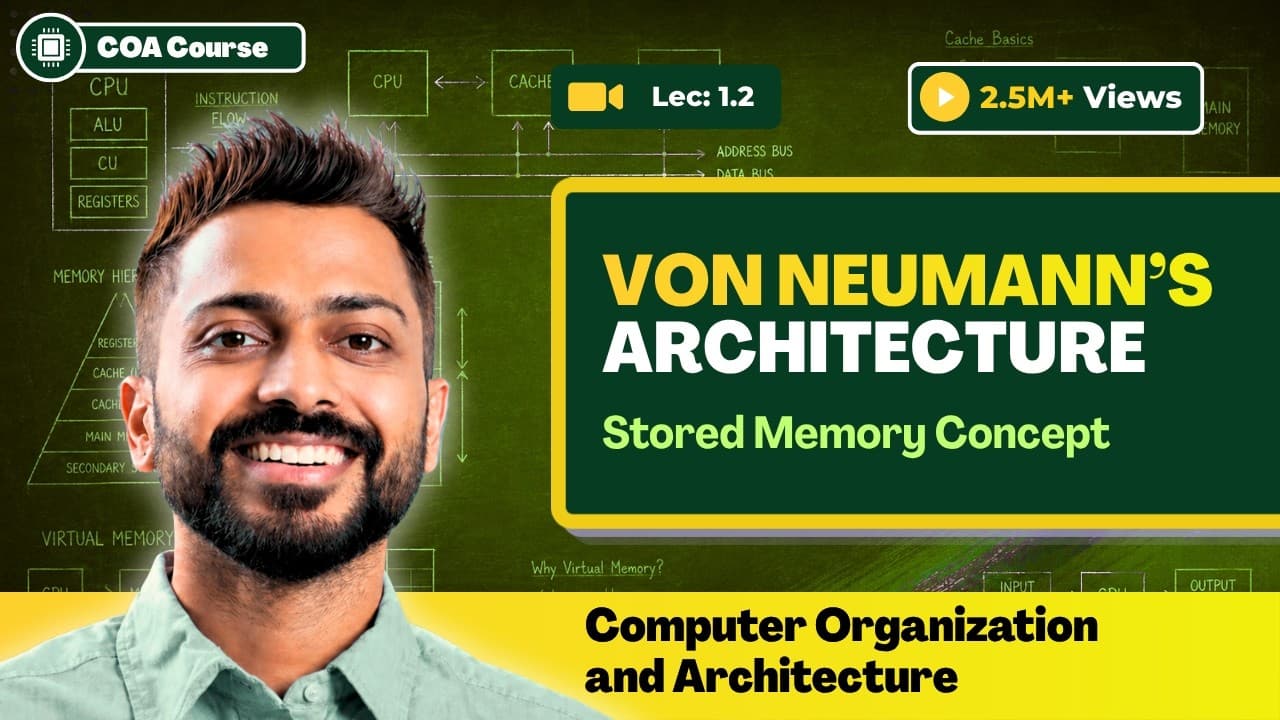
Von Neumann architecture stores program instructions and data at different addresses within the same main memory. The CPU retrieves them for processing, using registers for temporary storage, the ALU for arithmetic and logical operations, and the control unit to coordinate timing, sequencing, and read-write activity before results return to memory or an output destination.
Transcript
Hello friends, welcome to Gate Smashers In today's video, we are going to discuss about Von Newmann's architecture or we call it stored memory architecture or stored memory program What does it mean by stored memory? Where we keep two things inside memory one is data and second is program or set of instructions Data means like we write in program o... Read More
Key Insights
- The stored-program concept places both data and program instructions in the same main memory. Variables, constants, and instruction commands occupy different addresses, allowing one memory system to hold the information and operations needed for processing.
- Von Neumann architecture differs from Harvard architecture in its memory arrangement. Von Neumann architecture keeps instructions and data together in one main memory, while the described Harvard approach stores the instruction set and data in separate memories.
- The ALU is the CPU component that performs arithmetic, logical, and shift operations. Its available circuits support addition, subtraction, multiplication, division, AND, OR, XOR, and shifting, turning stored inputs into calculated or logically processed results.
- Registers are the CPU's fastest and smallest memory elements, and they store information temporarily. They can hold input data, output data, addresses, and intermediate results while instructions are being processed by the CPU.
- Registers reduce the burden created by the speed difference between the ALU and main memory. By temporarily holding values close to the ALU, they act as intermediaries and help processing proceed without relying on main memory for every immediate value.
- The program counter stores the address of the next instruction to execute, while the accumulator stores intermediate results. Other examples include input registers, output registers, and the memory address register, each supporting a particular part of CPU processing.
- The control unit generates timing signals and control signals. Timing signals organize the sequence of instruction execution, while control signals coordinate register access and read-write operations so components perform their assigned work in the required order.
- The data-processing path begins when information is retrieved from main memory and sent to the CPU. Registers temporarily hold it, the ALU processes it, and the result returns to main memory before being displayed or stored elsewhere.
Install to Summarize YouTube Videos and Get Transcripts
Explore YouTube Video Summarizer or Get YouTube Transcript Extractor
Questions & Answers
Q: What is the stored-program concept in Von Neumann architecture?
The stored-program concept means that both program instructions and data are kept in the same main memory. Data includes variables and constants used during processing, while a program consists of instructions that specify the required work. Instructions and data can occupy different addresses, but they share one memory rather than being placed in separate memory systems.
Q: How does Von Neumann architecture differ from Harvard architecture?
Von Neumann architecture stores data and program instructions in a single main memory, using different addresses for each type of information. The described Harvard architecture takes the opposite approach by keeping the instruction set in one memory and data in another. The central distinction is therefore whether instructions and data share memory or use separate memories.
Q: What does the ALU do in a computer system?
The arithmetic and logical unit performs the CPU's arithmetic, logical, and shift operations. It uses different circuits, including adders and subtractors, to support addition, subtraction, multiplication, division, AND, OR, XOR, and shifting. When a calculation such as adding two stored values is required, the actual arithmetic processing takes place in the ALU.
Q: Why are registers needed when main memory is available?
Registers are needed because the ALU works very quickly, while main memory is slower in comparison. Registers temporarily hold input values, output values, addresses, and intermediate results close to the processing components. Acting as intermediaries between the ALU and main memory, they reduce the burden caused by the speed mismatch and help accelerate processing.
Q: What information do CPU registers store?
CPU registers temporarily store several kinds of processing information, including input data, output data, addresses, and intermediate results. The program counter holds the address of the next instruction, while the accumulator holds intermediate results. The architecture also includes input and output registers and a memory address register, which support communication and processing inside the system.
Q: How does the control unit manage instruction execution?
The control unit manages execution by producing timing signals and control signals. Timing signals determine which instruction or action occurs first and what follows it, preserving the required sequence. Control signals coordinate access to registers and manage read-write operations, preventing components from being used for conflicting work while another operation is already taking place.
Q: How is data processed in Von Neumann architecture?
Data and instructions are first held in main memory. Required information is brought from memory into the CPU, where registers provide temporary storage and the ALU performs the necessary arithmetic or logical processing. The output is then returned to main memory. From there, it can be shown to the user on a monitor or stored in secondary memory.
Q: How are the components of Von Neumann architecture connected?
The components are connected through a bus system. The lecture identifies different bus types, including the address bus and data bus, which help connect main memory with the CPU and its internal components. It also states that multiplexers are used to implement this connection structure, while the detailed operation of the buses is reserved for later discussion.
Summary & Key Takeaways
-
Von Neumann architecture is based on the stored-program concept. Both program instructions and data, such as variables and constants, reside at separate addresses in one main memory. This arrangement contrasts with Harvard architecture, which places instructions and data in different memories. The shared-memory design is presented as common in current computer architectures.
-
The CPU contains the ALU, registers, and control unit. The ALU performs arithmetic, logical, and shift operations using specialized circuits. Registers hold inputs, outputs, addresses, and intermediate results temporarily. Their location on the CPU and high speed help bridge the performance difference between the fast ALU and slower main memory.
-
The control unit coordinates processing through timing and control signals. Timing signals determine the order in which instructions execute, while control signals manage access to registers and their read-write operations. Data moves from main memory into the CPU for processing, returns to memory, and can then reach a monitor or secondary memory.
Read in Other Languages (beta)
Share This Summary 📚
Summarize YouTube Videos and Get Video Transcripts with 1-Click
Try YouTube Summary with ChatGPT & Claude or YouTube Transcript Generator
Explore More Summaries from Gate Smashers 📚





Summarize YouTube Videos and Get Video Transcripts with 1-Click
Try YouTube Summary with ChatGPT & Claude or YouTube Transcript Generator