How Should You Use Stuart McGill, Ph.D.’s Big Three Exercises for Back Pain Relief?
TL;DR
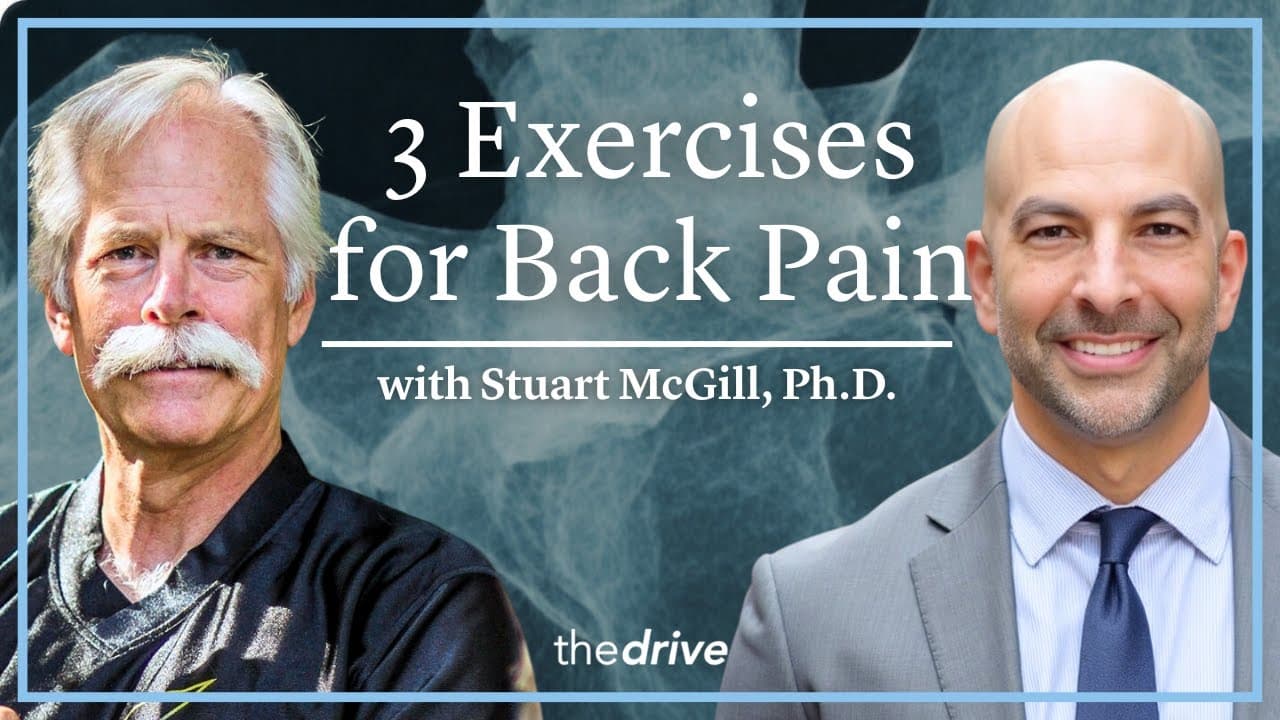
Use Stuart McGill’s Big Three only when an assessment indicates that stability training fits the mechanism of your back pain. The modified curl-up, side plank, and bird dog build torso stiffness while limiting spinal load, with repeated 10-second holds favored over fatiguing prolonged efforts. Their effects can include about 20 minutes of residual stiffness and, for some patients, an hour of pain relief. Read on for specific techniques, benefits, and scheduling guidance.
Transcript
Let's talk about those three exercises, Stuart. There are three exercises. Um, there's two of them that I've done consistently for quite some time. I really uh fancy them a bit. Um, the the the third one, the bird dog, I I only do occasionally. Um, but let's go through the three of them. And um, is it safe to say that that you and and just for the ... Read More
Key Insights
- The McGill Big Three are not appropriate for every person because back pain can arise from different mechanisms. McGill rejects the idea that everybody should perform them automatically and argues that an individual assessment must guide whether stability training is the appropriate solution.
- Core stiffness is a foundation for efficient movement because it prevents the torso from collapsing while limb muscles generate force. McGill describes unwanted collapse within the body’s linked segments as an energy leak that reduces how effectively force is directed toward a push, punch, or other movement.
- The modified curl-up is designed to challenge the abdominal muscles without reproducing painful low-back flexion. A person places the hands beneath the low back, lifts the elbows, and slightly raises the head, neck, and shoulders while preserving the posture identified as tolerable during assessment.
- The side plank is relatively spine sparing because it heavily challenges the muscles on the lower side while the upper side contributes less. McGill says this arrangement produces about half the spinal load associated with exercises that heavily recruit more of the torso musculature at once.
- The bird dog develops crossed muscular coordination by extending one leg and the opposite arm. This activates one side of the lower back and the opposite side of the upper back while teaching the brain to separate shoulder and hip motion from unwanted movement through the spine.
- Repeated 10-second holds build endurance while protecting exercise quality. McGill favors repeated exposures and a descending pyramid because prolonged holds can cause physical and neural fatigue, reduce the tolerable training level, and allow technique to deteriorate as the person becomes tired.
- The Big Three can create residual torso stiffness after a single session. McGill attributes this temporary effect to lasting neural stiffness rather than a structural change in muscle, with the effect lasting about 20 minutes in some people and longer in others.
- Temporary pain relief can guide how the exercises are scheduled. McGill notes that some patients report less pain for the next hour after performing the Big Three, so a 12-minute session in midmorning and another in midafternoon may help gradually reduce their symptoms.
Install to Summarize YouTube Videos and Get Transcripts
Explore YouTube Video Summarizer or Get YouTube Transcript Extractor
Questions & Answers
Q: What are Stuart McGill’s Big Three exercises for back pain?
The McGill Big Three are the modified curl-up, side plank, and bird dog. McGill selected them after testing numerous abdominal, back, twisting, pressing, and throwing exercises because they reliably create torso stiffness while limiting spinal load for people experiencing pain.
Q: Should everyone perform the McGill Big Three?
No. McGill says some people are already too stiff, while others have back pain caused by a mechanism that these exercises do not address. An assessment should determine the pain-provoking posture or movement and whether stability training is an appropriate solution.
Q: How does core stiffness support movement and performance?
Core stiffness prevents the torso from collapsing while a muscle generates force, avoiding what McGill calls an energy leak. This creates a firm proximal base that directs motion outward into a push, punch, or other movement. McGill also says residual stiffness can help football players run, cut, and change direction slightly faster.
Q: How is the modified curl-up performed for back pain?
Lie on the ground with your hands beneath your low back to preserve its posture, lift your elbows, and slightly hover your head, neck, and shoulders. The goal is to create an abdominal contraction without flattening the back into a posture that assessment identified as a pain trigger.
Q: Why is the side plank considered spine sparing?
The side plank strongly challenges the muscles on the lower side of the torso while the upper side contributes less. McGill says this produces about half the spinal load associated with exercises that heavily recruit more of the torso musculature at once.
Q: What does the bird dog exercise train?
The bird dog develops torso stability and crossed muscular coordination by extending one leg and the opposite arm. It activates one side of the lower back and the opposite side of the upper back while teaching the brain to separate shoulder and hip motion from unwanted spinal movement.
Q: Why does McGill recommend repeated 10-second holds?
Repeated 10-second holds build endurance while reducing the fatigue that can cause technique to deteriorate. McGill favors repeated exposures in a descending pyramid because prolonged holds can create physical and neural fatigue and lower the amount of stability training a person can tolerate.
Q: How long can the effects of the McGill Big Three last?
McGill says residual torso stiffness lasts about 20 minutes in some people and longer in others, attributing it to a temporary neural effect. Some patients report less pain for the next hour, so a 12-minute session in midmorning and another in midafternoon may help gradually reduce their symptoms.
Summary & Key Takeaways
-
The McGill Big Three are the modified curl-up, side plank, and bird dog, but they are not universal exercises for everyone. McGill argues that an assessment must identify the posture or movement provoking symptoms before exercise selection. People whose pain mechanism is unrelated to insufficient stability may require a different solution.
-
Core stiffness supports efficient force transfer through the body’s linked segments. Without proximal torso stiffness, a contracting muscle can collapse part of the linkage and create an energy leak instead of directing motion outward. The Big Three emerged from testing because they combined reliable stiffness with relatively low spinal loading for people experiencing pain.
-
The modified curl-up preserves the low-back posture, the side plank challenges one side of the torso, and the bird dog coordinates opposite limbs while developing stability. McGill recommends repeated 10-second intervals to build endurance without losing form. The resulting neural stiffness may persist temporarily, sometimes reducing pain and supporting faster directional changes.
Read in Other Languages (beta)
Share This Summary 📚
Summarize YouTube Videos and Get Video Transcripts with 1-Click
Try YouTube Summary with ChatGPT & Claude or YouTube Transcript Generator
Explore More Summaries from Peter Attia MD 📚






Summarize YouTube Videos and Get Video Transcripts with 1-Click
Try YouTube Summary with ChatGPT & Claude or YouTube Transcript Generator