How to Use Game Theory for Effective Decision Making
TL;DR
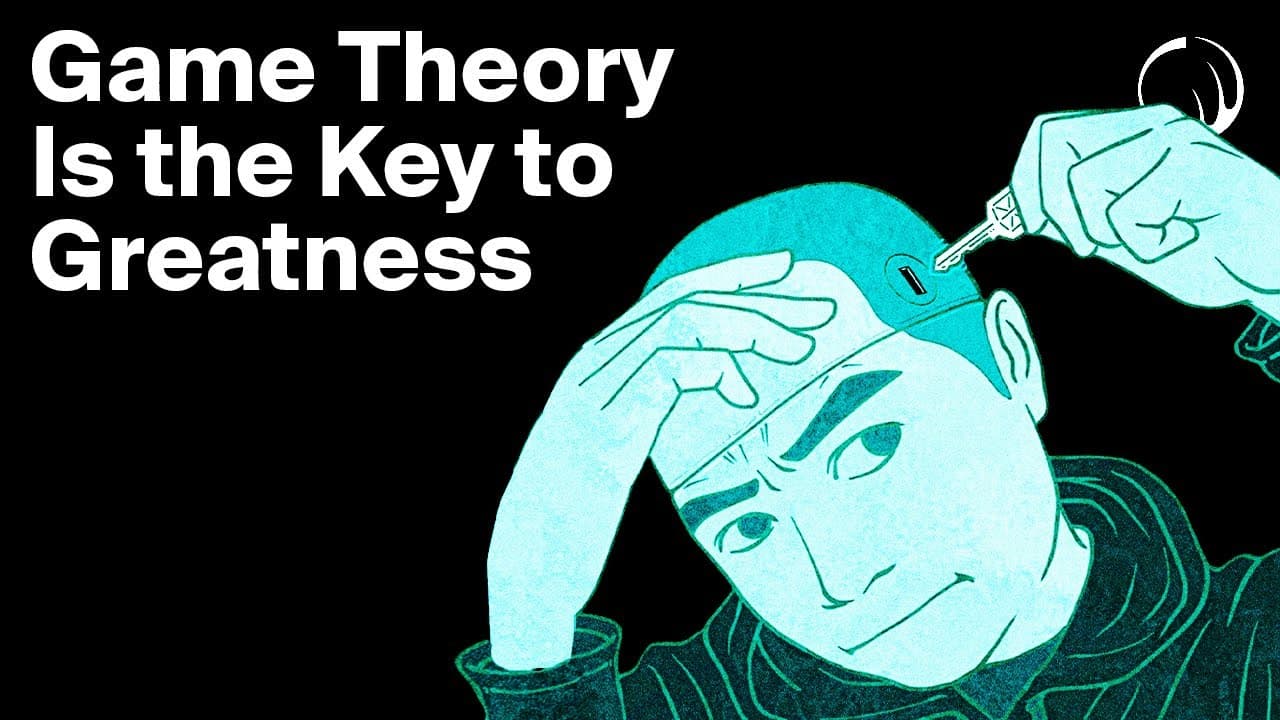
Game theory demonstrates that cooperation often leads to better outcomes in repeated interactions. The 'Tit for Tat' strategy, which starts with cooperation and reciprocates the opponent's last move, proves most effective. It emphasizes kindness, retaliation when necessary, and forgiveness, suggesting that a balanced approach is key to long-term success in social and economic interactions.
Transcript
This video is sponsored by boot.dev. Learn back-end web development through immersive gamified experiences. Go to boot.dev and use code wonder to get 25% off your first annual plan. You're 23 years old. You just moved into a modest two-bedroom apartment with a roommate, a neutral acquaintance you're splitting costs and responsibilities with. To ens... Read More
Key Insights
- Game theory is the mathematical study of decision-making in situations where outcomes depend on others' choices.
- The prisoner's dilemma illustrates how two individuals might not cooperate, even if it's in their best interest.
- Game theory distinguishes between cooperative and non-cooperative games, with the latter being more prevalent.
- The 'Tit for Tat' strategy, which reciprocates the opponent's last move, consistently proves effective in game theory simulations.
- Cooperation and forgiveness are strengths, while holding grudges and leading with defection often lead to failure.
- Axelrod's experiments showed that simple, cooperative strategies outperform complex, competitive ones in repeated interactions.
- Game theory suggests that focusing solely on winning can be less effective than aiming for mutual benefit over time.
- Real-life interactions are complex, involving emotions and irrationality, which game theory models may not fully capture.
Install to Summarize YouTube Videos and Get Transcripts
Explore YouTube Video Summarizer or Get YouTube Transcript Extractor
Questions & Answers
Q: What is game theory?
Game theory is the mathematical study of decision-making in situations where the outcomes depend on the choices of others. It examines the strategies individuals or groups use in competitive and cooperative situations to achieve optimal or suboptimal results. Game theory applies to various fields, including economics, politics, and social interactions.
Q: What is the prisoner's dilemma?
The prisoner's dilemma is a thought experiment in game theory where two individuals must decide whether to cooperate or betray each other without knowing the other's choice. Cooperation leads to the best collective outcome, but individual incentives often lead to defection, resulting in worse outcomes for both. It illustrates challenges in achieving mutual cooperation.
Q: What are cooperative and non-cooperative games?
Cooperative games involve interactions where participants work together towards shared goals, exchanging resources and information freely. Non-cooperative games, more prevalent, involve individuals or groups acting independently to maximize their own benefits, often at the expense of others. Game theory studies these dynamics to understand conflict and cooperation.
Q: What is the 'Tit for Tat' strategy?
The 'Tit for Tat' strategy in game theory involves starting with cooperation and then mimicking the opponent's last move. If the opponent cooperates, 'Tit for Tat' continues to cooperate; if the opponent defects, it retaliates. This strategy fosters long-term cooperation and is effective in repeated interactions, balancing kindness with appropriate retaliation.
Q: Why is cooperation important in game theory?
Cooperation is important in game theory because it often leads to better outcomes in repeated interactions. Cooperative strategies, like 'Tit for Tat', promote mutual benefit and long-term success. While defection might offer short-term gains, it can damage relationships and lead to worse outcomes over time. Cooperation fosters trust and stability in interactions.
Q: How did Axelrod's experiments contribute to game theory?
Axelrod's experiments tested various decision-making strategies in repeated prisoner's dilemma games. They revealed that simple, cooperative strategies like 'Tit for Tat' consistently outperformed complex, competitive ones. His findings emphasized the effectiveness of cooperation, forgiveness, and clear retaliation, challenging assumptions about the benefits of aggressive strategies.
Q: What are the limitations of game theory?
Game theory models may not fully capture the complexity of real-world interactions, which involve multiple participants, issues, and emotional factors. Real-life decisions are influenced by irrationality, sentiment, and changing circumstances, which can complicate the straightforward application of game theory strategies. Despite these limitations, game theory provides valuable insights into decision-making dynamics.
Q: How can game theory be applied in everyday life?
Game theory can be applied in everyday life by using strategies that promote cooperation and mutual benefit. Approaches like 'Tit for Tat' encourage starting with kindness, reciprocating actions, and forgiving past transgressions. By understanding the incentives and potential outcomes of interactions, individuals can make more informed decisions that foster positive relationships and long-term success.
Summary & Key Takeaways
-
Game theory explores decision-making where outcomes depend on others' choices. It highlights the prisoner's dilemma, where cooperation is mutually beneficial but often undermined by individual incentives. The 'Tit for Tat' strategy, which starts with cooperation and mimics the opponent's previous move, consistently proves effective in fostering long-term cooperation and success.
-
Axelrod's experiments in game theory revealed that simple, cooperative strategies outperform complex, competitive ones. 'Tit for Tat' wins by starting with cooperation, reciprocating moves, and forgiving opponents, emphasizing that cooperation and forgiveness are strengths, while defection and grudges lead to failure.
-
Game theory teaches that focusing solely on winning can be less effective than aiming for mutual benefit over time. Real-life interactions are complex, involving emotions and irrationality, which game theory models may not fully capture. However, a balanced approach of cooperation and appropriate retaliation fosters long-term success.
Read in Other Languages (beta)
Share This Summary 📚
Summarize YouTube Videos and Get Video Transcripts with 1-Click
Try YouTube Summary with ChatGPT & Claude or YouTube Transcript Generator
Explore More Summaries from Pursuit of Wonder 📚






Summarize YouTube Videos and Get Video Transcripts with 1-Click
Try YouTube Summary with ChatGPT & Claude or YouTube Transcript Generator