How to Enhance AI with Contextual Prompting
TL;DR
The key to maximizing AI efficiency lies in providing it with better context rather than complex prompts. By understanding and leveraging the five levels of context, users can transform AI from a basic tool into a powerful team member. The video explains each context level and how to apply them for improved AI interactions.
Transcript
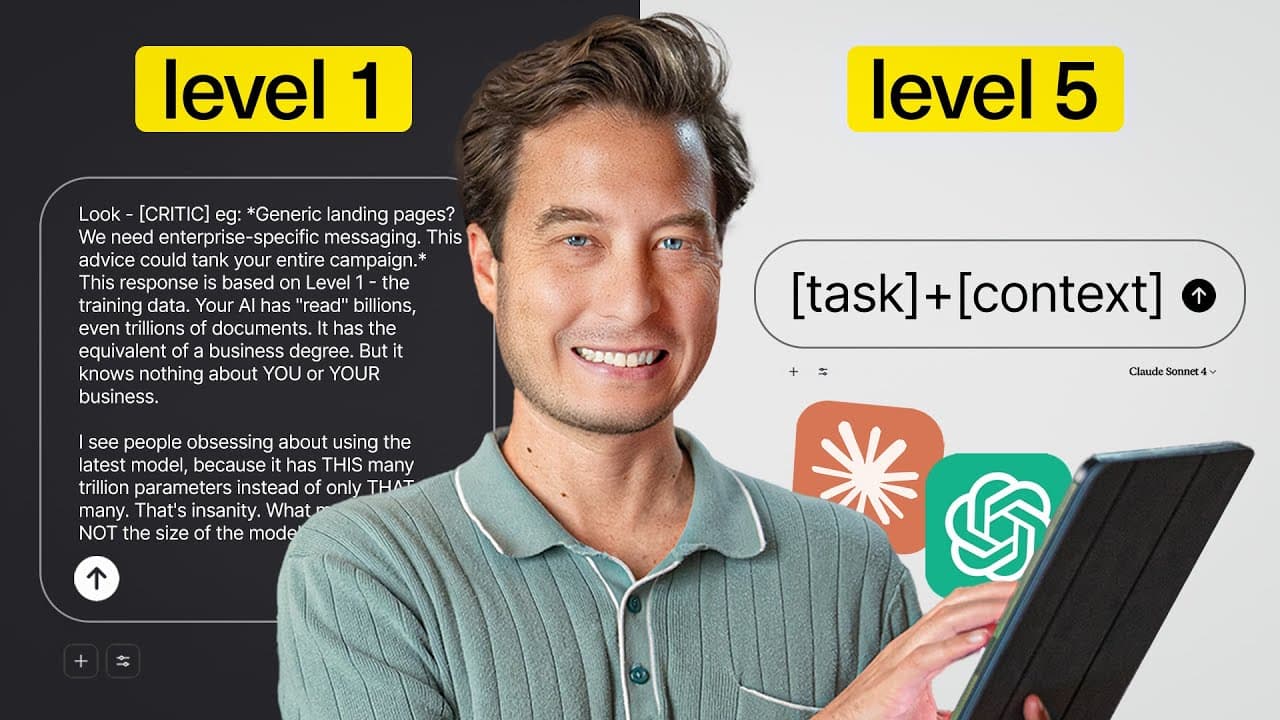
What if you could get better results from AI with a simple prompt like this than with a complex prompt like that? Well, the reality is you can because getting the most out of AI is no longer about better prompting. The secret lies in giving it better context. But what does that actually mean? And how can you use it to transform your AI from a forge... Read More
Key Insights
- AI's effectiveness improves with context, not just complex prompts.
- LLMs have a 120-page system prompt guiding responses.
- User preferences can be set for consistent AI interaction.
- Project knowledge allows AI to remember specific details.
- Context engineering enhances traditional prompt engineering.
- Five context levels: training data, system prompt, user preferences, project knowledge, and actual prompt.
- Trigger words in system prompts can deepen AI analysis.
- Customizing AI settings can lead to more accurate and relevant outputs.
Install to Summarize YouTube Videos and Get Transcripts
Explore YouTube Video Summarizer or Get YouTube Transcript Extractor
Questions & Answers
Q: How to improve AI responses with context?
Improving AI responses involves providing better context rather than complex prompts. Users should leverage the five levels of context: training data, system prompt, user preferences, project knowledge, and the actual prompt. By setting up these layers, AI can deliver more accurate, relevant, and strategic outputs, transforming it into a valuable team member.
Q: What are the five levels of AI context?
The five levels of AI context are: 1) Training data, which is the foundational knowledge from which AI draws; 2) System prompt, a hidden guide shaping AI responses; 3) User preferences, which tailor AI communication to individual needs; 4) Project knowledge, allowing AI to remember specific project details; and 5) The actual prompt, which utilizes all previous layers for optimal interaction.
Q: Why is system prompt important in AI?
The system prompt is crucial because it acts as a hidden guide that shapes how AI responds to user inputs. It contains essential instructions and trigger words that can be exploited to enhance AI's analytical depth and response quality. Understanding and leveraging the system prompt can lead to significantly improved AI interactions.
Q: How do user preferences affect AI interactions?
User preferences allow individuals to customize how AI communicates with them, ensuring that responses align with personal communication styles. By setting preferences such as response format or level of detail, users can achieve more consistent and satisfactory interactions, making AI a more effective tool for personalized tasks.
Q: What role does project knowledge play in AI?
Project knowledge enables AI to retain and utilize specific details about a project, such as product names, client information, and strategic goals. This level of context allows AI to provide tailored and informed responses, making it a more competent and reliable partner for ongoing projects, as it can draw on detailed and relevant information.
Q: How does context engineering improve prompt engineering?
Context engineering enhances prompt engineering by preloading AI with relevant information, allowing for more precise and effective prompts. When AI has access to comprehensive context, the need for lengthy, detailed prompts diminishes, as AI can infer and understand requirements more accurately, leading to better outcomes with less effort.
Q: What are trigger words in system prompts?
Trigger words in system prompts are specific terms that, when used, prompt AI to perform deeper analysis and provide more thoughtful responses. These words can significantly enhance the quality of AI outputs, as they activate advanced processing capabilities within the AI's system prompt, leading to more comprehensive and insightful interactions.
Q: How can AI be transformed into a strategic partner?
AI can be transformed into a strategic partner by leveraging the five levels of context: training data, system prompt, user preferences, project knowledge, and actual prompt. By setting these layers, AI can provide more precise, relevant, and strategic outputs, making it an invaluable tool for personalized and complex tasks, akin to a well-informed team member.
Summary & Key Takeaways
-
The video emphasizes that AI's potential is unlocked through context rather than complex prompts. By understanding the five context levels—training data, system prompt, user preferences, project knowledge, and actual prompt—users can significantly enhance AI's capabilities. The video demonstrates how each level contributes to creating a more effective AI interaction.
-
Utilizing system prompts and user preferences can lead to more targeted responses from AI. The video highlights the importance of project knowledge, which allows AI to retain specific information, making it an invaluable tool for personalized tasks. The final level, crafting the actual prompt, brings all context layers together for optimal AI performance.
-
The video provides a roadmap for mastering AI context: explore system prompts, set user preferences, and integrate project files. These steps enable users to create concise prompts that outperform lengthy ones, transforming AI into a strategic partner. By following the guide, viewers can achieve more efficient and effective AI interactions.
Read in Other Languages (beta)
Share This Summary 📚
Summarize YouTube Videos and Get Video Transcripts with 1-Click
Try YouTube Summary with ChatGPT & Claude or YouTube Transcript Generator
Explore More Summaries from Tiago Forte 📚






Summarize YouTube Videos and Get Video Transcripts with 1-Click
Try YouTube Summary with ChatGPT & Claude or YouTube Transcript Generator