How Does Claude Opus 5.5 Compare on Cost?
TL;DR
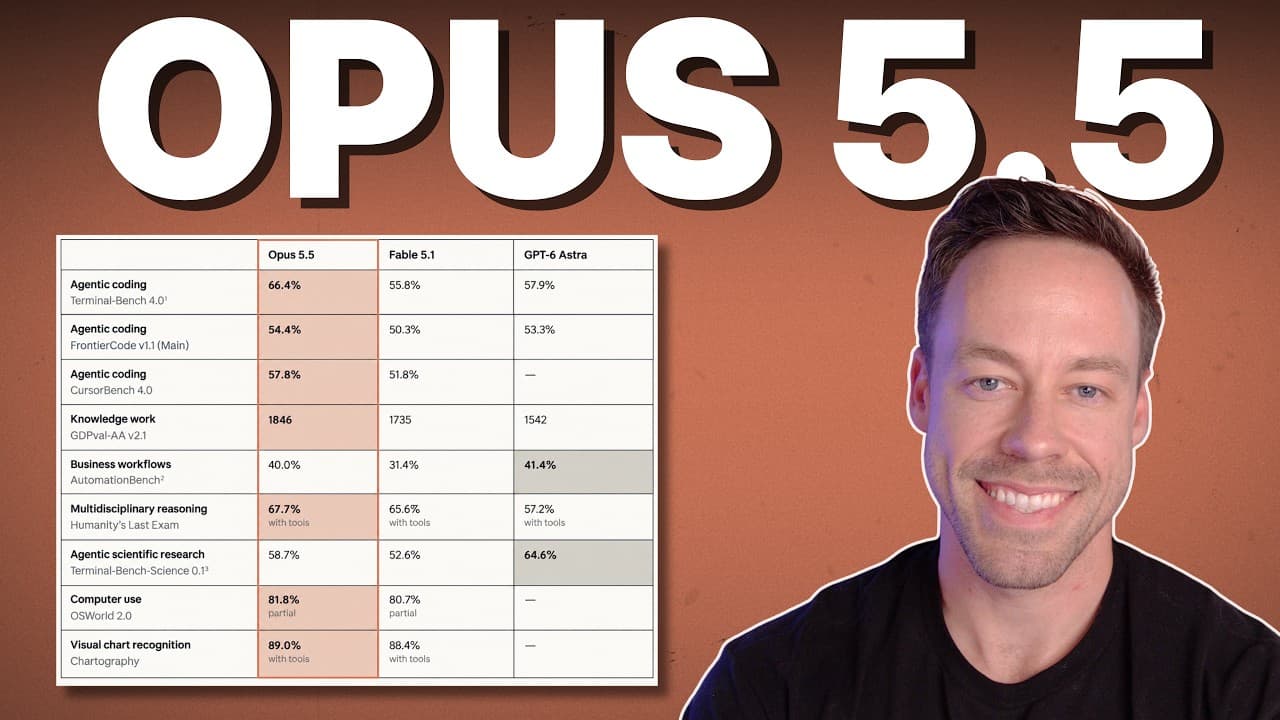
Claude Opus 5.5 reportedly matches or exceeds Fable 5.1 across most cited benchmarks while costing 40% less. The presented results also suggest that medium or high effort often delivers nearly maximum performance at far lower cost, although the model trails GPT6 Astra on business workflows and agentic scientific research, and real-world testing is still needed.
Transcript
So, we got a brand new Opus model. We've gone all the way from Claude 5 and jumped to 5.5. But what sort of changes do you need to know about? Well, the highlight is that Enthropic is saying Claude Opus 5.5 essentially operates at the same level as Fable 5.1, but costs 40% less. So, we're basically getting a cheaper Fable 5.1. Now, to start, let's ... Read More
Key Insights
- Claude Opus 5.5 is described as operating at approximately the same level as Fable 5.1 while costing 40% less. According to the presented benchmarks, it beats Fable 5.1 in nearly every measured area and makes substantial gains over Opus 5 on coding-related tasks.
- GPT6 Astra leads Opus 5.5 in two cited categories: business workflows and agentic scientific research. The reported margins are 1.4% for business workflows and about 6% for scientific research, while Opus 5.5 leads or remains competitive elsewhere in the displayed comparisons.
- Cost per completed task is more informative than token pricing alone because models may consume different quantities of tokens. The comparison therefore examines performance at multiple effort settings and the actual task cost, rather than assuming that a lower per-token price always creates lower overall expenses.
- Opus 5.5 at high effort reportedly scores 64.2% on Terminal Bench 4.0 for $3.88. Fable 5.1 at high effort scores 49.4% for $10.50, while Astra at high effort costs $7.21, making Opus 5.5 both stronger and cheaper in that comparison.
- Higher reasoning effort produces diminishing returns in the cited tests. Opus 5.5 moves from 64.2% at high effort to 64.8% at a higher setting while costing almost four times as much, suggesting that high effort may offer a more practical balance than extra-high or maximum effort.
- Medium effort is the strongest reported setting on the Frontier Code benchmark, reaching 54.6% compared with 54.4% at maximum effort. The medium setting is described as six or seven times cheaper, and it reportedly exceeds every other compared model while costing less than their low settings.
- Opus 5.5 token pricing is stated as $4 per million input tokens and $20 per million output tokens, with cheaper cache reads and writes than Opus 5. By comparison, both Astra and Fable 5.1 are listed at $10 for input and $50 for output.
- Opus 5.5 communication is described as clearer than Opus 5 because it uses less jargon, avoids idiosyncratic phrases, and follows supplied writing rules. Its safeguards resemble those of Fable, including rerouting certain cybersecurity and biology requests and blocking attempts to extract internal reasoning through altered context.
- More videos from this channel:
- More from this channel: Chase AI
Install to Summarize YouTube Videos and Get Transcripts
Explore YouTube Video Summarizer or Get YouTube Transcript Extractor
Questions & Answers
Q: How does Claude Opus 5.5 compare with Fable 5.1?
Claude Opus 5.5 is presented as delivering approximately Fable 5.1-level capability while costing 40% less. It reportedly beats Fable 5.1 across nearly all displayed benchmarks, including coding evaluations, and performs tasks more cheaply at corresponding effort settings. However, the conclusion is based mainly on benchmark results, and the transcript emphasizes that continued real-world use is necessary to confirm whether the advantage consistently holds.
Q: How much does Claude Opus 5.5 cost per million tokens?
Claude Opus 5.5 is priced in the transcript at $4 per million input tokens and $20 per million output tokens. Its cache reads and writes are also described as cheaper than those of Opus 5. For comparison, Astra and Fable 5.1 are each listed at $10 per million input tokens and $50 per million output tokens, giving Opus 5.5 a substantial stated pricing advantage.
Q: What is the best effort setting for Claude Opus 5.5?
Medium or high effort appears to offer the most efficient balance in the cited benchmarks. High effort reaches 64.2% on Terminal Bench 4.0, while a higher setting reaches only 64.8% at almost four times the cost. On Frontier Code, medium effort actually scores 54.6%, slightly above the maximum setting's 54.4%, despite being described as six or seven times cheaper.
Q: Does Claude Opus 5.5 outperform GPT6 Astra?
Claude Opus 5.5 reportedly outperforms the compared models across most displayed benchmarks, but GPT6 Astra remains ahead in two stated areas. Astra leads by 1.4% on the business workflows benchmark and by about 6% on agentic scientific research. Astra also leads on the automation benchmark, according to the knowledge-work comparison, so Opus 5.5 does not dominate every category.
Q: Is Claude Opus 5.5 cheaper per task than competing models?
The cited results indicate that Claude Opus 5.5 can be substantially cheaper per task. On Terminal Bench 4.0 at high effort, it reportedly scores 64.2% for $3.88. Fable 5.1 scores 49.4% for $10.50 at high effort, while Astra costs $7.21. Similar cost and performance patterns are said to appear in Frontier Code and Cursor Bench evaluations.
Q: How has communication improved in Claude Opus 5.5?
Claude Opus 5.5 is described as easier to understand and collaborate with than Opus 5. Anthropic reportedly reduced jargon and idiosyncratic wording while improving compliance with user-provided writing rules. The supplied comparisons cover tasks such as reporting bugs, summarizing discussion threads, and explaining design changes, addressing complaints that Opus 5 often communicated in an unnecessarily complicated and frustrating manner.
Q: What safeguards does Claude Opus 5.5 use?
Claude Opus 5.5 reportedly applies safeguards similar to those used by the Fable series for cybersecurity and biology questions. If it judges that a request may support harmful activity, such as hacking someone, it reroutes the request to Opus 4.8. It also prevents API users from editing Claude's prior context as part of an attempt to extract the model's internal reasoning.
Q: Should benchmark results for Claude Opus 5.5 be trusted?
The benchmarks suggest that Claude Opus 5.5 is both capable and cost-efficient, but the transcript stops short of treating them as definitive proof. Performance measured in controlled evaluations may not fully represent everyday workloads, reliability, or model behavior over time. The stated conclusion is that users need to test the model in practice before deciding whether its reported advantages hold consistently in real-world work.
Summary & Key Takeaways
-
Claude Opus 5.5 is presented as a less expensive alternative to Fable 5.1, with stronger results across most cited benchmarks. Its two stated losses against GPT6 Astra occur in business workflows and agentic scientific research, where Astra leads by 1.4% and about 6%, respectively. These findings remain benchmark-based rather than conclusive real-world evidence.
-
Cost-per-task comparisons favor Opus 5.5, particularly at medium and high effort. On Terminal Bench 4.0, its high setting reportedly reaches 64.2% for $3.88, compared with Fable 5.1 at 49.4% for $10.50. Higher effort settings often increase spending sharply while producing little or no measurable performance improvement.
-
Anthropic reportedly improved Opus 5.5's communication by reducing jargon, avoiding unusual phrasing, and following writing instructions more reliably. The model also applies safeguards similar to the Fable series, including rerouting certain cybersecurity and biology requests to Opus 4.8 and preventing API context editing intended to extract the model's reasoning.
Read in Other Languages (beta)
Share This Summary 📚
Summarize YouTube Videos and Get Video Transcripts with 1-Click
Try YouTube Summary with ChatGPT & Claude or YouTube Transcript Generator
Explore More Summaries from Chase AI 📚




Summarize YouTube Videos and Get Video Transcripts with 1-Click
Try YouTube Summary with ChatGPT & Claude or YouTube Transcript Generator