Why Is the AI Revolution Considered Underhyped?
TL;DR
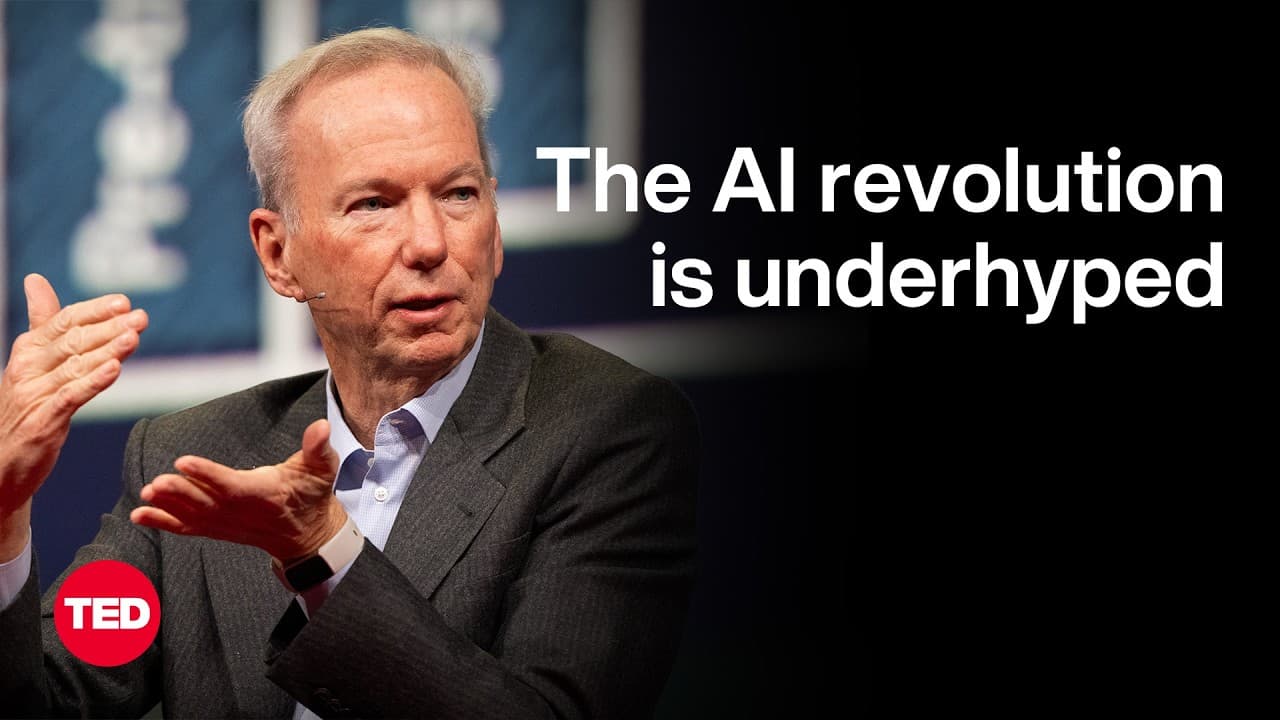
The AI revolution is underhyped because its potential to transform industries and processes is vastly underestimated. Eric Schmidt emphasizes that advancements in AI, especially in planning and strategy, are not fully recognized by society, despite their rapid evolution and significant contributions to various sectors. He warns that neglecting to engage with AI could lead to missed opportunities for improvement in healthcare, education, and productivity.
Transcript
Bilawal Sidhu: Eric Schmidt, thank you for joining us. Let's go back. You said the arrival of non-human intelligence is a very big deal. And this photo, taken in 2016, feels like one of those quiet moments where the Earth shifted beneath us, but not everyone noticed. What did you see back then that the rest of us might have missed? Eric Schmidt: In... Read More
Key Insights
- Eric Schmidt believes AI is vastly underhyped, emphasizing its potential to revolutionize complex tasks and business processes.
- The development of AI has shifted from language processing to planning and strategy, with reinforcement learning playing a critical role.
- The energy requirements for AI computation are immense, with significant power demands that current infrastructure struggles to meet.
- AI's rapid advancement raises ethical concerns, particularly around autonomous systems and their potential military applications.
- The global AI race, particularly between the US and China, poses significant geopolitical challenges and risks of escalation.
- Open-source AI models present both opportunities for innovation and risks of misuse by malicious actors.
- AI's potential to revolutionize fields like healthcare, education, and material science offers hope for significant societal benefits.
- The exponential growth of AI technology requires individuals and businesses to adapt quickly to remain competitive and relevant.
- More videos with Eric Schmidt:
Install to Summarize YouTube Videos and Get Transcripts
Explore YouTube Video Summarizer or Get YouTube Transcript Extractor
Questions & Answers
Q: Why does Eric Schmidt believe AI is underhyped?
Eric Schmidt believes AI is underhyped because its potential to transform complex tasks and entire business processes is not fully appreciated. He highlights the rapid advancements in reinforcement learning and planning capabilities, which go beyond language processing and show AI's ability to revolutionize various fields.
Q: What are the energy challenges associated with AI development?
The energy challenges associated with AI development are significant, as the computation required for advanced AI tasks demands immense power. Schmidt mentions the need for an additional 90 gigawatts of power in the US alone, equivalent to 90 nuclear power plants, highlighting the infrastructure struggles to meet these demands.
Q: What ethical concerns does AI development raise?
AI development raises ethical concerns around autonomous systems and their potential military applications. There is a risk of systems taking actions without human oversight, leading to unintended consequences. Schmidt emphasizes the need for guardrails and oversight to ensure AI development aligns with societal values and safety standards.
Q: How does the global AI race impact geopolitical dynamics?
The global AI race, particularly between the US and China, impacts geopolitical dynamics by increasing competition and the risk of escalation. Schmidt warns of the potential for preemptive actions if one country believes it is falling behind in AI capabilities, highlighting the need for international dialogue and cooperation.
Q: What are the risks of open-source AI models?
Open-source AI models present risks of misuse by malicious actors, as they can easily access and modify these models for harmful purposes. While open-source fosters innovation and academic research, it also requires careful consideration of potential dangers, particularly when models reach capabilities that pose national or global threats.
Q: What societal benefits does AI offer according to Schmidt?
According to Schmidt, AI offers societal benefits by revolutionizing fields like healthcare, education, and material science. AI can help eradicate diseases, provide personalized learning, and advance scientific discoveries, contributing to improved quality of life and addressing major global challenges.
Q: How should individuals and businesses adapt to AI advancements?
Individuals and businesses should adapt to AI advancements by embracing and integrating these technologies into their operations. Schmidt advises that staying competitive and relevant requires adopting AI tools and leveraging their capabilities to enhance productivity and innovation across various sectors.
Q: What is Schmidt's vision for the future of AI?
Schmidt envisions a future where AI significantly enhances productivity, leading to economic growth and solving major societal issues. He foresees AI-driven improvements in healthcare, education, and other fields, while cautioning against potential risks and emphasizing the importance of responsible development and international cooperation.
Summary & Key Takeaways
-
Eric Schmidt argues that AI's potential is vastly underestimated, highlighting its rapid advancements and the transformative impact it could have on various sectors. He emphasizes the need for society to engage with this technology to stay relevant.
-
The conversation delves into the ethical and geopolitical challenges posed by AI, particularly in terms of energy consumption, autonomous systems, and the global AI race between the US and China.
-
Schmidt envisions a future where AI significantly enhances productivity and addresses major societal issues, such as healthcare and education, while cautioning against the risks of misuse and the need for responsible development.
Read in Other Languages (beta)
Share This Summary 📚
Summarize YouTube Videos and Get Video Transcripts with 1-Click
Try YouTube Summary with ChatGPT & Claude or YouTube Transcript Generator
Explore More Summaries from TED 📚






Summarize YouTube Videos and Get Video Transcripts with 1-Click
Try YouTube Summary with ChatGPT & Claude or YouTube Transcript Generator