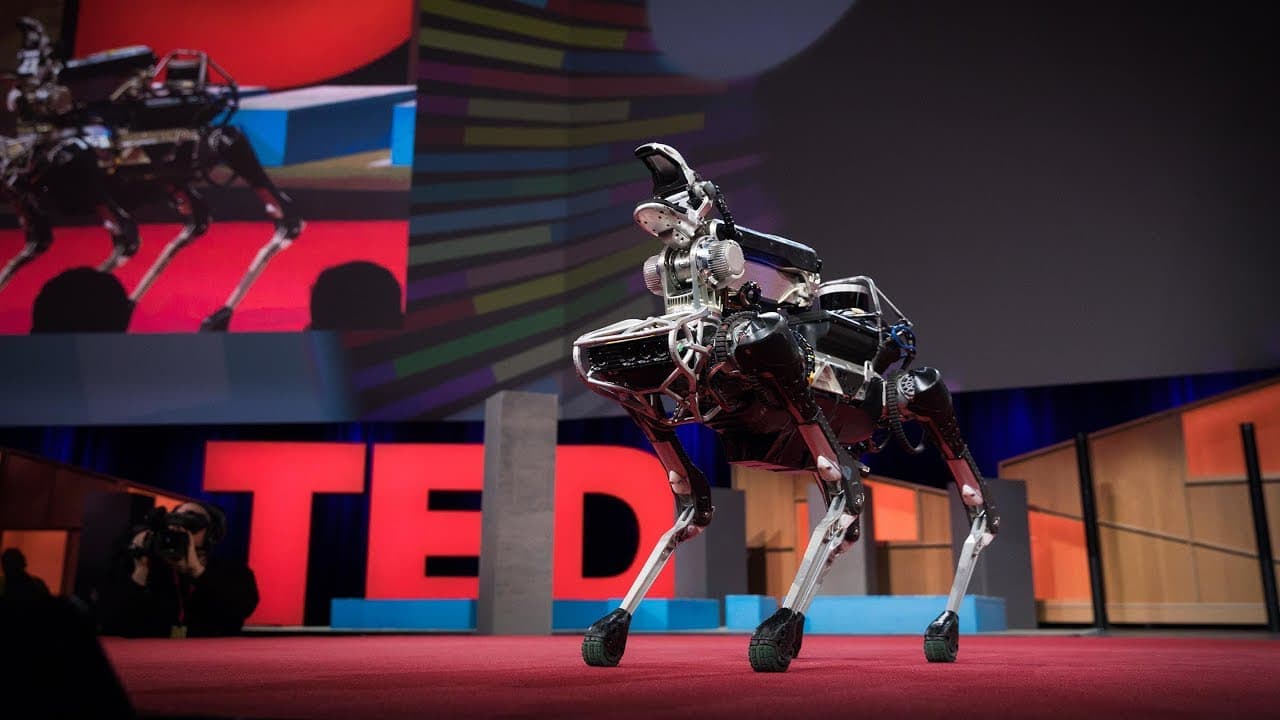
Meet Spot, the robot dog that can run, hop and open doors | Marc Raibert
TL;DR
Spot, the robot dog from Boston Dynamics, showcases advanced abilities like dynamic mobility, balance, and mobile manipulation. Its applications include package delivery, assisting in disaster scenarios, and aiding in caregiving for the elderly. With its real-time perception and autonomous navigation, Spot can tackle diverse environments and perform various tasks, making it a versatile solution for future challenges.
Transcript
(Laughter) (Laughter) That's SpotMini. He'll be back in a little while. I -- (Applause) I love building robots. And my long-term goal is to build robots that can do what people and animals do. And there's three things in particular that we're interested in. One is balance and dynamic mobility, the second one is mobile manipulation, and the third on... Read More
Key Insights
- 🤖 Robots with balance and dynamic mobility, mobile manipulation, and mobile perception capabilities can go almost anywhere on different terrains and perform tasks like humans.
- 👥 These robots have potential applications in tasks such as delivering packages, helping with household chores, taking care of the elderly and disabled, and even disaster response and remediation.
- 🌍 The development of dynamically stabilized robots, including BigDog and Spot, has improved their locomotion and ability to navigate challenging terrains like deep snow and stairways.
- 💡 Making autonomous robots involves not only programming and sensors but also the integration of hardware design and the physics of the real world to deal with uncertainties.
- 📐 Recent advancements in hardware design have resulted in more lightweight and efficient robots, thanks to 3-D printing and data-driven design processes.
- 📷 Robots like Spot, with cameras and sensors, can perceive and navigate their surroundings, adapt their movements in real-time, and perform tasks like picking up objects.
- 💼 Various potential applications for robots include assisting in disaster areas like Fukushima, automating household chores, and providing support for the elderly and invalids.
- ⚙️ While the military has shown interest in robotics and has funded their development, advanced technology like robots can be used for both positive and potentially negative purposes.
- 🎙️ More videos with Marc Raibert:
Install to Summarize YouTube Videos and Get Transcripts
Explore YouTube Video Summarizer or Get YouTube Transcript Extractor
Questions & Answers
Q: What are the three main areas of focus in building robots?
The three areas of focus in building robots that the speaker mentioned are balance and dynamic mobility, mobile manipulation, and mobile perception.
Q: How does the speaker describe the capabilities of humans and animals in terms of mobility and manipulation?
The speaker mentions that humans and animals have the ability to go almost anywhere on Earth and handle various tasks with ease, thanks to their balance, dynamic mobility, and mobile manipulation skills.
Q: What are the challenges in making autonomous robots?
One of the challenges in making autonomous robots is designing them to deal with the uncertainty of the real world. The robots need to be able to adapt and respond to unexpected disturbances or obstacles.
Q: How has the speaker approached the design of robots?
The speaker believes in a holistic design approach, where the software, hardware, and behavior of the robot are all designed and developed together. This approach allows for a harmonious interaction between all the components, leading to a successful robot design.
Q: What has been the progress in robot development in terms of size and capabilities?
The speaker mentions that there has been significant progress in robot development, with robots becoming smaller, lighter, and more capable. The speaker cites examples of robots that have gone from weighing nearly 400 pounds to 165 pounds, while retaining their strength and capabilities.
Q: What are some potential applications for these robots?
Some potential applications for these robots include assisting in tasks such as package delivery, industrial operations, remediation efforts in hazardous environments like Fukushima, and providing assistance in caregiving for aging or disabled individuals. The speaker believes there are countless other applications yet to be discovered.
Q: Has there been interest in military applications for these robots?
Yes, the speaker confirms that the military has shown interest in funding robotics and has been a significant supporter of robotic research and development. However, the speaker does not view the military as the "dark side" and recognizes that advanced technology, including robotics, can have a range of uses and applications.
Summary
In this video, Marc Raibert discusses his passion for building robots that can mimic the capabilities of people and animals. He focuses on three key areas of interest: balance and dynamic mobility, mobile manipulation, and mobile perception. Raibert showcases several of his robots, including SpotMini, BigDog, Cheetah, Atlas, and Handle, with demonstrations highlighting their mobility, dexterity, and perception. He emphasizes the importance of holistic design, combining software, hardware, and behavior, and shares advancements in 3D printing for robot hardware. Raibert concludes by discussing potential applications for his robots, such as assisting with package delivery, clean-up efforts in hazardous environments, and caregiving for the elderly and disabled.
Questions & Answers
Q: What are the three specific areas of interest in building robots that Marc Raibert mentions?
Marc Raibert is interested in balance and dynamic mobility, mobile manipulation, and mobile perception.
Q: How does Marc Raibert showcase the capabilities of his robots?
Marc Raibert showcases his robots through live demonstrations of their mobility, dexterity, and perception.
Q: What are some examples of robots that Marc Raibert presents?
Marc Raibert presents several robots, including SpotMini, BigDog, Cheetah, Atlas, and Handle.
Q: What is the purpose of the robot named SpotMini?
SpotMini is a robot designed for tasks such as package delivery and navigation through various terrains.
Q: How does Marc Raibert illustrate the potential for legged-robot delivery?
Marc Raibert demonstrates the capabilities of the SpotMini robot by taking it to employees' homes and testing its ability to navigate stairs and various access ways.
Q: What are the three components that need to be considered for making autonomous robots?
According to Marc Raibert, the three components for making autonomous robots are software, hardware, and behavior, which should be designed holistically and interact with each other.
Q: What recent advancements in hardware design does Marc Raibert mention?
Marc Raibert discusses advancements in hardware design, specifically using 3D printing to create robot parts that resemble animal anatomy. This data-driven hardware design improves the strength and capabilities of the robots.
Q: What other applications does Marc Raibert envision for his robots?
Marc Raibert envisions his robots being used in various applications, such as assisting with clean-up efforts in hazardous environments like Fukushima, providing caregiving support for the aging and disabled, and many other yet-to-be-discovered applications.
Q: Does Marc Raibert mention any areas of concern or potential misuse of his robots?
Marc Raibert acknowledges that the military has shown interest in robotics and that advanced technology can be used for both positive and negative purposes. However, he does not explicitly state any concerns or potential misuse of his robots.
Q: How does Marc Raibert describe the relationship between computers and the physics of the world in successful robot design?
Marc Raibert describes a holistic design approach where computers provide suggestions to the robot while considering the physics of the world, including gravity, friction, and bouncing into things. He emphasizes the need for harmony between software, hardware, and behavior in order to achieve a successful robot design.
Q: How does Marc Raibert conclude his presentation?
Marc Raibert concludes by expressing his gratitude to the Boston Dynamics team, who have worked hard on the development of the robots he presented. He also thanks the audience for their attention and participation.
Takeaways
Marc Raibert's talk showcases his passion for building robots that can mimic human and animal capabilities. He highlights the importance of balance and dynamic mobility, mobile manipulation, and mobile perception in robot development. Raibert presents several of his robots and demonstrates their abilities in areas such as package delivery, terrain navigation, and object manipulation. He emphasizes the need for a holistic design approach, combining software, hardware, and behavior. Raibert envisions a wide range of applications for his robots, including hazardous environment clean-up, caregiving for the elderly and disabled, and more. However, he acknowledges that advanced technology, like robotics, can be used for both positive and potentially negative purposes.
Summary & Key Takeaways
-
The speaker's long-term goal is to build robots that can do what people and animals do, focusing on balance and dynamic mobility, mobile manipulation, and mobile perception.
-
The speaker showcases various robots developed by Boston Dynamics, including SpotMini, Handle, and Atlas, demonstrating their mobility, dexterity, and perception capabilities.
-
The speaker discusses potential applications for these robots, such as package delivery, assisting in Fukushima remediation, and caregiving for the elderly and disabled.
Read in Other Languages (beta)
Share This Summary 📚
Summarize YouTube Videos and Get Video Transcripts with 1-Click
Try YouTube Summary with ChatGPT & Claude or YouTube Transcript Generator
Explore More Summaries from TED 📚


Summarize YouTube Videos and Get Video Transcripts with 1-Click
Try YouTube Summary with ChatGPT & Claude or YouTube Transcript Generator