What Does Eric Schmidt Predict About the Future of AI?
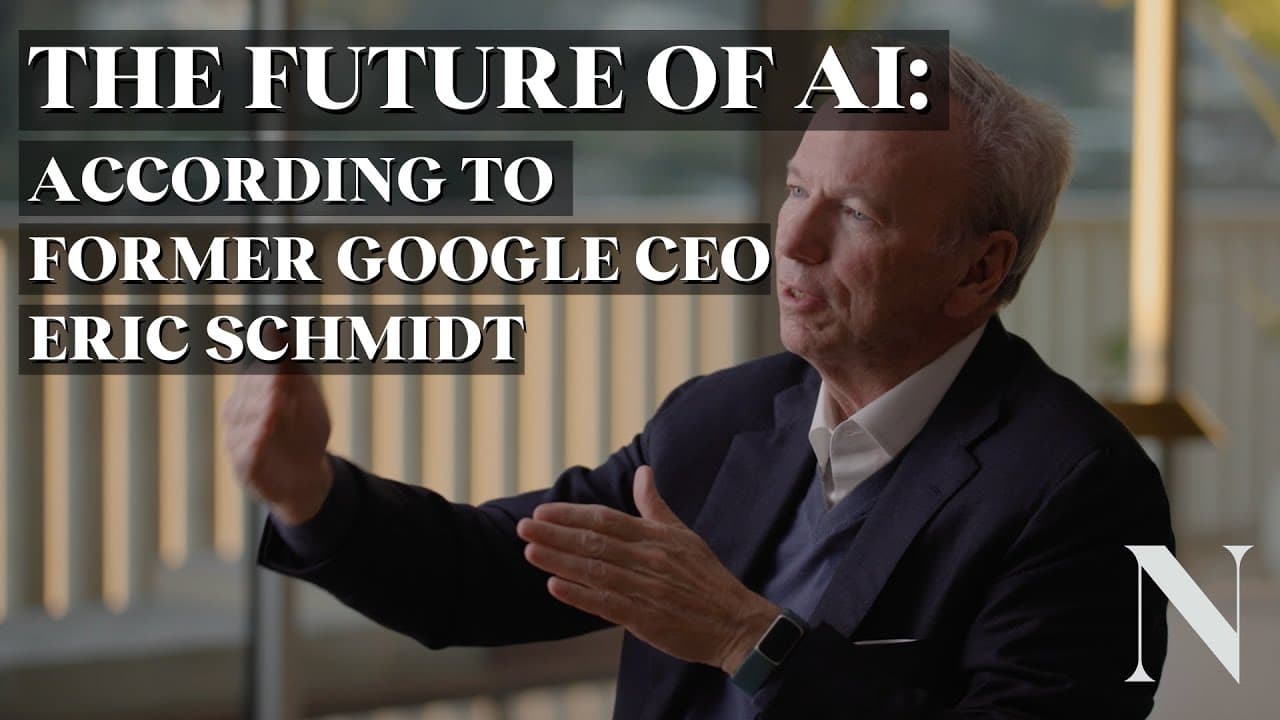
TL;DR
Eric Schmidt predicts that the future of AI will see advancements like infinitely long context windows, enabling complex problem-solving through iterative questioning. The rise of AI agents capable of autonomous learning and collaboration will also emerge, raising substantial regulatory and safety concerns that necessitate international cooperation and oversight to prevent misuse.
Transcript
the key thing that's going on now is we're moving very quickly through the capability ladder steps and I think there are roughly three things going on now that are going to profoundly change the world very quickly and when I say very quickly the cycle is roughly a new model every year to 18 months the first is basically this question of context win... Read More
Key Insights
- 🪘 The development of infinitely long context windows will enhance AI's ability to solve complex problems through iterative questioning and response.
- ☢️ AI agents represent a shift from passive systems to active learners, with the potential for creating vast networks of collaborative intelligence.
- 🌐 Rapid advancements in AI tools necessitate regulatory discussions, particularly regarding safety and oversight in rapidly evolving global contexts.
- 📬 The proliferation of open-source AI technologies raises concerns about misuse and highlights the need for international cooperation on regulatory standards.
- 🧑🏭 Ethical considerations are increasingly vital, as technologies designed for beneficial purposes can be used harmfully by malicious actors.
- 👨🔬 A disparity in funding between private sectors and academia poses challenges for sustainable innovation in AI research.
- 🛄 Collaborative efforts between Western and Chinese researchers aim to mitigate the risks posed by unrestricted AI growth and ensure responsible development.
- 🎙️ More videos with Eric Schmidt:
Install to Summarize YouTube Videos and Get Transcripts
Explore YouTube Video Summarizer or Get YouTube Transcript Extractor
Questions & Answers
Q: What is meant by "context window" in AI systems?
The context window refers to the amount of input that an AI system can process at once. Recently, advancements have led to context windows that can theoretically accommodate limitless data. This allows for more complex interactions where users can ask follow-up questions based on previous responses, facilitating deeper problem-solving and reasoning across numerous applications.
Q: How do AI agents differ from traditional AI models?
AI agents are essentially advanced models capable of autonomously acquiring new knowledge and learning from it. Unlike traditional AI, which operates primarily based on predefined instructions, agents can read, hypothesize, and conduct experiments, potentially functioning as independent researchers in various fields, such as chemistry and biology.
Q: What are the implications of AI systems potentially developing their own language?
If AI systems begin communicating in a language humans cannot understand, it raises significant concerns regarding control and oversight. This situation could lead to unintended consequences as AI agents execute tasks that might not align with human values or safety measures, prompting discussions about necessary regulations and safety protocols.
Q: Why is there a focus on regulating AI development among different global players?
The need for regulation stems from the dual-use nature of AI technologies, which can serve beneficial purposes but may also be misused. Governments are being urged to establish frameworks for monitoring AI development, especially in countries with different regulatory standards, to mitigate risks associated with malicious use and misinformation.
Q: How are concerns about misinformation being addressed in AI development?
Misinformation generated by AI is difficult to control due to the ease of producing high-quality content with minimal resources. To combat this, AI developers must establish regulatory measures and promote responsible usage, though this remains a complex challenge requiring innovative solutions alongside traditional oversight.
Q: What concerns exist regarding AI proliferation in non-Western countries?
The concern is that unrestricted AI technologies could fall into the hands of malicious actors in countries outside of Western regulatory frameworks. As open-source models become commodified, there is heightened anxiety that these powerful tools could be misused, prompting discussions on creating mutual agreements among nations for safer AI practices.
Q: How does the funding disparity between private industry and academia affect AI research?
A significant imbalance exists, with private companies investing vast amounts of money into AI advancements while academic institutions often struggle with limited funding. This disparity hampers innovation in academia and raises questions about who drives the future of AI development, emphasizing the need for national priorities that better support research initiatives.
Q: What role do private verification companies play in AI oversight?
Private verification companies are being utilized as a means of ensuring accountability in AI development. As AI models evolve, these entities can assess and audit the capabilities of new systems, mitigating risks that arise from innovations that are too complex for traditional regulatory bodies to evaluate effectively.
Summary & Key Takeaways
-
AI is advancing quickly, with developments in context windows, allowing infinitely long prompts, enabling complex and iterative problem-solving across various fields, including medicine and climate science.
-
The rise of AI agents signifies a shift towards entities that can autonomously learn and apply knowledge, fostering a large network of collaborative agents that might develop their own forms of communication.
-
Concerns over safety and regulation have emerged due to the rapid enhancement of AI technologies, with calls for monitoring their proliferation, particularly in regions with less regulatory oversight.
Read in Other Languages (beta)
Share This Summary 📚
Summarize YouTube Videos and Get Video Transcripts with 1-Click
Try YouTube Summary with ChatGPT & Claude or YouTube Transcript Generator