What Is Error Diffusion Dithering?
TL;DR
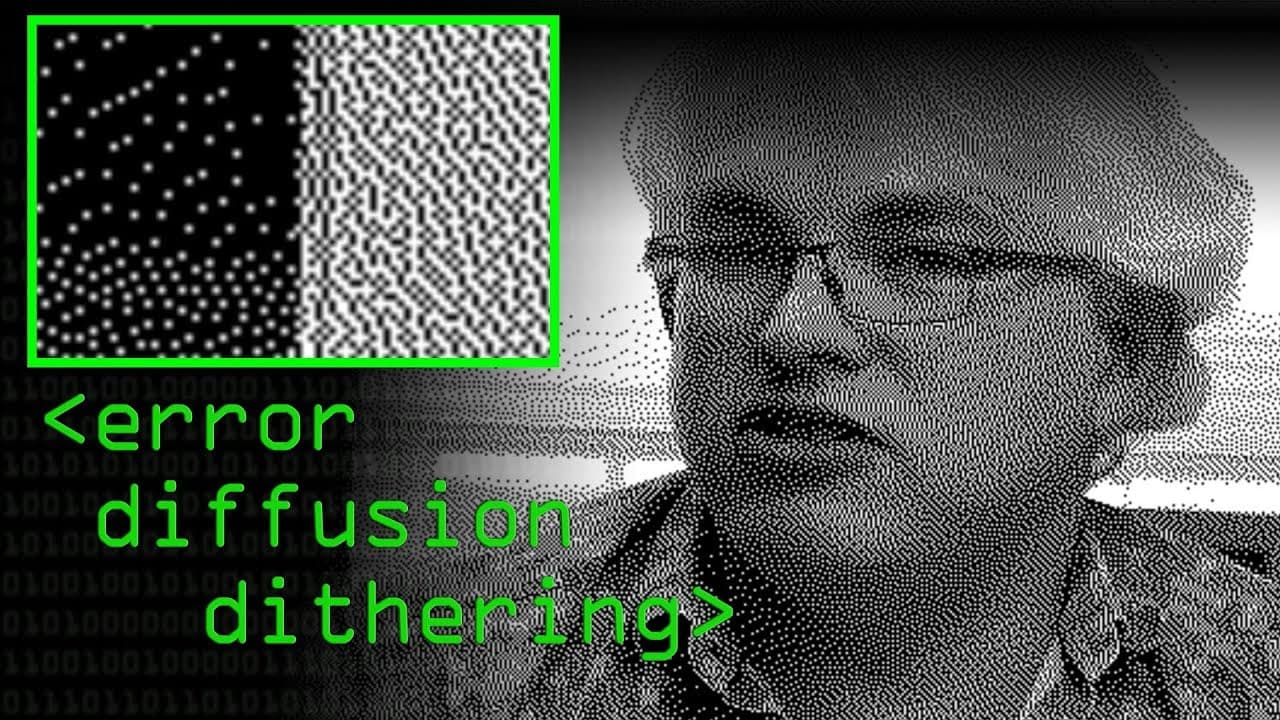
Error diffusion dithering is a technique that simulates grey scales in images using just black and white pixels. It involves adjusting the brightness of surrounding pixels to compensate for errors in contrast, primarily through the Floyd-Steinberg algorithm, resulting in an image that appears to include varying shades of grey.
Transcript
We looked at the auditor scissoring is an attempt to Simulate those extra gray scales. Let's keep it to a gray scales for the purpose of this video just using black and white pixels There's another approach we can take which is called error diffusion So what we do and we'll still use black and white to do this we take a picture Let's start with thi... Read More
Key Insights
- 🖤 Error diffusion is a technique for converting continuous tone images into black and white pixels while compensating for brightness errors.
- ❓ The Floyd-Steinberg algorithm is a popular error diffusion method that redistributes the error to surrounding pixels.
- 👀 Error diffusion creates the appearance of gray scales, but when zoomed in, the pattern may look more random compared to other dithering techniques.
- 🖨️ Error diffusion is commonly used in printers, cameras, and television to create accurate representations of gray scales.
Install to Summarize YouTube Videos and Get Transcripts
Explore YouTube Video Summarizer or Get YouTube Transcript Extractor
Questions & Answers
Q: What is error diffusion and how does it work?
Error diffusion is a technique used in image processing to convert continuous tone images into black and white pixels. It involves setting pixels to white or black based on their closeness to the desired value, and then calculating the error between the set value and the actual value.
Q: How does the Floyd-Steinberg algorithm distribute the error?
The Floyd-Steinberg algorithm distributes the error to surrounding pixels. It scans the image from top left, pixel by pixel, and for each pixel, it takes a fraction of the error and distributes it to neighboring pixels. This redistribution helps compensate for brightness errors and creates a more accurate representation of the original image.
Q: What are the advantages of error diffusion over other dithering techniques?
One advantage of error diffusion is that it ensures each dot is a single pixel wide, resulting in a more precise representation of the gray scales. Other dithering techniques may create different sized dots, which can lead to irregular patterns. Error diffusion also allows for the compensation of errors over the entire image, resulting in a more visually pleasing representation.
Q: Where else is error diffusion used?
Error diffusion is still used in various applications, such as black and white printing and television. It is also used in image sensors and cameras to convert higher bit depths to lower ones for display or storage purposes.
Summary & Key Takeaways
-
Error diffusion is an approach that uses black and white pixels to simulate gray scales in images.
-
The process involves setting pixels to either white or black based on their proximity to the desired value, and calculating the error between the set value and the actual value.
-
Error diffusion algorithms, such as the Floyd-Steinberg algorithm, distribute the error to surrounding pixels to compensate for brightness discrepancies.
Read in Other Languages (beta)
Share This Summary 📚
Summarize YouTube Videos and Get Video Transcripts with 1-Click
Try YouTube Summary with ChatGPT & Claude or YouTube Transcript Generator
Explore More Summaries from Computerphile 📚

Summarize YouTube Videos and Get Video Transcripts with 1-Click
Try YouTube Summary with ChatGPT & Claude or YouTube Transcript Generator