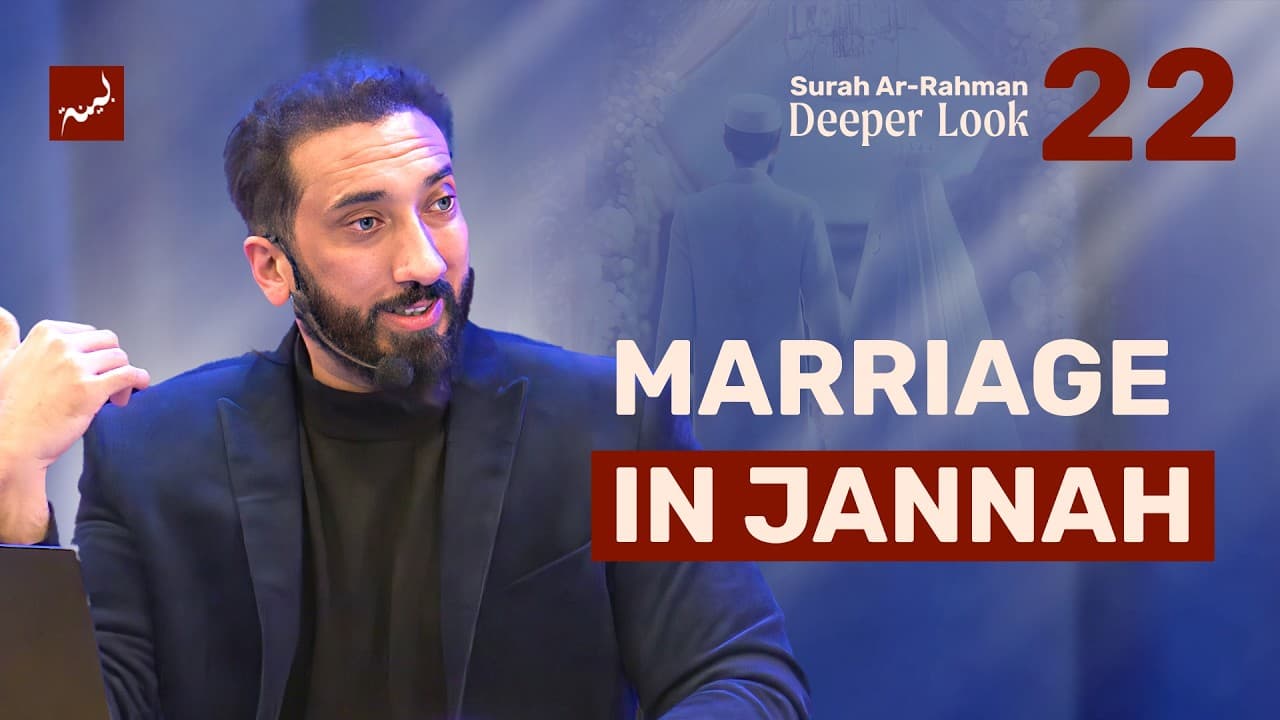
What Does the Quran Say About Love in Jannah?
TL;DR
Jannah grants believers whatever they desire while removing jealousy, insecurity, resentment, and other painful emotional residue. Its devoted spouses represent permanent, mutually fulfilling love, and the explicit promise also reassures men who restrained powerful desires for Allah. Women’s rewards are not confined to a rigid list because Allah already knows their varied wishes.
Transcript
last time in this surah alman series like you can't just say okay I'm not at least I'm not doing anything bad okay fine I don't pray and I don't I don't do I don't fast I don't do the good stuff but at least I don't do any bad stuff that's not good enough and then other people are come around and say well I do a lot of good things but the so what i... Read More
Key Insights
- True fear of Allah requires both leaving sin and performing good deeds. Avoiding obvious wrongdoing does not replace prayer, fasting, and positive action, while doing many good things does not make a smaller amount of deliberate wrongdoing irrelevant.
- Women’s desires in Jannah are not presented as a single uniform list. The varied responses of the female research interns illustrate why one fixed description of marriage, jewelry, or companionship could appeal to some women while bothering or excluding others.
- Allah’s promise of whatever a person desires makes an exhaustive catalog of women’s rewards unnecessary. The omission of explicit male spouses for women is presented as mercy and honor because Allah knows their wishes without publicly spelling out potentially intimate desires.
- The description of beautiful spouses acknowledges men’s intense longing for female love, respect, desire, and companionship. The lesson frames these emotional and physical needs as powerful motivations that can influence men to work, establish themselves, and pursue marriage.
- The early Muslim community had to abandon existing romantic and emotional attachments after new religious restrictions were introduced. Their transition was not effortless, and the promised spouses of Jannah are described as compensation for desires and temptations they restrained for Allah.
- Qaṣirat al-ṭarf describes a gaze that does not extend beyond one’s spouse. The explanation is mutual: she is completely devoted to him, and her beauty and companionship leave him with no wish to look beyond her.
- Love in Jannah is portrayed as permanent and mutually absorbing. Unlike worldly relationships marked by unequal attention, need for distance, or fading affection, both spouses find complete joy in one another without feeling burdened by closeness.
- Emotional life in Jannah is different from emotional life in this world. Insecurity, possessiveness, jealousy, resentment, anxiety, and comparison will not operate in the same painful way, so heavenly relationships should not be imagined through present emotional limitations.
Install to Summarize YouTube Videos and Get Transcripts
Explore YouTube Video Summarizer or Get YouTube Transcript Extractor
Questions & Answers
Q: What does the Quran say believers will desire in Jannah?
The discussion says that believers in Jannah will receive whatever they desire. Their rewards are therefore not limited to every item or relationship explicitly named in the passage. Allah already knows each person’s wishes, including desires that are private, difficult to express, or different from those of other people, and this knowledge is presented as sufficient assurance.
Q: Why are women’s spouses not explicitly described in this passage?
Women’s spouses are not explicitly described because women do not necessarily share one uniform set of desires. Some may want marriage, others may not, and some may need time even to identify their preferred rewards. A specific description could satisfy some women while troubling others. The broader promise of receiving whatever one desires includes every individual preference without confining women to one list.
Q: What does qaṣirat al-ṭarf mean in the description of Jannah?
Qaṣirat al-ṭarf refers to a shortened or confined gaze that does not pass beyond the beloved spouse. It describes a woman whose attention is devoted to her companion, but the explanation also makes the devotion mutual: his eyes do not go beyond her either. The phrase therefore represents exclusive attention, reciprocal attraction, and complete satisfaction with one another.
Q: Why does the Quran describe beautiful spouses for men in Jannah?
The description addresses a strong male longing for female companionship, love, respect, attraction, and emotional affirmation. It also reassures men who restrained romantic or physical desires for Allah, including early believers who had to end existing attachments after religious boundaries changed. The promised companionship is presented as compensation for genuine sacrifice, not merely as physical pleasure or objectification.
Q: Will jealousy and insecurity exist in relationships in Jannah?
The discussion states that emotional conditions in Jannah will not remain the same as they are in worldly life. Ill feelings connected to insecurity, jealousy, possessiveness, resentment, anxiety, and comparison will be removed or fundamentally changed. Consequently, heavenly relationships cannot be accurately judged by projecting today’s fears, rivalries, or emotional wounds onto the promised life of Jannah.
Q: How is love in Jannah different from worldly romantic love?
Love in Jannah is described as permanent, mutual, and free from emotional imbalance. In worldly relationships, one person may be intensely devoted while the other gives little attention, feels crowded, or asks for distance. In Jannah, both spouses delight in closeness, remain absorbed in one another, and experience no decay of affection, unreturned longing, comparison, or emotional residue.
Q: How does restraint in this life relate to reward in Jannah?
A person who protects himself, guards his conduct, and withholds forbidden desires for Allah is promised compensation in Jannah. The early believers are used as an example because they had known a life without the later relationship restrictions and then had to break emotional and romantic attachments. Their restraint involved real pain, which makes the promised fulfillment a meaningful response to sacrifice.
Q: What practical lessons about marriage apply to life now?
The description of heavenly love also challenges believers to improve present relationships. Its practical themes include guarding the gaze, protecting intimacy, restoring joy in marriage, resisting comparison culture, and reshaping the heart. Although worldly marriage cannot be identical to Jannah, believers can try to reflect its mutual attention, dignity, loyalty, and emotional fulfillment within their current relationships.
Summary & Key Takeaways
-
The passage presents two complementary paths to reward: leaving sin and actively doing good. A person cannot treat avoiding obvious wrongdoing as a substitute for prayer, fasting, and good deeds, nor can abundant good deeds excuse deliberately continuing harmful conduct. True reverence for Allah requires both forms of moral effort.
-
Rewards for women are not restricted to a specific description of spouses because women’s desires are varied and cannot be represented by one uniform list. The broader promise is that people in Jannah receive whatever they desire. Allah’s knowledge of each person’s wishes makes an exhaustive public description unnecessary and preserves modesty.
-
Qaṣirat al-ṭarf describes spouses whose attention is mutually focused and deeply devoted. This relationship contains no unreturned affection, comparison, emotional distance, jealousy, or fading attachment. The passage also challenges believers to guard their gaze, protect intimacy, resist comparison culture, and restore joy within marriage during their present lives.
Read in Other Languages (beta)
Share This Summary 📚
Summarize YouTube Videos and Get Video Transcripts with 1-Click
Try YouTube Summary with ChatGPT & Claude or YouTube Transcript Generator
Explore More Summaries from Nouman Ali Khan - Official - Bayyinah 📚


Summarize YouTube Videos and Get Video Transcripts with 1-Click
Try YouTube Summary with ChatGPT & Claude or YouTube Transcript Generator