How to Understand Networking and AWS VPCs
TL;DR
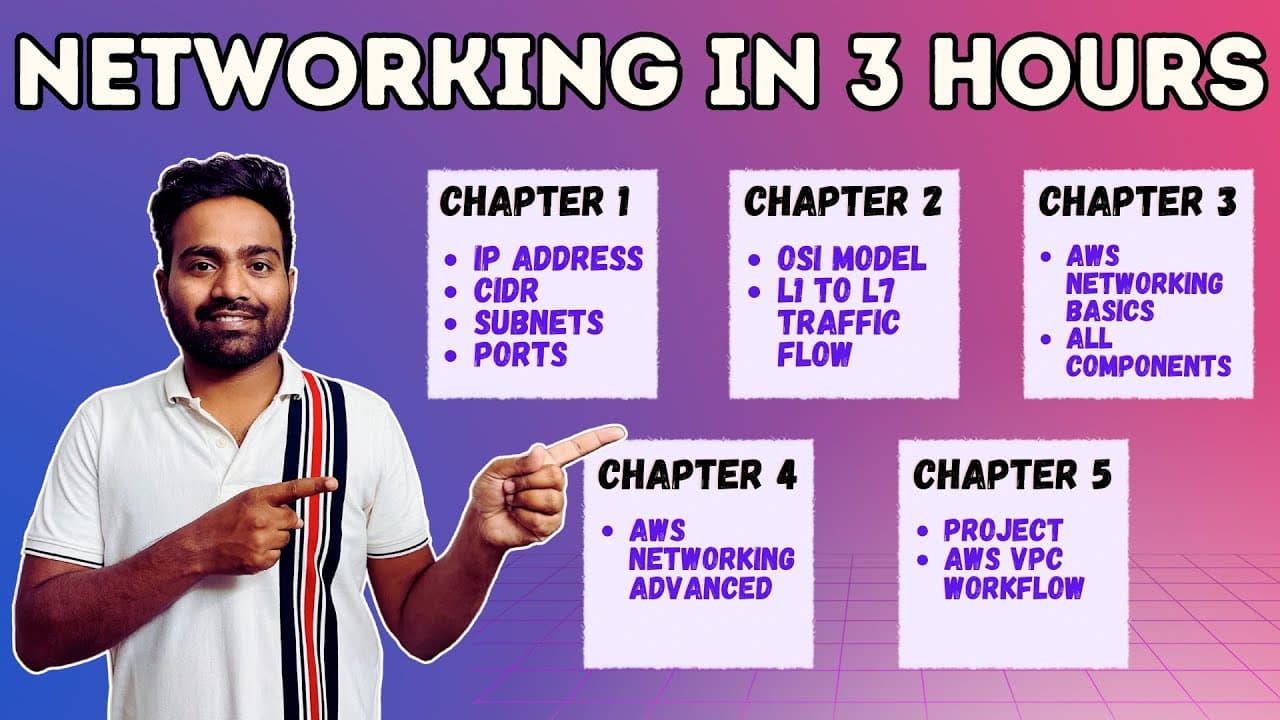
An IPv4 address uniquely identifies a device and consists of four 8-bit values, each ranging from 0 to 255. Building on that foundation, the material connects CIDR, subnets, ports, and the OSI model to AWS networking, including VPCs, routes, gateways, security groups, network ACLs, load balancers, Route 53, and a hands-on VPC project.
Transcript
hello everyone my name is abishek and welcome back to my channel this video aims at explaining the networking Concepts right from the fundamentals even if you don't understand what exactly is an IP address you can go ahead and watch this video this is a 3our long video I broke this video down into five chapters and using each chapter you will learn... Read More
Key Insights
- An IP address is a unique identification assigned to a device connected to a network, allowing administrators to distinguish, monitor, track, or restrict individual devices instead of applying the same policy to every device on the network.
- IPv4 is a standard that represents an address using four bytes, totaling 32 bits, with the four decimal values separated by dots. Addresses such as 192.168.12.14 follow this structure, while a value like 600 cannot appear in an IPv4 address.
- Each IPv4 decimal value is limited to 0 through 255 because one byte contains eight bits. When all eight binary positions are set to one, their powers of two combine to produce the maximum decimal value of 255.
- Binary address representation is important for understanding later networking concepts. Converting each IPv4 value into eight bits shows how a computer interprets the address and establishes the foundation needed for the video's treatment of CIDR and subnetting.
- Subnetting is presented as a method for dividing a larger allocation of IP addresses into separated network areas. This separation becomes important when an organization needs to prevent a compromised device on one network from reaching every other connected device and sensitive server.
- The OSI model organizes networking into Layer 1 through Layer 7. It forms the second chapter of the course and provides a structured bridge between foundational subjects such as addressing, CIDR, subnets, and ports and the later AWS networking chapters.
- An AWS VPC brings the networking concepts into a cloud environment through components including subnets, routes, route tables, internet gateways, load balancers, and Route 53. The material also distinguishes public and private subnets as part of the VPC architecture.
- AWS security groups and network ACLs are advanced network security concepts covered in a dedicated chapter. The course compares these controls and then applies AWS networking knowledge through hands-on VPC work and two networking-related architecture projects.
Install to Summarize YouTube Videos and Get Transcripts
Explore YouTube Video Summarizer or Get YouTube Transcript Extractor
Questions & Answers
Q: What is an IP address and why is it needed?
An IP address is a unique identification number assigned to a device connected to a network. It lets administrators distinguish one device from another when monitoring activity, tracking access, or blocking a specific website for a particular device. Without unique addresses, a restriction intended for one device could have to be applied to every device sharing the network.
Q: How is an IPv4 address represented?
An IPv4 address is represented as four decimal values separated by dots, with examples in the material including 172.2.6.34, 10.1.2.4, and 192.168.12.14. Each value represents one byte, or eight bits, so the complete address contains four bytes and 32 bits. Every decimal value must remain within the range from 0 to 255.
Q: Why can each IPv4 value only range from 0 to 255?
Each section of an IPv4 address represents one byte, and one byte contains eight bits. Those positions correspond to powers of two from 2^0 through 2^7. When all eight positions contain one, their combined decimal value is 255. Consequently, an address containing a section such as 600 does not meet the IPv4 format described in the lesson.
Q: How do computers interpret a decimal IPv4 address?
A computer interprets each decimal section of an IPv4 address as eight binary bits. For example, the lesson represents 192 by activating the positions for 2^7 and 2^6, which correspond to 128 and 64. Repeating this conversion for all four decimal sections produces the complete 32-bit representation that the computer uses for the address.
Q: Why is binary conversion important for CIDR and subnets?
Binary conversion shows how every decimal section of an IPv4 address maps to eight individual bit positions. The instructor repeatedly emphasizes this representation because it becomes useful when the course moves into CIDR and subnet concepts. Understanding the 32-bit structure makes the relationship between address values, available IP addresses, CIDR ranges, and subnet divisions easier to follow.
Q: Why should an office network be divided into subnets?
Dividing an office network into subnets can reduce the exposure created when every device shares one unrestricted network. The lesson describes an employee visiting a malicious website, allowing a hacker to access that device. If all devices and sensitive servers remain on the same network, that initial access can place payroll, financial information, and other connected systems at risk.
Q: What AWS networking components are covered?
The AWS networking chapters cover VPCs, internet gateways, public and private subnets, routes, route tables, load balancers, and Route 53. They also address security groups and network ACLs, including a comparison between those controls. The material finishes by applying these components through hands-on AWS VPC work, a VPC workflow, and networking-related architecture projects.
Q: How is the networking course organized?
The course is organized into five chapters. Chapter 1 covers IP addresses, CIDR, subnets, and ports. Chapter 2 covers the OSI model and Layers 1 through 7. Chapter 3 introduces AWS networking, Chapter 4 focuses on AWS security groups and network ACLs, and Chapter 5 provides hands-on AWS VPC implementation and project work.
Summary & Key Takeaways
-
The first chapter introduces IP addresses as unique identifiers for devices on a network. It explains IPv4 as four bytes, or 32 bits, with each decimal value limited to 0 through 255. Binary conversion is emphasized because it becomes useful when studying CIDR ranges, subnets, and address allocation.
-
The networking fundamentals expand into CIDR, subnets, ports, and the OSI model from Layer 1 through Layer 7. Subnetting is presented as a way to divide a larger network, addressing the security risk created when every office device shares one unrestricted network and one compromised device can threaten others.
-
The AWS chapters connect networking fundamentals to VPC architecture and implementation. Covered components include public and private subnets, routes, route tables, internet gateways, load balancers, Route 53, security groups, and network ACLs. The course concludes with hands-on AWS VPC work and two networking-related architecture projects.
Read in Other Languages (beta)
Share This Summary 📚
Summarize YouTube Videos and Get Video Transcripts with 1-Click
Try YouTube Summary with ChatGPT & Claude or YouTube Transcript Generator
Explore More Summaries from Abhishek.Veeramalla 📚




Summarize YouTube Videos and Get Video Transcripts with 1-Click
Try YouTube Summary with ChatGPT & Claude or YouTube Transcript Generator