How AI Models Revolutionize Electrolyte Solutions
TL;DR
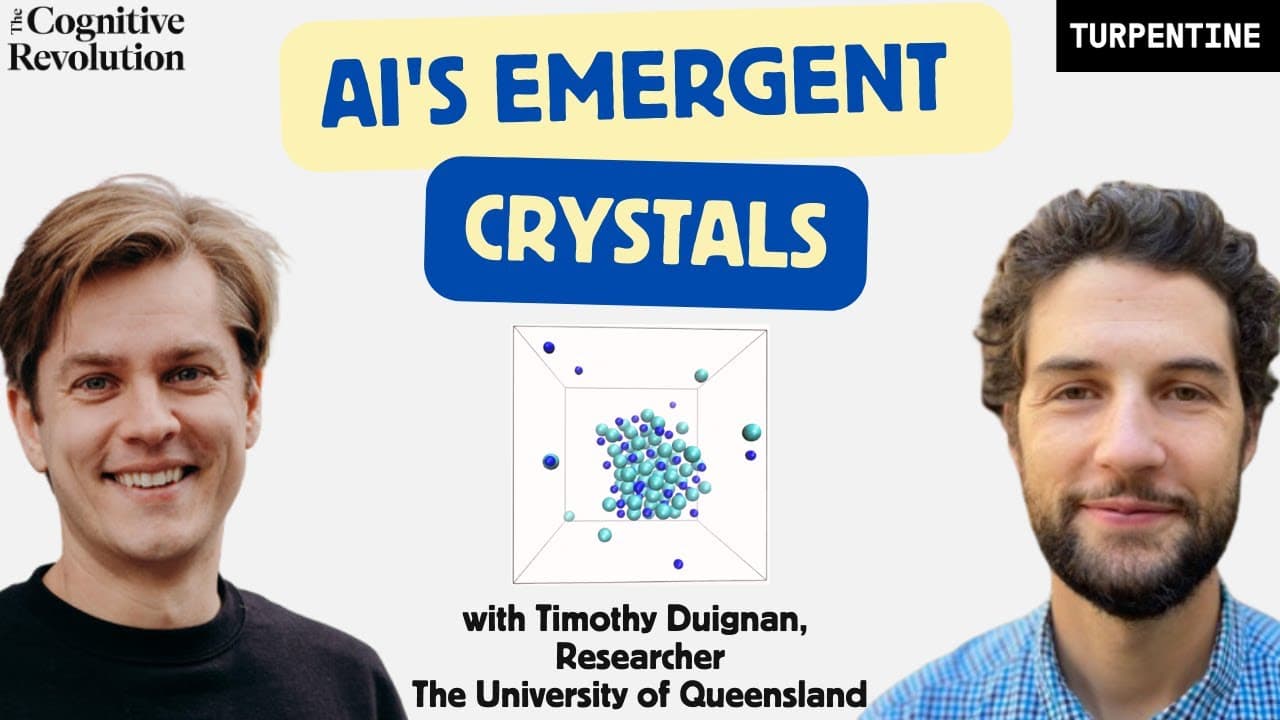
AI techniques are transforming computational chemistry by enabling faster and more accurate simulations of electrolyte solutions. Tim Duignan's work at the University of Queensland uses neural networks to predict behaviors of atoms and molecules, offering potential breakthroughs in understanding systems like saltwater and lithium batteries. This acceleration in scientific discovery could lead to superhuman AI capabilities in the near future.
Transcript
hello and welcome to the cognitive Revolution where we interview Visionary researchers entrepreneurs and Builders working on the frontier of artificial intelligence each week we'll explore their revolutionary ideas and together we'll build a picture of how AI technology will transform work life and Society in the coming years I'm Nathan lens joined... Read More
Key Insights
- AI models are transforming the simulation of electrolyte solutions, enabling faster and more accurate predictions.
- Electrolyte solutions are crucial in fields like climate change, battery technology, and biology, yet are not fully understood.
- Neural network potentials can simulate molecular dynamics faster than traditional quantum mechanical approaches.
- Coarse graining allows AI models to simulate large systems by abstracting away solvent molecules, focusing on ions.
- AI models can generalize to predict phenomena like crystallization and self-ionization, even without specific training data.
- Equivariance in AI models helps reduce training data needs by encoding rotational symmetries of space.
- Active learning techniques can enhance AI model training by identifying and incorporating edge cases.
- Scaling AI models could lead to universal potentials, capable of simulating any atomic arrangement with minimal additional data.
Install to Summarize YouTube Videos and Get Transcripts
Explore YouTube Video Summarizer or Get YouTube Transcript Extractor
Questions & Answers
Q: How do AI models revolutionize electrolyte solutions?
AI models revolutionize electrolyte solutions by enabling faster and more accurate simulations than traditional quantum mechanical methods. Neural networks predict the behavior of atoms and molecules, allowing for larger and longer-lived simulations. This advancement accelerates scientific discovery in fields like climate change, battery technology, and biology.
Q: What is coarse graining in AI simulations?
Coarse graining in AI simulations is a technique that abstracts away solvent molecules, focusing on ions to simulate large systems more efficiently. By averaging the effects of solvent molecules, AI models can predict the forces and energies in a system without explicitly simulating every solvent molecule, allowing for faster and larger-scale simulations.
Q: How do neural network potentials work in molecular dynamics?
Neural network potentials in molecular dynamics replace the expensive quantum mechanical calculations with AI models that predict energies and forces based on atomic positions. This allows simulations to run much faster, enabling the study of larger systems and longer time scales, thus accelerating scientific discovery in chemistry and related fields.
Q: What role does equivariance play in AI models for chemistry?
Equivariance in AI models for chemistry encodes the rotational symmetries of space, reducing the amount of training data needed. By understanding that molecular properties remain unchanged under rotation, AI models can generalize better and predict molecular behaviors more accurately, enhancing the efficiency of simulations in computational chemistry.
Q: Can AI models predict crystallization without specific training data?
Yes, AI models can predict crystallization without specific training data by generalizing from learned patterns in liquid phases. Neural networks can extrapolate the behavior of ions in solution to predict crystal formation, showcasing the models' ability to generalize beyond their training data and discover new phenomena in molecular systems.
Q: How does active learning improve AI model training in chemistry?
Active learning improves AI model training in chemistry by identifying and incorporating edge cases where the model's uncertainty is high. By adding these cases to the training data, AI models can better generalize and predict rare events or phenomena, enhancing their accuracy and reliability in simulating complex molecular systems.
Q: What are the potential applications of universal AI potentials in chemistry?
Universal AI potentials in chemistry could simulate any atomic arrangement with minimal additional data, potentially transforming the field. They could predict molecular behaviors across various systems, aiding in the discovery of new materials, optimizing chemical processes, and advancing our understanding of complex systems like batteries and biological molecules.
Q: How can AI models handle temperature variations in simulations?
AI models handle temperature variations in simulations by using a thermostat in the classical motion solver, which adjusts the system's energy to maintain the desired temperature. This allows simulations to explore different temperatures easily, providing insights into phase changes and other temperature-dependent phenomena without additional training data.
Summary & Key Takeaways
-
AI models are revolutionizing computational chemistry by enabling faster simulations of electrolyte solutions, crucial for understanding phenomena in climate change, batteries, and biology. Tim Duignan's work at the University of Queensland uses neural networks to predict behaviors of atoms and molecules, offering potential breakthroughs.
-
Neural network potentials simulate molecular dynamics more efficiently than traditional methods, allowing for larger and longer-lived simulations. Techniques like coarse graining abstract away solvent molecules, focusing on ions to simulate large systems, while equivariance reduces training data needs by encoding space symmetries.
-
AI models can generalize to predict phenomena like crystallization and self-ionization, even without specific training data. Active learning identifies edge cases for improved training. Scaling AI models could create universal potentials, simulating any atomic arrangement with minimal additional data.
Read in Other Languages (beta)
Share This Summary 📚
Summarize YouTube Videos and Get Video Transcripts with 1-Click
Try YouTube Summary with ChatGPT & Claude or YouTube Transcript Generator
Explore More Summaries from Cognitive Revolution "How AI Changes Everything" 📚






Summarize YouTube Videos and Get Video Transcripts with 1-Click
Try YouTube Summary with ChatGPT & Claude or YouTube Transcript Generator