How to keep Claude Code focused during long sessions
TL;DR
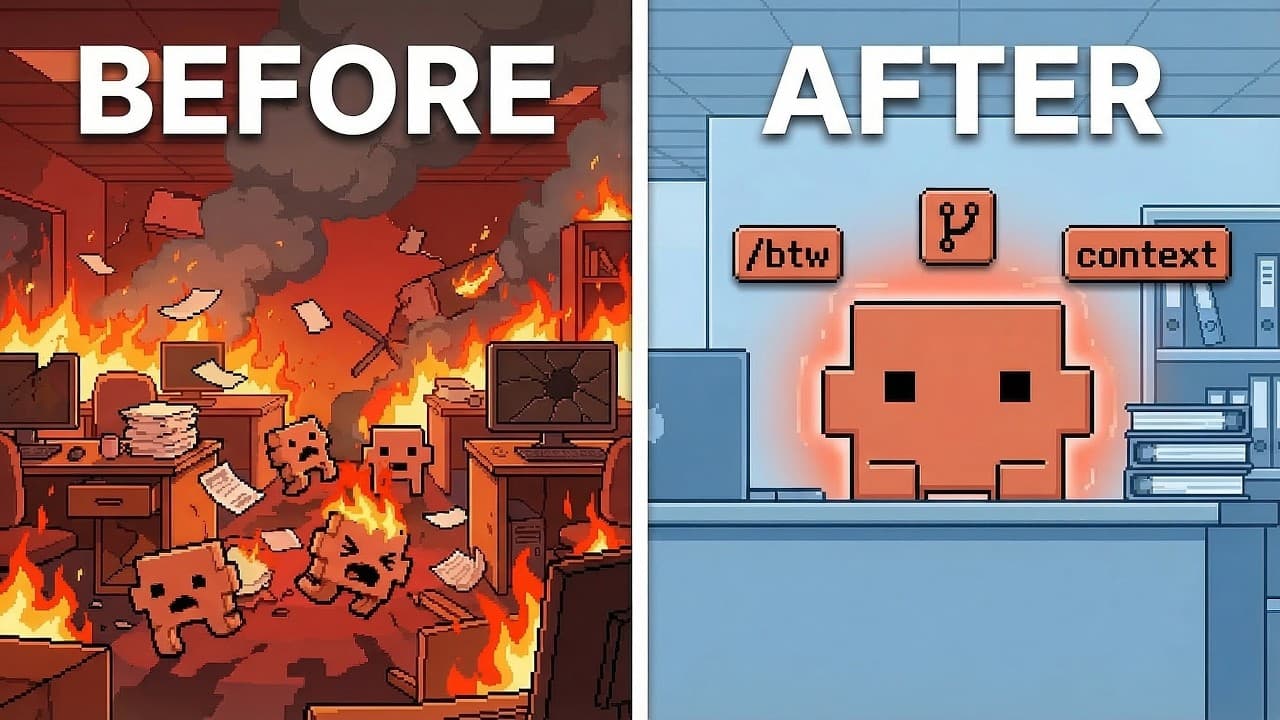
Use three shields to keep Claude Code from drifting: slash btw for side questions that don’t eat context, context fork to run heavy tasks in a separate context, and slash fork to branch conversations so dead ends don’t pollute the main thread. This approach reduces noise, maintains coherence, and yields cleaner results after complex research tasks.
Transcript
If you've ever had a long running session in Claude Code, then you know that at some point things start to feel off. You start getting slower responses, worse suggestions, and it's almost as if Claude Code has full amnesia on what you're working on. But it's not Cloud Code getting dumber. It's you drowning in context. Every file it reads, every sea... Read More
Key Insights
- Claude Code efficacy depends on limiting main context load to preserve signal over time.
- The /btw shield lets you ask informative questions without adding to the main context window.
- context: fork isolates heavy searches and tool calls in a separate context window for cleaner main results.
- The vault search example demonstrates how context forks keep data collection separate from the main task.
- Using /fork enables versioned exploration without losing the original progress.
- Forked conversations produce clean, rollable branches that can be revisited later.
- Token usage is reduced when heavy tasks run in their own context window than in the main session.
- Combining these shields with clean cloud MD practices improves long session performance.
Install to Summarize YouTube Videos and Get Transcripts
Explore YouTube Video Summarizer or Get YouTube Transcript Extractor
Questions & Answers
Q: How can I keep long Claude Code sessions from getting noisy?
To keep long Claude Code sessions focused you should use three shields: the slash btw for side questions that do not consume context, the context: fork to run heavy research in a separate context window, and the slash fork to create branched conversations. This separation prevents dead ends and tool chatter from polluting your main task, resulting in clearer ongoing work and better summaries.
Q: What is the purpose of /btw in Claude Code workflows?
The /btw shield is designed to handle side questions and small references without consuming main context window space. It allows you to pull in static data, quick checks, or clarifications, which keeps the primary task buffer lean. This improves response relevance and reduces cognitive load during long-running sessions.
Q: How does context: fork improve efficiency during research tasks?
Context: fork runs heavy searches and tool calls in a separate context window, so the main context remains clean and concise. When the task finishes, you receive a single clean summary back to the main window, reducing token waste and preventing the main session from becoming cluttered with raw notes and intermediate results.
Q: What is the role of /fork in session management?
Slash fork creates a new, independent conversation path or version of the task. It allows you to reimagine outcomes or explore alternatives without overwriting the original work. This keeps multiple approaches organized and prevents dead ends from derailing the primary progress.
Q: Can you illustrate how a vault search uses context fork?
In the vault search example, context fork runs the search within a separate context window, returning a structured summary to the main session. This prevents all raw results and tool outputs from flooding the main context, enabling a cleaner final slide deck and easier iteration on improvements.
Q: What happens if you want a second version of a deliverable after forking?
If you fork and produce a first version, you can request a second version with a different spin while keeping the original branch intact. Forcing a fresh path keeps the main context focused on the preferred version, while you compare improvements side by side.
Q: How do the three shields relate to token efficiency?
Using context fork and slash based shields reduces token consumption by isolating heavy tasks and unwanted chatter from the main context. The result is fewer tokens used in the primary window, faster responses, and cleaner, shareable outputs.
Q: What best practices maximize Claude Code effectiveness across long sessions?
Best practices include keeping the cloud MD lean, defining clear Claude rules to avoid bloat, and combining the three shields with disciplined context management. This approach preserves clarity, reduces context decay, and yields consistent, high-quality results across complex projects.
Summary & Key Takeaways
-
Maintain a lean main context by offloading heavy work to a separate context window using context: fork, which keeps the primary task clearer.
-
Use slash btw to ask quick side questions without bloating the main context window and interrupting the task flow.
-
Employ slash fork to create parallel, independent conversation branches so dead ends do not pollute the primary session.
Read in Other Languages (beta)
Share This Summary 📚
Summarize YouTube Videos and Get Video Transcripts with 1-Click
Try YouTube Summary with ChatGPT & Claude or YouTube Transcript Generator
Explore More Summaries from Mark Kashef 📚



Summarize YouTube Videos and Get Video Transcripts with 1-Click
Try YouTube Summary with ChatGPT & Claude or YouTube Transcript Generator