How to craft elite AI prompts quickly for work
TL;DR
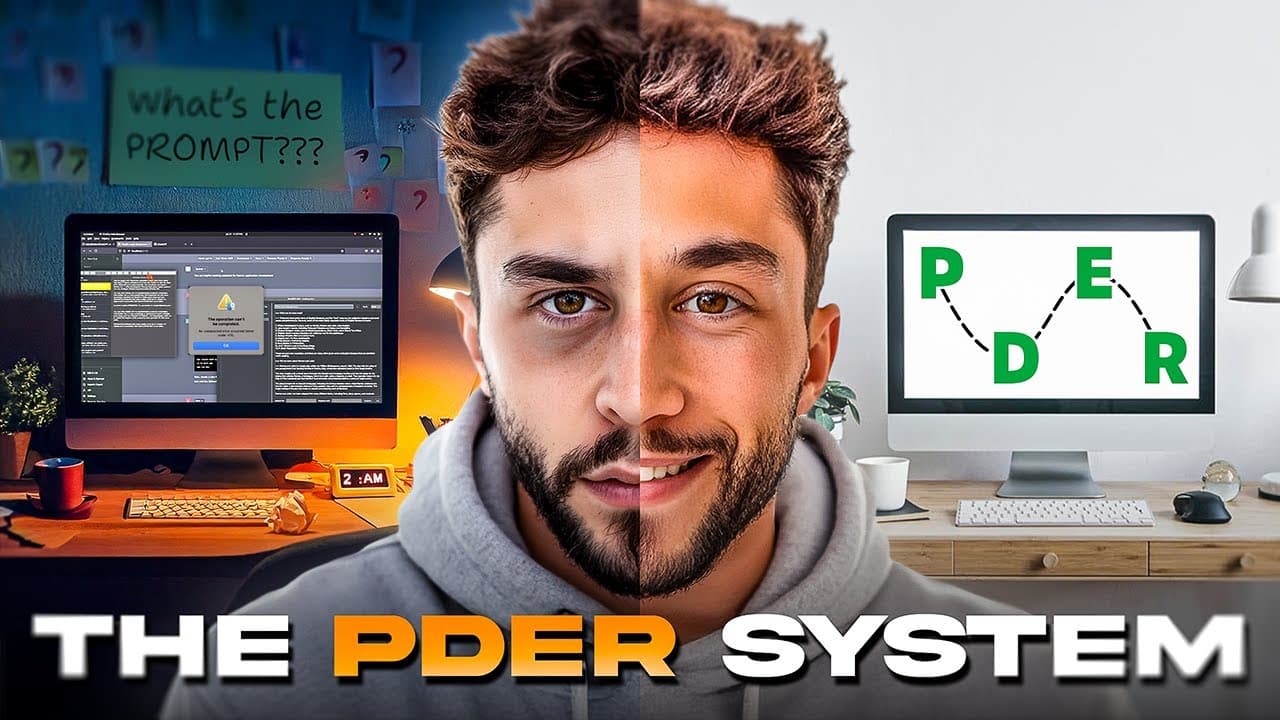
The Peter process speeds up prompt creation by planning first, then drafting with AI tools, followed by testing in a professional IDE and refining based on results. This framework reduces the time to production grade prompts from days to minutes while improving reliability and value for client work and internal automation.
Transcript
over the past two years my AI agency morning side AI has built AI systems for companies of all sizes from local martial arts gyms to publicly traded companies and even an NBA team and at the core of every one of our client projects are a handful of powerful AI prompts which in a few hundred carefully chosen words can automate hundreds or even thous... Read More
Key Insights
- Plan first, define inputs and outputs to set a clear target for the prompt.
- Draft rapidly with an AI tool that applies latest prompting techniques for fast iterations.
- Evaluate prompts against multiple inputs using a professional IDE to ensure reliability.
- Refine responses by analyzing outputs and making targeted improvements.
- Use research backed prompting methods to improve result quality and consistency.
- Leverage custom AI tools to generate solid initial drafts and reduce time spent.
- Employ a dedicated IDE to test prompts in a controlled environment.
- This system is designed to be teachable and scalable across teams and projects.
- More videos from this channel:
- More from this channel: Liam Ottley
Install to Summarize YouTube Videos and Get Transcripts
Explore YouTube Video Summarizer or Get YouTube Transcript Extractor
Questions & Answers
Q: How does the Peter process start when building a new prompt?
The Peter process begins with planning, which means clearly defining what the prompt should do before writing a single word. It asks what inputs and formats are needed, what model should be used, and any client specific constraints. This step typically takes five to ten minutes but saves hours later by aligning goals and scope.
Q: What does the drafting phase involve in this framework?
Drafting uses an AI tool to rapidly generate an initial prompt that incorporates the latest research backed techniques. This phase focuses on producing a solid first version quickly so that later evaluation and refinement can focus on targeted improvements rather than starting from scratch each time.
Q: Why is evaluation performed with a professional prompt engineering IDE?
Evaluation with a professional IDE is used to strategically test the prompt against multiple expected inputs. This provides a structured, rapid testing environment where results can be measured and compared across scenarios, ensuring the prompt behaves correctly under diverse data and use cases before any real world deployment.
Q: What happens during the refinement stage of the Peter process?
Refinement looks at the responses generated during testing, identifying gaps, errors, or inconsistencies. It then makes targeted improvements to the prompt to close those gaps, and the cycle repeats. This iterative loop helps achieve high reliability and performance without overhauling the whole prompt.
Q: What makes the Peter process valuable for AI agencies?
The process accelerates delivery of elite prompts, enabling agencies to automate more work with consistent quality. By combining planning, rapid drafting, rigorous testing, and iterative refinement, teams can create production grade prompts faster, deliver better client results, and scale AI enablement across multiple projects.
Q: How does this approach affect time spent versus quality?
You can achieve higher quality prompts in less time because the planning and drafting phases set a clear direction early, and evaluation with an IDE surfaces issues quickly. The refinement phase then fixes specific problems, reducing trial and error and avoiding long cycles of back and forth.
Q: What kind of resources does the video offer to viewers?
Viewers get access to a planning worksheet, an AI prompt generator tool, and a link to a professional prompt IDE. These resources are designed to help practitioners implement the Peter process in their own work, whether for internal automation or client projects.
Q: Who can benefit from learning the Peter process?
The method benefits employees seeking to automate tasks, AI agency owners delivering client work, and business leaders training teams to write effective prompts. It is presented as simple enough to be taught to non engineers while powerful enough to create robust automation at scale.
Summary & Key Takeaways
-
The Peter process is a four step system: plan, draft, evaluate, and refine, designed to produce production grade AI prompts quickly.
-
Planning defines inputs, outputs, models, and constraints before writing any prompt, saving hours later.
-
The approach combines research backed prompting with custom tools and a professional IDE to accelerate high quality prompt creation.
Read in Other Languages (beta)
Share This Summary 📚
Summarize YouTube Videos and Get Video Transcripts with 1-Click
Try YouTube Summary with ChatGPT & Claude or YouTube Transcript Generator
Explore More Summaries from Liam Ottley 📚






Summarize YouTube Videos and Get Video Transcripts with 1-Click
Try YouTube Summary with ChatGPT & Claude or YouTube Transcript Generator