How to Fine-Tune GPT-3 for AI Startups Effectively?
TL;DR
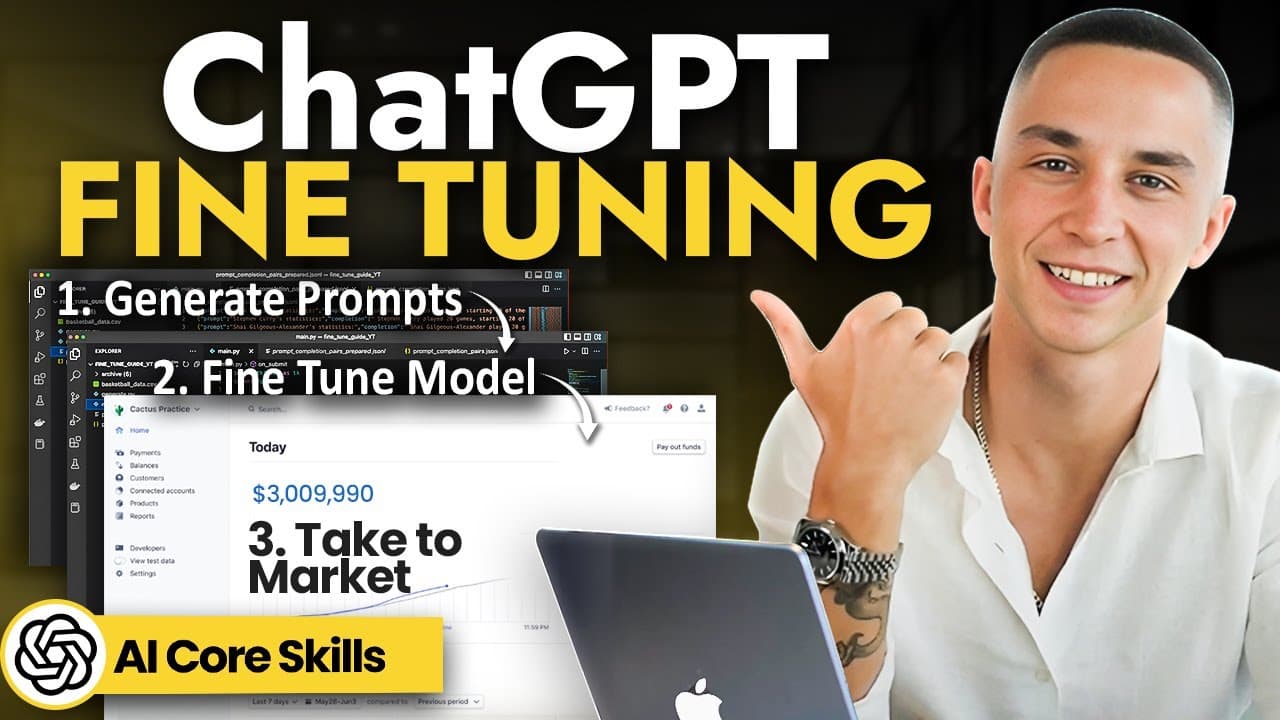
To fine-tune GPT-3 for your AI startup, start by collecting and formatting your dataset into prompt-completion pairs. Use a script to automate this process, and then apply your data to train a fine-tuned model using OpenAI's API. Understanding these steps is crucial for leveraging AI opportunities in business.
Transcript
my recent video about how to fine-tune gpt3 and build an AI startup in a few minutes got a lot of questions about the Nitty Gritty details on how you can actually do this fine tuning process rather than try to answer you all in the comments I thought I'd pop back on here and make a quick video showing you the step-by-step process of how to go from ... Read More
Key Insights
- 🎁 Fine-tuning GPT-3 presents a significant opportunity for entrepreneurs in the AI industry.
- 👨💼 Understanding the fine-tuning process is crucial for identifying and capitalizing on business opportunities.
- 💁 Manipulating and formatting the dataset is an important step in preparing the data for fine-tuning.
- 💄 Automating the generation of prompt and completion pairs makes the process more efficient and scalable.
- 👻 Fine-tuning GPT-3 allows for customization and specialization of the language model.
- 👤 The fine-tuned model can be interacted with using a graphical user interface (GUI).
- 🥠 Continuous training and data refinement are necessary to improve the fine-tuned model's performance.
Install to Summarize YouTube Videos and Get Transcripts
Explore YouTube Video Summarizer or Get YouTube Transcript Extractor
Questions & Answers
Q: Why is fine-tuning GPT-3 important for entrepreneurs in the AI industry?
Fine-tuning GPT-3 allows entrepreneurs to create customized models for their specific business needs, providing them with a competitive edge in the market. It enables them to apply data to these models and build valuable businesses.
Q: How can I download and manipulate the dataset for fine-tuning GPT-3?
To download the dataset, you can use platforms like Kaggle. Once downloaded, import the data to Google Sheets for manipulation. Remove any unnecessary rows or columns and format it appropriately before saving it as a CSV file.
Q: Can I automate the process of creating prompt and completion pairs?
Yes, you can use a Python script to automate the generation of hundreds of thousands of prompt and completion pairs. This allows for a scalable approach to fine-tuning GPT-3 and saves time compared to manual creation.
Q: How do I fine-tune GPT-3 using the prompt and completion pairs?
After preparing the data in the desired format, you can use OpenAI's fine-tuning process. This involves uploading the data, specifying the base model, and waiting for the fine-tuned version of GPT-3 to be created.
Summary & Key Takeaways
-
This video provides a detailed guide on how to go from data to prompting completions to create a fine-tuned version of GPT-3.
-
It emphasizes the importance of understanding the fine-tuning process for entrepreneurs looking to build businesses in the AI industry.
-
The video uses NBA players' performance data as an example to explain the process, from downloading the dataset to manipulating it and creating prompt and completion pairs.
Read in Other Languages (beta)
Share This Summary 📚
Summarize YouTube Videos and Get Video Transcripts with 1-Click
Try YouTube Summary with ChatGPT & Claude or YouTube Transcript Generator
Explore More Summaries from Liam Ottley 📚





Summarize YouTube Videos and Get Video Transcripts with 1-Click
Try YouTube Summary with ChatGPT & Claude or YouTube Transcript Generator