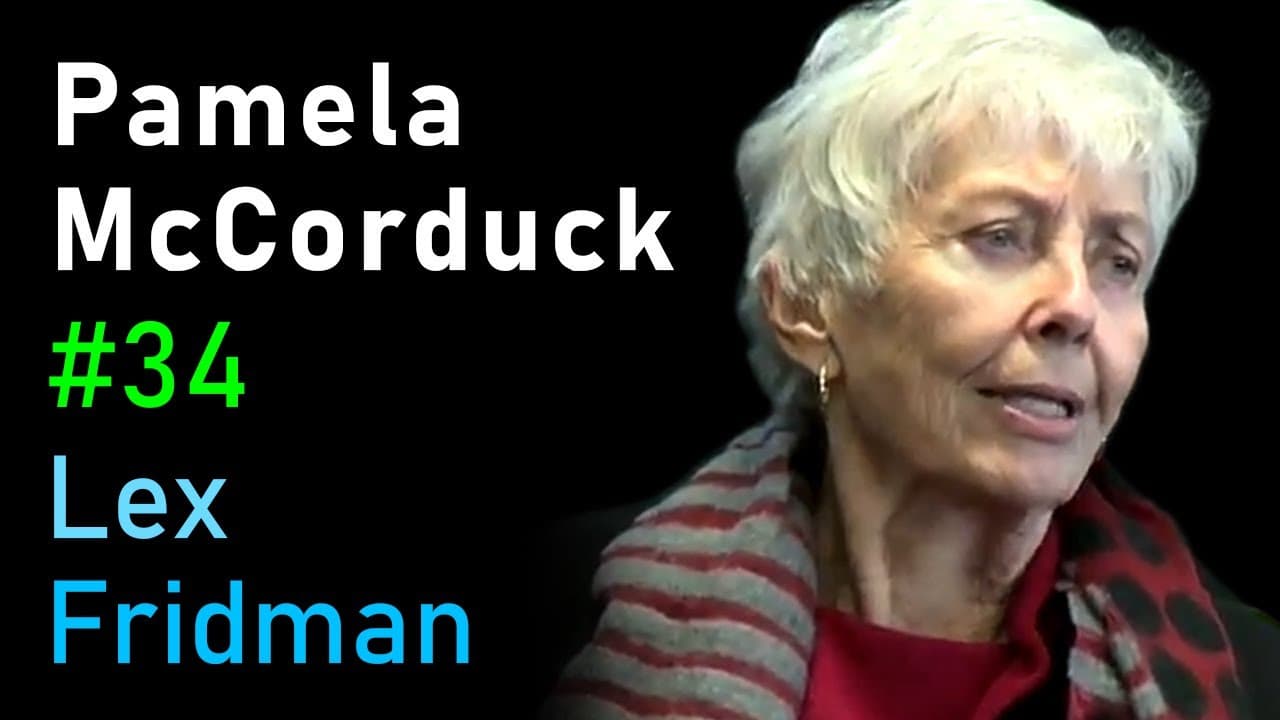
Pamela McCorduck: Machines Who Think and the Early Days of AI | Lex Fridman Podcast #34
TL;DR
Pamela McCorduck reveals that 'Machines Who Think' stemmed from her desire to document early AI pioneers, blending their innovative work with mythic elements. She highlights how these foundational figures understood the significance of their contributions, which continue to influence the evolution of intelligence today.
Transcript
the following is a conversation with Pamela Romo quartic she's an author who is written on the history and the philosophical significance of artificial intelligence her books include machines who think in 1979 the fifth generation in 1983 with Edie foggy and mom who's considered to be the father of expert systems the edge of chaos the features of w... Read More
Key Insights
- 🧍 The history of AI can be traced back to ancient myths and legends, highlighting humanity's long-standing fascination with creating intelligence outside the human cranium.
- 😖 The founding fathers of AI were pioneers who recognized the importance of their work and its potential for transforming society.
- 🙈 The evolution of AI has seen shifts from symbolic AI to algorithmic AI, with future potential in symbolic processing.
Install to Summarize YouTube Videos and Get Transcripts
Explore YouTube Video Summarizer or Get YouTube Transcript Extractor
Questions & Answers
Q: How did Pamela McCorduck first become interested in writing about artificial intelligence?
McCorduck's interest in AI was sparked while sitting under the portal at Stanford, where she considered writing a novel about the "weird people" in AI. Instead, she chose to write a history, interviewing experts in the field.
Q: How did the early pioneers of AI view the significance of their work?
McCorduck explains that the founding fathers of AI, such as Allen Newell, Herbert Simon, Marvin Minsky, and John McCarthy, recognized the importance of their research and were aware that they were shaping an entirely new field.
Q: How did AI evolve from its early beginnings to the present day?
McCorduck details the shift from symbolic AI to algorithmic AI, noting that while symbolic AI faced some challenges, it laid the groundwork for future advancements. She also highlights the role of deep learning and the potential for future breakthroughs in symbolic processing.
Q: What are Pamela McCorduck's thoughts on the existential threats posed by AI?
McCorduck acknowledges the concerns surrounding AI, including the potential for misuse and lack of ethics. However, she remains optimistic about the possibilities of AI and believes that AI can be imbued with empathy and ethical values.
Key Insights:
- The history of AI can be traced back to ancient myths and legends, highlighting humanity's long-standing fascination with creating intelligence outside the human cranium.
- The founding fathers of AI were pioneers who recognized the importance of their work and its potential for transforming society.
- The evolution of AI has seen shifts from symbolic AI to algorithmic AI, with future potential in symbolic processing.
- Concerns surrounding AI include the need for ethical considerations and the potential loss of control, but optimism remains for the positive impacts AI can bring to society.
Summary
Pamela McCorduck, an author who has written extensively on the history and philosophical significance of artificial intelligence, shares her journey of writing the book "Machines Who Think" in 1979. She discusses how AI was born out of myth and legend, and how it has evolved over the years. McCorduck also reflects on her conversations with early AI pioneers and the founding fathers of AI, as well as the changes and challenges that the AI community has faced. She explores the historical roots of AI and the philosophical fears and concerns surrounding it. The conversation delves into topics such as the definition of intelligence, the role of literature in AI, the evolution of AI research, the concept of AI winter, the singularity, and the potential impact of AI on society.
Questions & Answers
Q: How did Pamela McCorduck first arrive at the idea of writing the book "Machines Who Think"?
McCorduck had originally planned to write a novel inspired by the weird people in AI that she knew. However, she realized that she could write a history book by interviewing these people and compiling their stories. Despite facing challenges and skepticism, she saw the opportunity to document the early days of AI and its founders.
Q: Did the early AI pioneers realize the significance and importance of their work at the time?
Yes, according to McCorduck, the early pioneers such as Allen Newell, Herbert Simon, Marvin Minsky, and John McCarthy were aware that what they were doing was groundbreaking and important. They knew that they were at the forefront of a new field that aimed to simulate aspects of human intelligence and advance cognitive psychology.
Q: Who were the key figures and founding fathers of AI from the Dartmouth conference in 1956?
The key figures from the Dartmouth conference were Allen Newell, Herbert Simon, Marvin Minsky, and John McCarthy. However, McCorduck points out that there were other important players in the AI community during that era, such as Joe Traub, who was not at the Dartmouth conference but was involved in AI later on.
Q: How did the literary background and the notion of creating intelligence outside the human cranium contribute to the development of AI?
McCorduck explains that the literary background helped shape the idea of AI as the ancient wish to forge the gods. The AI pioneers sought to simulate human intelligence and expand the definition of intelligence beyond the human brain. Over time, our understanding of intelligence has evolved, leading to the exploration of intelligence in other organisms and even in cells.
Q: Why did Pamela McCorduck decide to write "Machines Who Think" and what were the challenges she faced in getting funding for the book?
McCorduck wanted to document the history of AI for a general audience and highlight its connection to myths, legends, and literature. She faced challenges in obtaining funding for the book, as some organizations questioned her qualifications as a historian of science. However, she eventually received a private grant from IDI Fredkin at MIT, which allowed her to pursue the project.
Q: Has there been another book similar to "Machines Who Think" that provides a historical perspective on AI since its publication?
McCorduck is not aware of any book similar to "Machines Who Think" that has covered the history of AI comprehensively. She believes that the romance of AI and its connection to literature are often overlooked in favor of more algorithmic and monetizable aspects of the field.
Q: What are the roots of AI and how far back do they go?
The roots of AI can be traced back to ancient stories and myths, such as The Iliad and The Odyssey, which featured robots and automatons. In more recent history, scientists in the late 19th and early 20th centuries attempted to create intelligent machines, but lacked the technological advancements needed at the time. The concept of AI expanded over the years, with intelligence being attributed to various organisms and systems.
Q: What are the differences between the Hellenic and Bragg points of view on robots and AI?
The Hellenic point of view portrays robots as helpful and welcomes the idea of creating intelligence outside the human cranium. On the other hand, the Bragg point of view comes from a religious perspective, opposing the imitation of humans and seeing it as blasphemous. The fear associated with AI can be linked to religious and moral concerns, but McCorduck believes that the fear of AI replacing humans is unfounded and that AI can offer valuable benefits.
Q: How has the AI community evolved over the decades, specifically in terms of the conversation and work around AI?
According to McCorduck, the AI community has maintained the same excitement, vision, and belief in the potential of AI throughout the decades. While there have been shifts in focus and challenges, such as the transition from symbolic AI to algorithmic AI, the spirit of pushing the boundaries and making a difference in the world remains.
Q: What are Pamela McCorduck's views on the concept of the singularity and how it has evolved over time?
McCorduck expresses her skepticism towards the singularity as presented by Ray Kurzweil. She argues that machines are already smarter than humans in certain aspects, and there won't be a sudden crossroads moment where machines surpass human intelligence. Instead, intelligence and advancements will continue to evolve in a more gradual and complex manner. McCorduck believes that AI has the potential to enhance human life rather than replace humans entirely.
Q: Has Pamela McCorduck's own timeline and understanding of the singularity concept changed over the years?
McCorduck acknowledges that her understanding of the singularity and the timeline of advancements in AI has changed over time. While she believes in the potential of AI, she also recognizes the challenges and complexities involved in achieving human-level intelligence. She is cautious about overpromising and acknowledges that breakthroughs and timelines in AI are difficult to predict.
Summary & Key Takeaways
-
Pamela McCorduck shares her journey of writing "Machines Who Think" in 1979, where she interviewed early pioneers of AI and explored the intersection of AI with myth and legend.
-
McCorduck reflects on the mindset of the founding fathers of AI, who understood the importance of their work and its potential impact on society.
-
She discusses the expansive timeline of AI, from ancient myths to groundbreaking research in the 20th century, and how our definition of intelligence has evolved over time.
Read in Other Languages (beta)
Share This Summary 📚
Summarize YouTube Videos and Get Video Transcripts with 1-Click
Try YouTube Summary with ChatGPT & Claude or YouTube Transcript Generator
Explore More Summaries from Lex Fridman Podcast 📚
Summarize YouTube Videos and Get Video Transcripts with 1-Click
Try YouTube Summary with ChatGPT & Claude or YouTube Transcript Generator